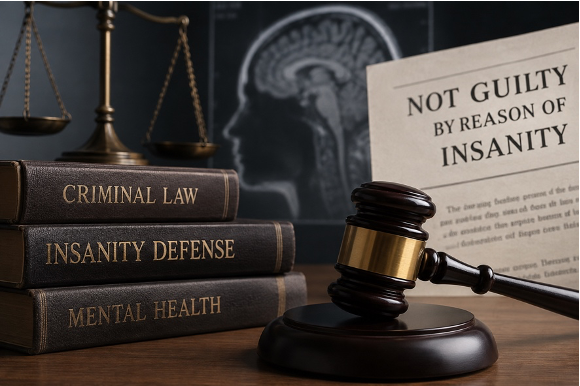
Few criminal defenses generate as much controversy as the insanity defense.[i] To some, a verdict of not guilty by reason of insanity sounds like an escape from responsibility.[ii] To others, punishing a person who could not understand the nature or wrongfulness of her actions undermines the basic principles upon which criminal liability rests. Madness does not always look irrational, for a person experiencing severe mental illness may speak coherently, complete ordinary tasks, and even act according to plan. When that person commits a crime, however, those outward signs of rationality present criminal law with a difficult question: when does mental illness become severe enough to eliminate criminal responsibility?
That question took center stage in the recent trial of Lindsay Clancy. Lindsay Clancy (“Clancy”), a Massachusetts mother, was charged with murdering her three young children in January 2023.[iii] Clancy did not dispute causing the deaths of her children.[iv] Instead, her defense argued that she was suffering from postpartum psychosis and lacked criminal responsibility at the time of the killings.[v] Prosecutors maintained that Clancy remained criminally responsible, pointing to her conduct before and during the killings as evidence that she understood her actions and their wrongfulness.[vi] After nearly six weeks of trial and seven days of deliberations, the jury was unable to reach a unanimous verdict.[vii] A single holdout juror blocked what would otherwise have been an eleven-to-one vote to acquit.[viii] The judge then declared a mistrial on September 4, 2026.[ix]
The result in Commonwealth v. Clancy illustrates why the insanity defense remains one of criminal law’s most difficult doctrines. Although commonly called the “insanity defense,” Massachusetts law refers to the issue as a defendant’s “lack of criminal responsibility,” which is an important distinction.[x] The legal question to be decided is not simply whether Clancy suffered from a mental illness; rather, the question is whether her mental condition affected her capacities to the degree required by Massachusetts law.[xi] Under Massachusetts law, a person is not criminally responsible if, because of a mental disease or defect, the person lacks the substantial capacity either to appreciate the criminality or wrongfulness of the conduct or to conform the conduct to the requirements of the law.[xii] Once criminal responsibility is properly raised, the Commonwealth bears the burden of proving beyond a reasonable doubt that the defendant was criminally responsible.[xiii] The burden of proving criminal responsibility never shifts to the defendant. It belongs to the Commonwealth, and the Commonwealth alone to prove beyond a reasonable doubt.
The Clancy trial shows how difficult it can be to apply that standard. The defense argued that Clancy’s mental health had deteriorated following the birth of her third child and that she was experiencing postpartum psychosis when she killed her children.[xiv] The prosecution did not dispute that Clancy experienced significant mental health problems; rather, they argued that her mental health had not deteriorated enough for her to lack criminal responsibility.[xv] For the prosecution, Clancy’s conduct surrounding the killings provided evidence of deliberation and awareness. Prosecutors argued that she deliberately created an opportunity to be alone with the children by sending her husband to purchase food and medication.[xvi] They also pointed to her actions before, during, and after the killings as evidence that she remained criminally responsible.[xvii]
The defense viewed that same conduct differently. Clancy’s attorneys maintained that postpartum psychosis had distorted her perception of reality.[xviii] The defense presented evidence that Clancy believed she had heard a male voice telling her that killing the children was her “last chance” and that they would be better off in heaven.[xix] According to the defense, purposeful behavior did not necessarily mean that Clancy appreciated the wrongfulness of her actions or possessed the capacity to conform her conduct to the law.
This tension is the same one introduced at the outset of the case. To critics, a coherent, capable-seeming defendant who nonetheless walks free under an insanity verdict looks like an escape from responsibility. While to defenders, holding such a defendant criminally liable when she genuinely could not appreciate the wrongfulness of her conduct offends the basic premise that criminal punishment requires a guilty mind. Clancy’s case demonstrates why evidence of planning does not necessarily resolve the question of criminal responsibility. Eleven jurors reportedly favored acquittal despite hearing the prosecution’s case, which included evidence that Clancy deliberately sent her husband out for food and medication before the killings.[xx] That division illustrates the distinction between evidence that a defendant was capable of purposeful conduct and the separate legal question of whether the defendant possessed the capacities required under Massachusetts law.[xxi] The legal significance of planning does not turn on whether a defendant acted deliberately, but on what the planning reveals about her capacity to appreciate wrongfulness or conform her conduct to the law.
Massachusetts’ criminal responsibility standard makes the distinction between purposeful conduct and legal responsibility particularly important. The standard does not ask simply whether a defendant was capable of planning, completing ordinary tasks, or behaving coherently. Instead, it asks whether, because of a mental disease or defect, the defendant lacked substantial capacity to appreciate the wrongfulness of the conduct or to conform the conduct to the requirements of the law.[xxii] Massachusetts’s approach differs from that of other states, where the burden may instead fall on the defense to prove that the defendant was legally insane.[xxiii] This difference is significant because, in Massachusetts, the Commonwealth must eliminate reasonable doubt as to the defendant’s criminal responsibility.[xxiv] Evidence of planning may therefore be relevant to criminal responsibility, but planning alone does not answer either part of the legal test. Its significance depends on what that conduct reveals about the defendant’s mental capacity at the time of the offense.[xxv]
Clancy’s case demonstrates how the same evidence can operate differently under that standard. Her ability to send her husband out of the house, drive a vehicle, attend appointments, and plan a birthday party could support the Commonwealth’s position that she retained the ability to reason and act deliberately.[xxvi] The defense’s evidence of hallucinations and an allegedly distorted perception of reality, however, raised a different question: whether an ability to carry out deliberate acts necessarily demonstrated an ability to appreciate the wrongfulness of the acts.[xxvii] The jury was therefore required to determine whether Clancy’s conduct proved beyond a reasonable doubt that she possessed the capacities Massachusetts law requires for criminal responsibility. In both instances, the evidence must be considered in relation to the specific legal capacities at issue.
A defendant found not guilty by reason of lack of criminal responsibility does not necessarily return home.[xxviii] Clancy currently remains in custody at a state psychiatric hospital while her case continues.[xxix] Following the mistrial, Clancy’s attorney, Kevin Reddington, asked the trial judge to enter a finding of not guilty by reason of lack of criminal responsibility.[xxx] He argued that the Commonwealth presented insufficient evidence of criminal responsibility.[xxxi] A hearing on the motion is scheduled for September 29, 2026.[xxxii] To date, prosecutors have not announced whether they will retry Clancy if the motion is denied.[xxxiii]
Ultimately, Commonwealth v. Clancy does not provide a simple answer to the relationship between mental illness and criminal responsibility. Instead, the trial demonstrates why that distinction can be so difficult to draw. Evidence of purposeful conduct may support a finding of criminal responsibility, while evidence of psychosis may affect what that same conduct reveals about a defendant’s mental state. Neither necessarily answers the legal question alone. When madness has a method, the insanity defense requires a jury to determine not simply whether a defendant acted purposefully, but what that purpose reveals about the defendant’s criminal responsibility.
[i] See Eric Levenson, Lindsay Clancy’s Holdout Juror Shows Ongoing Skepticism of the ‘Insanity Defense’, CNN (Sep. 13, 2026), https://www.cnn.com/2026/09/13/us/lindsay-clancy-insanity-defense [https://perma.cc/KDX2-TMKD] (“‘The insanity plea polarizes many people,’ Johnston said.”).
[ii] See id. (“Overall, people often perceive the insanity defense as a ‘get-out-of-jail-free card,’ but it’s rarely used and even more rarely successful, said Johnston, the forensic psychologist.”).
[iii] See Maria Ramirez Uribe, Key Things to Know About Lindsay Clancy’s Case After Judge Declares Mistrial, PBS News (Sep. 4, 2026, at 15:41 PM EDT), https://www.pbs.org/newshour/nation/key-things-to-know-about-lindsay-clancys-case-after-judge-declares-mistrial [https://perma.cc/WLR3-NAJ3] (“Clancy, a 36-year-old former labor and delivery nurse, doesn’t deny killing her children before trying to cause her own death by suicide in 2023.”).
[iv] See Nicki Brown, Notes on Lindsay Clancy’s Cellphone Paint a Picture of a Woman ‘Going Downhill’, CNN (Aug. 13, 2026), https://www.cnn.com/2026/08/13/us/lindsay-clancy-notes-cellphone-trial [https://perma.cc/6ZLP-E9AB] (“Clancy, 36, does not deny she killed her children – Cora, 5; Dawson, 3; and 8-month-old Callan – in the family’s Duxbury home on January 24, 2023.”).
[v] See Deborah Becker, Lindsay Clancy’s Trial Highlights Gaps in Understanding, Treating Postpartum Psychosis, NPR (Aug. 16, 2026, at 5:00 AM ET), https://www.npr.org/2026/08/16/nx-s1-5931964/lindsay-clancy-trial-postpartum-psychosis-diagnosis [https://perma.cc/NV7T-QVLS] (“While the prosecution paints her as a deliberate killer, Lindsay Clancy’s defense team argues she was in the grips of severe postpartum psychosis, and didn’t receive proper medical care.”).
[vi] See Safia Samee Ali, What Patrick Clancy Knew Before Lindsay Clancy Killings, NewsNation (Sep. 4, 2026, at 13:46 PM CDT), https://www.newsnationnow.com/crime/patrick-clancy-lindsay-clancy-killings-what-did-he-know/ [https://perma.cc/5EYX-68J2] (“Prosecutors allege she strangled the children with exercise bands before attempting suicide by jumping from a second-story window.”).
[vii] See Peter Charalambous, Judge in Lindsay Clancy Case Indefinitely Impounds Jury Questionnaires, ABC News (Sep. 23, 2026), https://abcnews.com/GMA/News/judge-lindsay-clancy-case-indefinitely-impounds-jury-questionnaires/story?id=136694294 [https://perma.cc/M2QG-AX3F] (“Sullivan declared a mistrial in Clancy’s case on Sept. 4, after jurors failed to reach a unanimous verdict.”).
[viii] See Jessica Hill, Jurors Speak Out About Lindsay Clancy Mistrial and the Lone Holdout, PBS News (Sep. 9, 2026, at 12:34 PM EDT), https://www.pbs.org/newshour/nation/jurors-speak-out-about-lindsay-clancy-mistrial-and-the-lone-holdout [https://perma.cc/RZ8J-45MD] (“A lone juror blocked Lindsay Clancy from being acquitted, insisting he wouldn’t find her not guilty by reason of insanity despite saying during deliberations that he had reasonable doubt, the jury’s foreperson said in a TV interview Tuesday.”); see also Nicholas Bogel-Burroughs, Holdout Juror in Lindsay Clancy Case Says He Didn’t Doubt Her Guilt, N.Y. Times (Sep. 18, 2026), https://www.nytimes.com/2026/09/18/us/lindsay-clancy-trial-holdout-juror.html?smid=url-share [https://perma.cc/AZ3V-W75D] (“The trial of Ms. Clancy ended this month with the jury deadlocked, 11 to 1, in favor of acquitting her on murder and manslaughter charges. Jurors deliberated for roughly 38 hours across seven days before the judge declared a mistrial.”); see also Xiolene Lozano, Why Lindsay Clancy’s Trial Ended in a Mistrial Even After 11 Jurors Reportedly Favored Acquittal, L. Comment. (Sep. 9, 2026), https://www.lawcommentary.com/articles/lindsay-clancy-mistrial-11-jurors-insanity-acquittal [https://perma.cc/2XRR-CYZW] (“Eleven people reportedly believed prosecutors had not proved beyond a reasonable doubt that Clancy was criminally responsible. One juror would not join them.”).
[ix] See Hill, supra note viii (“The interview with Boston’s NBC10 aired four days after a judge declared a mistrial when jurors failed to reach a unanimous verdict on the question of whether Clancy was criminally responsible for killing her three young children in 2023.”).
[x] See Tanner Stening, Lindsay Clancy Trial: How the Insanity Defense Differs in Mass., Ne. Glob. News (July 31, 2026), https://news.northeastern.edu/2026/07/31/daniel-medwed-lindsay-clancy-trial/ [https://perma.cc/UZ9L-N754] (“‘In Massachusetts, we don’t typically use the term ‘insanity defense’, Medwed said, citing the stigma that attaches to the word ‘insanity.’ Instead, it’s referred to as ‘lack of criminal responsibility.’’”).
[xi] See Samuel Strom, Background and History of the Insanity Defense, FindLaw (Dec. 9, 2023), https://www.findlaw.com/criminal/criminal-procedure/the-insanity-defense-history-and-background.html [https://perma.cc/W67R-TDAK] (“The insanity defense asserts that a criminal defendant is not criminally liable for their illegal acts due to their insanity.”); see also Sareen Habeshian, ‘Emotional Rollercoaster’ – Lindsay Clancy Jurors Speak Out on What Led to Mistrial, BBC (Sep. 9, 2026), https://bbc.com/news/articles/c74k13kpv2no [https://perma.cc/K7HB-7EFK] (“Under Massachusetts law, there was no burden on Clancy to prove her mental illness and that she lacked criminal responsibility.”).
[xii] See Joe Serpa, The Lindsay Clancy Trial: A Cruel, Insensitive, and Out-of-Touch Prosecution, Serpa L. Off. (Sep. 9, 2026), https://www.serpalaw.com/boston-criminal-law-updates/lindsay-clancy-prosecution-tactical-error/ [https://perma.cc/2ZZU-VATV] (“A person is not criminally responsible if, as a result of mental disease or defect, that person lacked substantial capacity either to appreciate the wrongfulness of the conduct or to conform the conduct to the requirements of law.”).
[xiii] See id. (“Once the defense is raised and the evidence would permit a reasonable doubt, the Commonwealth must prove criminal responsibility beyond a reasonable doubt. Commonwealth v. Keita, 429 Mass. 843, 849 to 850 (1999).”).
[xiv] See Nicki Brown, Lindsay Clancy’s Triple-Murder Trial Nears its End as Defense Attorney Rests His Case, CNN (Aug. 21, 2026), https://www.cnn.com/2026/08/21/us/lindsay-clancy-trial-defense-rests [https://perma.cc/NQS7-653P] (“But her attorney argues she should not be held criminally responsible for their deaths because she was suffering from postpartum psychosis, a rare mental condition, after months of purported failures by her medical providers to adequately treat her.”).
[xv] See Amna Nawaz, Jackson Hudgins, & Katie Marlow, The Central Issue that the Lindsay Clancy Jury Will Be Deliberating, PBS (Aug. 27, 2026, at 18:45 PM EDT), https://www.pbs.org/newshour/show/lindsay-clancy-trial-draws-attention-to-postpartum-mental-health [https://perma.cc/VWC7-XKMZ] (“They’re arguing that she was able to appreciate right and wrong, and regardless of whether she was struggling with her mental health at the time, that that is not enough, in the prosecution’s eyes, to absolve her of criminal responsibility.”).
[xvi] See Jacey Fortin, Lindsay Clancy Heard a Voice Telling Her to Kill Her Children, Witnesses Say, N.Y Times (Aug. 20, 2026), https://www.nytimes.com/2026/08/20/us/lindsay-clancy-trial-voice-children.html [https://perma.cc/MG44-HKF5] (“Prosecutors argued that Ms. Clancy had planned the killings rationally and plotted to get her husband, Patrick Clancy, out of the house before she choked their children with exercise bands.”).
[xvii] See Leah Willingham & Michael Casey, Lindsay Clancy’s Lawyer Asks the Judge to Spare Her a Second Trial For Killing Her Children, ABC 7 News (Sep. 10, 2026), https://abc7ny.com/story/lindsay-clancys-lawyer-asks-judge-spare-second-trial-killing-children/19816419/ [https://perma.cc/XJW8-85D3] (“Prosecutors pointed to Clancy’s actions in the weeks, days and hours leading up to the killings — driving, planning a child’s birthday party, bringing her daughter to a doctor’s appointment — and her ability to perform other everyday tasks as evidence she was of sound mind when the killings took place.”).
[xviii] See Jen Christensen, The Lindsay Clancy Trial Brings Maternal Mental Health into the Spotlight, CNN (Sep. 4, 2026), https://www.cnn.com/2026/09/04/health/postpartum-psychosis-lindsay-clancy [https://perma.cc/6BR3-TD7Q] (“Clancy’s attorney contended that she was not criminally responsible because she was experiencing postpartum psychosis, a rare mental health condition.”).
[xix] See Fortin, supra note xvi (“In multiple visits after that, Ms. Cavanaugh added, Ms. Clancy described a persistent male voice that had goaded her to kill her children and herself, adding that the voice had ‘told her that if she did not follow the command, neither she nor her children would be safe.’”); see also Nawaz, Hudgins, & Marlow, supra note xv (“She was in the throes of postpartum psychosis, that she heard voices, that she was not able to appreciate what she was doing rationally.”).
[xx] See Leah Willingham, Testimony Concludes in Lindsay Clancy Murder Trial; Jury to Hear Closing Arguments Thursday, ABC 7 News (Aug. 26, 2026), https://abc7news.com/post/lindsay-clancy-trial-day-21-testimony-expected-wrap-wednesday-closing-arguments-thursday/19738443/ [https://perma.cc/3D8Y-M463] (“Prosecutors say Clancy planned the killings and understood her actions were wrong.”); see also Madeline Halpert, Lindsay Clancy’s Lawyer Asks Judge to Investigate Juror and Check His Phone, BBC (Sep. 22, 2026), https://bbc.com/news/articles/cm4gvyw80dp2o [https://perma.cc/LW8K-ESAU] (“Several jurors have said after the trial ended that they were ultimately divided 11-1 in favour of finding Clancy not criminally responsible.”); see also Willingham & Casey, supra note xvii (“Eleven of 12 jurors were ready to clear Clancy of criminal responsibility last Friday, but their deadlock forced the judge to declare a mistrial, leaving the case unresolved.”); see also Lindsay Clancy ‘Criminally Responsible’ For Killing Her Children, Psychologist Testifies, NBC News (Aug. 25, 2026, at 4:06 PM EDT), https://www.nbcnews.com/news/us-news/live-blog/live-updates-lindsay-clancy-trial-continues-judge-denies-motion-mistri-rcna594264 [https://perma.cc/EM28-4GX2] (“Prosecutors say Clancy deliberately killed her kids, arguing that she sent her husband out on errands before strangling the children and then attempting suicide.”).
[xxi] See Deborah Becker, As Clancy Jurors Remain Deadlocked, What to Know About The ‘Insanity Defense’, WBUR (Sep. 2, 2026), https://www.wbur.org/news/2026/09/01/massachusetts-lindsay-clancy-insanity-defense-criminal-liability [https://perma.cc/Y52T-L5KG] (“‘It’s either-or, the appreciation of the wrongfulness of the conduct or the inability to conform your conduct to the law,’ Halpern said.”).
[xxii] See id. (“That standard, which was further clarified by the Massachusetts Supreme Judicial Court, requires prosecutors to prove that a defendant could appreciate that their conduct was wrong or could control their behavior.”).
[xxiii] See id. (“Massachusetts is also unusual in placing of the burden on prosecutors to prove a person was sane. Many other states require the defense to prove insanity or a mental state so compromised that a defendant should not be convicted of a crime.”).
[xxiv] See id. (“Under Massachusetts law, when someone pleads not guilty by reason of a ‘lack of criminal responsibility’ — the state’s technical term for the insanity defense — the burden is on the prosecution to prove the defendant was sane at the time of the crimes.”).
[xxv] See Serpa, supra note xii (“The disputed question was whether postpartum psychosis deprived Clancy of the substantial capacity either to appreciate the wrongfulness of her conduct or to conform her conduct to the law.”).
[xxvi] See Eric Levenson & Nicki Brown, Testimony Ends in Lindsay Clancy Trial and Closings Set for Thursday, CNN (Aug. 27, 2026), https://www.cnn.com/2026/08/26/us/lindsay-clancy-trial-final-stages [https://perma.cc/2KPF-XAFG] (“He pointed to her ‘preparatory planning,’ which included conducting searches on her phone, mapping the distance from their home to a restaurant, and then committing the killings in the timeframe when her husband was out of the home.”); see also Serpa, supra note xii (“The Commonwealth argued that she planned the deaths, arranged for her husband to be out of the house, understood the wrongfulness of her conduct, and did not have the condition the defense described.”).
[xxvii] See Michael Casey, As Jurors Deliberate in the Lindsay Clancy Trial, Here Are Key Moments They May Be Considering, ABC News (Aug. 29, 2026), https://abc7ny.com/post/lindsay-clancy-verdict-watch-key-moments-trial-jury-may-considering-deliberations/19757324/ [https://perma.cc/53NM-HMT2] (“Paul Zeizel, a clinical and forensic psychologist who visited Lindsay Clancy in the hospital after she killed the children, testified that he overheard her saying that a disembodied male voice had told her she had no choice but to kill her children and then herself.”); see also Serpa, supra note xii (“Kevin Reddington argued that command hallucinations left her without control over her actions. A defense forensic psychiatrist testified that Clancy heard a voice directing the killings.”).
[xxviii] See Katie Kindelan & Mason Leib, Lindsay Clancy Trial: What Does It Mean to Be ‘Not Guilty by Lack of Responsibility?’, ABC News (Sep. 4, 2026, at 10:52 AM), https://abcnews.com/GMA/News/lindsay-clancy-trial-guilty-lack-responsibility/story?id=136187449 [https://perma.cc/5V5J-4CMR] (“In the state of Massachusetts, a person may be found not guilty of a crime ‘if they lacked criminal responsibility when they committed the offense,’ according to the Massachusetts Court System. This is colloquially referred to as not guilty by reason of insanity.’”).
[xxix] See id. (“If she is found not guilty due to lack of criminal responsibility, the court would begin the process of committing Clancy to a state psychiatric facility. Her commitment order would be subject to regular review by the court, though she could be committed to the facility indefinitely.”).
[xxx] See Peter Charalambous, Katie Kindelan, & Vera Drymon, Lindsay Clancy’s Attorney Asks Judge to Force ‘Not Guilty’ Finding, ABC News (Sep. 10, 2026, at 15:22 PM), https://abcnews.com/GMA/News/lindsay-clancys-attorney-asks-judge-force-guilty-finding/story?id=136345786 [https://perma.cc/R9F5-7M2D] (“While the newly filed motion references the 11 jurors who believed Clancy was not guilty — as well as the holdout juror — Reddington argued that the case should end because prosecutors failed to present sufficient evidence at trial.”).
[xxxi] See id. (“‘The government did not present evidence that allows a juror earnestly seeking the truth to determine that the defendant’s guilt on the crime was proved on each element of the offense,’ Reddington wrote.”).
[xxxii] See id. (“Reddington requested the judge hear arguments about the motion during the next conference in the case, scheduled for Sep. 29.”).
[xxxiii] See id. (“Cruz has not said publicly whether he plans to retry Clancy.”).