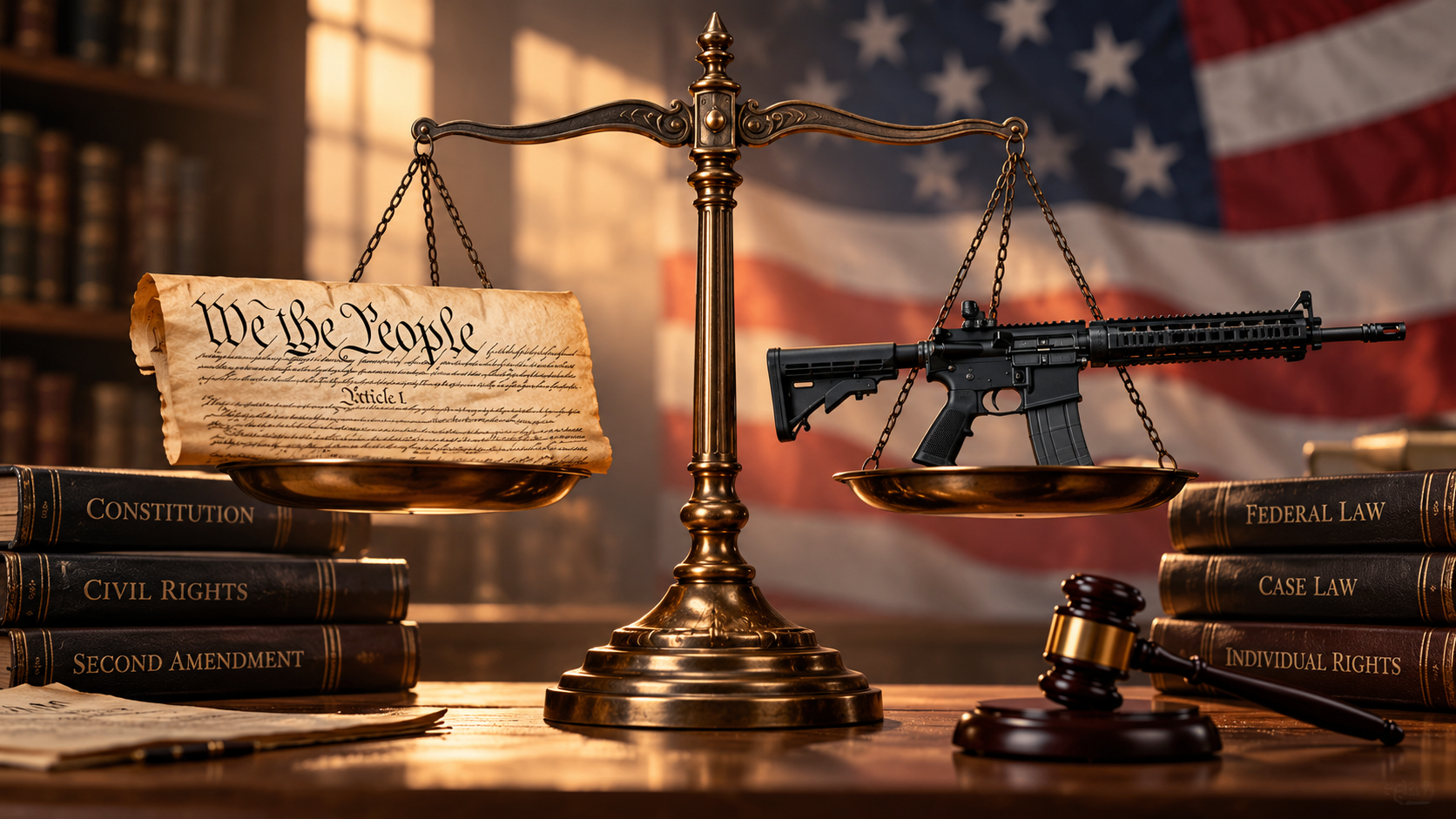
The Second Amendment to the United States Constitution states, in full, that “[a] well regulated Militia, being necessary to the security of a free State, the right of the people to keep and bear Arms, shall not be infringed.”[i] While this language has been a contentious source of debate and scrutiny,[ii] the interpretation of the clause has been largely untouched by the Supreme Court since the 1800s for the majority of American History until relatively recently.[iii] That pattern changed with the Court’s 2008 decision in District of Columbia v. Heller.[iv] There, Justice Scalia writing for the majority, meticulously and diligently walks readers through the language and history of the Second Amendment to arrive at the conclusion that it guarantees the individual right to possess and carry, specifically for defensive purposes, only those weapons that have some reasonable relationship to the preservation or efficiency of a well regulated militia, in case of confrontation.[v] However, as Scalia notes, the right to keep and bear arms is not unlimited.[vi] So the question becomes what kinds of “[a]rms” does the Second Amendment protect, and what kinds of government regulations are permitted so as to not “infringe[]” on that protection?
The next step in the Court’s mission to determine the scope of the Second Amendment (after it was incorporated to apply against the states McDonald v. City of Chicago[vii]) was N.Y. State Rifle & Pistol Ass’n v. Bruen. There, the Court laid out the standard that should be applied when analyzing the constitutionality of gun regulations. Known famously as the Bruen test, any law that regulates an individual’s conduct that the “Second Amendment’s plain text covers . . . the Constitution presumptively protects that conduct.”[viii] The burden then shifts to the government to show “that it is consistent with the Nation’s historical tradition of firearm regulation.”[ix] That second inquiry requires the government to find a “historical analogue” (i.e., a past regulation at the time of the founding) for their regulation that must be “relevantly similar” to the modern law as to justify its burdens.[x] To be relevantly similar to the modern law, a historical analogue must have imposed sufficiently similar restrictions (how it burdens the keeping or bearing of arms) and rest on a sufficiently similar rationale (why it burdens the keeping or bearing of arms) as the modern law does.[xi]
Since Bruen, many of the Court’s Second Amendment decisions revolved around regulations prohibiting certain categories of people from keeping and bearing arms or the manner in which arms may be borne, rather than a prohibition on a certain type of “arm.”[xii] However, that is set to change. In a 2025 denial of certiorari, Justice Kavanaugh acknowledged that AR-15s are owned by millions of Americans and allowed to be owned in a significant majority of the States, and as such a ban on these semiautomatic rifles (like in Maryland, for example) “should and presumably will [be] address[ed]” by the Court “in the next Term or two.”[xiii] That time has arrived. In June 2026, the Court granted certiorari in two cases (that will be consolidated), one from Illinois and one from Connecticut, each presenting the exact same question: Whether the Second and Fourteenth Amendments guarantee the right to possess AR-15 platform and similar semiautomatic rifles.[xiv]
The Illinois cases, Viramontes v. Cook County, concerns an Illinois county ordinance that “generally prohibits the possession, acquisition, and transfer of any ‘assault weapon . . . .’”[xv] The Petitioner, Cutberto Viramontes, brought suit in the Federal District Court for the Northern District of Illinois arguing that the county’s ban violated his Second Amendment right to bear arms. The District Court disagreed and granted the government’s motion for summary judgment.[xvi] The court explained that under Seventh Circuit precedent, AR-15s are indistinguishable from an M16 assault rifle and thus do not count as an “‘[a]rm that ordinary people would keep at home for purposes of self-defense, not . . . exclusively or predominantly useful in military service, or . . . not possessed for lawful purposes.’”[xvii] In the Seventh Circuit, a ban on M16s has been upheld because it “respects” the “long tradition, unchanged from the time when the Second Amendment was added to the Constitution, supporting a distinction between weapons and accessories designed for military or law-enforcement use, and weapons designed for personal use.”[xviii] While the Supreme Court has not given comprehensive guidance to lower courts on what types of weapons are protected and which are not, the clearest standard that applies is that the Second Amendment protects all weapons that are “in common use at the time.”[xix] Weapons that are “dangerous and unusual” are not protected arms.[xx]
After decades of a steady increase in gun violence tragedies in America and a dramatic surge in ownership of AR-15s, the Court will finally weigh in on whether these weapons can be banned. However, at this point, AR-15s are almost certainly going to be considered to be “in common use” for a lawful purpose. The AR-15 is the most popular rifle in the United States, with about 26.4 million people owning one.[xxi] Since 41 states permit AR-15 ownership and considering its wide usage in the country, the Court is likely to find that the rifle is “in common use” and therefore protected by the Second Amendment.[xxii] But if this question had been decided in the early days of AR-15 production, before its rise in popularity and when more restrictions on access to these guns existed, would they have been considered to be in common use then? Justice Breyer highlights the potential circular reasoning that the common use standard seems to demand in his dissent in Heller, stating: “According to the majority’s reasoning, . . . . if tomorrow someone invents a particularly useful, highly dangerous self-defense weapon, Congress and the States had better ban it immediately, for once it becomes popular Congress will no longer possess the constitutional authority to do so.”[xxiii]
The oral arguments for these two important cases are scheduled for December 2nd, 2026.[xxiv]
[i] U.S. Const. amend. II.
[ii] See Michael Kryzaneck, Guns, Violence, and the Second Amendment, Bridgewater State Univ. (Mar. 13, 2023), https://www.bridgew.edu/stories/2023/guns-violence-and-second-amendment [https://perma.cc/2P93-6X6V]; see also JUSTIA, Gun Rights / Gun Control Supreme Court Cases, https://supreme.justia.com/cases-by-topic/gun-rights/ [https://perma.cc/X4PB-BWE8].
(last visited Sep. 28, 2026) (referring to the Second Amendment as “[o]ne of the most controversial provisions of the U.S. Constitution”); see also League of Woman Voters of Bloomington, The Most Controversial Commas in American History (July 15), https://www.lwv-bloomington.com/blog/controversialcommas [https://perma.cc/8UTN-TYJN].
(referring to the Second Amendment as “one of the most debated and scrutinized parts of the Bill of Rights).
[iii] See Wolford v. Lopez, 146 S. Ct. 2032, 2041 (2026) (“For more than two centuries after the ratification of the Second Amendment, this Court had few occasions to examine its meaning.”); see also JUSTIA, supra note ii (“For most of its history, the Supreme Court addressed the Second Amendment only occasionally and in relatively narrow circumstances.”); see also Nelson Lund & Adam Winkler, Interpretation and Debate: The Second Amendment, Nat’l Const. Ctr., https://constitutioncenter.org/the-constitution/amendments/amendment-ii/interpretations/99 [https://perma.cc/F4HJ-RD6W] (last visited Sep. 28, 2026) (“Until recently, the judiciary treated the Second Amendment almost as a dead letter.”).
[iv] See Wolford, 146 S. Ct. at 2041; see Lund, supra note iii; see also District of Columbia v. Heller, 554 U.S. 570, 635 (2008) (“[T]his case represents this Court’s first in-depth examination of the Second Amendment . . . .”).
[v] See Heller, 554 U.S. at 576–92, 602, 622.
[vi] See id. at 595 (“Of course the right [is] not unlimited . . . . Thus, we do not read the Second Amendment to protect the rights of citizens to carry arms for any sort of confrontation . . . .”).
[vii] See McDonald v. City of Chicago, 561 U.S. 742, 791 (2010); see also Wolford, 146 S. Ct. at 2042–43 (explaining that the next evolution of Second Amendment doctrine after Heller was the incorporation of the right to bear arms against the states in McDonald).
[viii] See N.Y. State Rifle & Pistol Ass’n v. Bruen, 597 U.S. 1, 24 (2022).
[ix] See id.; accord Wolford, 146 S. Ct. at 2043–44.
[x] See Bruen, 597 U.S. at 29–30; accord Wolford, 146 S. Ct. at 2044.
[xi] See Bruen, 597 U.S. at 29; accord Wolford, 146 S. Ct. at 2044.
[xii] Compare United States v. Rahimi, 602 U.S. 680, 684 (2024) (involving a federal statute that “prohibits an individual subject to a domestic violence restraining order from possessing a firearm if that order involves a finding that he ‘represents a credible threat to the physical safety of [an] intimate partner” (quoting 18 U.S.C. § 922(g)(8))), with United States v. Hemani 146 S. Ct. 1677, 1684 (2026) (involving a federal prohibition of possession of guns by “anyone who is an ‘unlawful user of’ or ‘addicted to’ a ‘controlled substance’” (quoting 18 U.S.C. § 922(g)(3))), and Wolford, 146 S. Ct. at 2045–47 (involving Hawaii’s complex gun licensing regime involving a “flip” of the default common law rule that anyone may enter private property open to the public unless specifically prohibited to say that no one carrying a firearm is allowed on such property without express authorization); see also Brian DeLay, The Myth of Continuity in American Gun Culture, 113 Cal. L. Rev. 1, 6 (2025) (“While challenges to felon-in-possession laws constitute the large plurality of Second Amendment cases before federal courts in the Bruen era, . . . class-of-arms cases are the next most common category.”).
[xiii] See Snope v. Brown, 145 S. Ct. 1534, 1534–35 (2025) (Kavanaugh, J., respecting the denial of certiorari).
[xiv] See Petition for Writ of Certiorari at i, Viramontes v. Cook Cnty. (Aug. 27, 2025) (No. 25-238), 2025 U.S. S. CT. BRIEFS LEXIS 2752, at *5; see also Viramontes v. Cook Cnty., No. 25-238, 2026 U.S. LEXIS 2893, at *1 (2026) (“Petition for writ of certiorari to the United States Court of Appeals for the Second Circuit granted as to the question presented by the petition in No. 25-238. The case is consolidated, and a total of one hour is allotted for oral argument.); see also Alex Rivenbark, The Court’s Big Gun Cases – and What’s Next, SCOTUSBlog (July 31, 2026), https://www.scotusblog.com/2026/07/the-courts-big-gun-cases-and-whats-next/ [https://perma.cc/L7LK-E6T4] (“On June 30, the justices issued an orders list . . . which included a cert grant in Viramontes v. Cook County and Grant v. Higgins . . . . [T]he justices will consider whether the Second Amendment protects the right to possess semiautomatic rifles such as AR-15s.”).
[xv] See Dave S. Sidhu, Cong. Rsch. Serv., LSB11108, The Second Amendment at the Supreme Court: Challenges to Federal Gun Laws 2 (Aug. 11, 2026).
[xvi] See Viramontes v Cnty. of Cook, No. 21 C 4595, 2024 U.S. Dist. LEXIS 36145, at *24–25 (N.D. Ill. Mar. 1, 2024).
[xvii] See id. at 11 (quoting Bevis v. City of Naperville, 85 F.4th 1175, 1194 (7th Cir. 2023)).
[xviii] See Bevis v. City of Naperville, 85 F.4th 1175, 1202 (7th Cir. 2023).
[xix] See Bruen, 597 U.S. at 47; see Heller, 554 U.S. at 627 (quoting United States v. Miller, 307 U.S. 174, 179 (1939)).
[xx] See Heller, 554 U.S. at 627.
[xxi] See Matt Ford, The Mother of All Assault Weapons Cases is Coming, The New Republic (Sept. 14, 2026), https://newrepublic.com/article/215234/ar-15-protected-second-amendment [https://perma.cc/NJN5-BUP4].
[xxii] See generally Snope v. Brown, 145 S. Ct. 1534, 1534–35 (2025) (Kavanaugh, J., respecting the denial of certiorari) (“Given that millions of Americans own AR-15s and that a significant majority of the States allow possession of those rifles, petitioners have a strong argument that AR-15s are in ‘common use’ by law-abiding citizens and therefore are protected by the Second Amendment.”).
[xxiii] See Heller, 554 U.S. at 721 (Breyer, J., dissenting).
[xxiv] Amy Howe, Court Announces Cases it Will Hear in December, Including Challenges to the Constitutionality of Bans on AR-15s, SCOTUSBlog (Sept. 4, 2026), https://www.scotusblog.com/2026/09/court-announces-cases-it-will-hear-in-december-including-challenges-to-the-constitutionality-of-/ [https://perma.cc/F7JF-B4Y3].