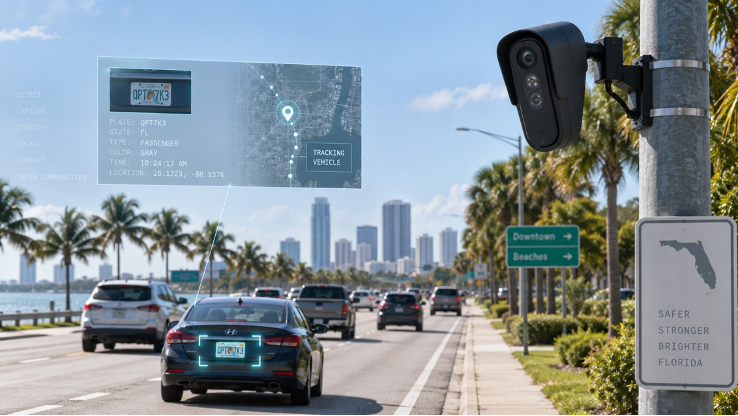
Over the span of 667 days, Florida police officer Christopher Goodson used law-enforcement resources to search his estranged wife’s license plate 717 times.[i] From September 1, 2024, to June 30, 2026, Officer Goodson employed the help of the increasingly controversial automated license plate recognition system (“ALPR”), Flock Safety, to track where and when her vehicle had been spotted.[ii] Although Flock is intended for “bona fide” criminal investigations, misuse of its technology has surfaced in police departments across the country.[iii] Remarkably, Goodson’s unauthorized and unwarranted use of Flock data was not discovered through departmental oversight, but through an independent investigation led by The Washington Post.[iv] After Goodson received a text message from his estranged wife who had been contacted by Post journalists regarding his alleged misuse of the Flock database, Goodson disclosed to his supervisor that he had made those “several” inquiries for the safety of his children.[v] An investigation launched afterwards instead uncovered the 717 searches, many disguised as legitimate law-enforcement inquiries, and Goodson was subsequently charged with official misconduct and unlawful use of a computer case.[vi]
Goodson’s case is emblematic of a growing controversy surrounding Flock Safety, a private technology company whose surveillance cameras have become almost ubiquitous among law enforcement agencies.[vii] Founded in 2017, Flock Safety develops AI-powered ALPRs, along with video surveillance and audio detection technology.[viii] Its roadside motion-activated cameras photograph passing vehicles and use AI software to identify license plate numbers and other vehicle characteristics.[ix] Flock cameras have the ability to capture vehicles as far as 75 feet away, and each sighting records the vehicle’s location and time, creating a database that law enforcement can search for past movements.[x] Once agencies share access to their cameras, officers can search for vehicle sightings beyond their own jurisdictions. Today, Flock’s network includes more than 120,000 cameras nationwide and is used by thousands of law enforcement agencies.[xi]
While the pervasive nature of Flock cameras in city streets is unsettling, their appeal for public safety is equally easy to understand. ALPRs allow law enforcement to easily locate stolen vehicles, find missing or abducted people, and identify vehicles connected to crimes far more efficiently than traditional investigative methods.[xii] Flock says its technology played a role in approximately one million police cases in 2025.[xiii] But the same efficiency that makes the system useful also creates its central privacy concern. A single camera only reveals a vehicle passing a particular road at a particular time. Networked together, however, thousands of cameras easily transform those isolated observations into a searchable history of where a vehicle was, and how often its driver, has been. As surveillance technology becomes cheaper, more precise, and more interconnected, the constitutional line between public observation and intrusive government tracking has become increasingly difficult to draw.
The public’s concern with Flock surveillance revisits the Court’s longstanding difficulty to develop Fourth Amendment jurisprudence that keeps pace with rapid technological developments. In Katz v. United States, the Supreme Court moved beyond the Amendment’s traditional focus on physical intrusion, famously declaring that the “Fourth Amendment protects people, not places.”[xiv] Justice Harlan’s concurrence supplied the framework that now dominates modern Fourth Amendment doctrine. Under that reasonable-expectation-of-privacy test, government conduct constitutes a search when it invades an expectation of privacy that the individual actually holds and that society is prepared to recognize as reasonable.[xv] But as surveillance technology advanced, courts confronted the more difficult question of whether observations made in public remain constitutionally insignificant when technology combines them over time into a detailed account of a person’s movements.
That question came into sharper focus in United States v. Jones.[xvi] Although the Court held that the government’s installation and use of a GPS tracker constituted a search based on its physical trespass to the vehicle, the concurring opinions tackled the broader implications of prolonged electronic tracking.[xvii] Justices Sotomayor and Alito both expressed concern that technology could transform otherwise public movements into a comprehensive record revealing intimate details of a person’s life.[xviii] Together, their concurrences reflected what has become known as the mosaic theory, under which surveillance that reveals little in isolated pieces may become constitutionally significant when those pieces are assembled into a broader picture.[xix]
Six years later, the majority in Carpenter v. United States signaled the Court’s growing willingness to recognize Fourth Amendment concerns when modern technology creates an extensive record of a person’s movements using location data.[xx] There, the Court held that obtaining seven days of historical cell-site location information constituted a search, despite the data being held by a third party.[xxi] The Court emphasized that such information can reveal the “whole of [a person’s] physical movements” when collected over time and provide an intimate account of private life.[xxii] Although Carpenter limited its narrow holding to cell-site location data, its reasoning gave greater doctrinal significance to the concerns raised in the Jones concurrences.[xxiii]
The uncertainty surrounding how these principles apply to ALPR surveillance makes Justice Alito’s warning in Jones particularly relevant.[xxiv] Recognizing the difficulty of developing meaningful constitutional doctrine amid rapidly changing technology, he observed that “[i]n circumstances involving dramatic technological change, the best solution to privacy concerns may be legislative.”[xxv] More than a decade later, Flock demonstrates why. Courts have increasingly recognized the privacy implications of aggregated location data, but the point at which an ALPR network triggers Fourth Amendment protections remains unsettled. In the absence of that certainty, legislatures should not leave protection against misuse to departmental discretion or the policies of the private company operating that system.
Flock has responded to mounting criticism by adopting additional privacy safeguards.[xxvi] The company recently announced that it would reduce its default retention period from thirty days to seven, made case codes and audit logs mandatory for searches, and add mechanisms to identify and restrict abnormal search activity.[xxvii] Those measures are meaningful, but voluntary corporate safeguards are not a substitute for the law.[xxviii] The minimum protections governing government access to sensitive location information should not depend on the continued willingness of a private company to maintain policies it created and can later change.[xxix] Statutory protections can instead establish uniform rules that bind agencies and officers regardless of the vendor they use.
Florida’s existing ALPR statutes illustrate the gap. Sections 316.0777 and 316.0778 regulate where ALPR systems may be installed, restrict disclosure of identifying information, and require limits on data retention.[xxx] Yet neither provision expressly prohibits an officer from accessing ALPR data for a personal or otherwise unauthorized purpose, nor does either establish a penalty specifically for doing so.[xxxi] General criminal laws may still apply, as Goodson’s prosecution for official misconduct and unlawful computer access demonstrates.[xxxii] But statutes written for other forms of misconduct are an imperfect substitute for a law addressing the misuse of a surveillance system capable of reconstructing a person’s movements. Florida should expressly prohibit knowing access to ALPR data for purposes unrelated to legitimate law enforcement activity and attach meaningful criminal and civil consequences to violations.
Florida’s need for legislative intervention is especially apparent in light of Governor Ron DeSantis’ acknowledgement that the State’s existing safeguards against ALPR misuse are inadequate.[xxxiii] Despite DeSantis’ longstanding support of law enforcement and public safety measures, he acknowledged in a press conference last month that Florida does not have “really strong penalties” for such conduct.[xxxiv] Additionally, the Florida Department of Transportation has since revoked permits for ALPR systems on state roads, citing reports of misuse, data-privacy concerns, and surveillance schemes while several Florida law-enforcement agencies have suspended their own programs.[xxxv] These measures reflect mounting concern over the technology, but permit revocations and voluntary suspensions are no substitute for durable statewide rules. If Florida continues to permit enforcement access to ALPR technology, the Legislature should define permissible uses, require meaningful oversight, and impose clear consequences when officers exploit that access for personal purposes.
[i] Katelyn Massarelli & Carla Bayron, Haines City Officer Arrested for Misusing Flock Cameras to Track Estranged Wife: Officials, FOX 13 TAMPA BAY (Aug. 11, 2026, at 22:17 ET), https://www.fox13news.com/news/haines-city-officer-arrested-misusing-flock-cameras-track-estranged-wife-officials [https://perma.cc/YRK7-EV3C].
[ii] Id.
[iii] Drew Harwell, Douglas MacMillan, & Aaron Schaffer, How Rogue Officers Turned a Nationwide Camera Network into a Tool for Stalking, Wash. Post (Aug. 2, 2026), https://www.washingtonpost.com/technology/2026/08/02/how-police-officers-used-vast-network-cameras-spy-their-exes [https://perma.cc/7WPA-N3N3].
[iv] Sierra Rains, Haines City Officer Used Flock Cameras to Track Estranged Wife on 717 Occasions: Affidavit, WFLA (Aug. 18, 2026, at 11:36 ET), https://www.wfla.com/news/polk-county/haines-city-officer-used-flock-cameras-to-track-estranged-wife-on-717-occasions-affidavit [https://perma.cc/56S4-XT6K]. Other news organizations like USA Today also conducted similar investigations into potential Flock misuse, identifying patterns of potentially improper searches that law enforcement agencies had failed to detect internally. See Kenny Jacoby, Austin Fast, & Jack Lemnus, Our Flock Camera Investigation Sparks Police Firings, Arrests, USA TODAY (Sep. 3, 2026, at 20:30 ET), https://www.usatoday.com/story/news/nation/2026/08/28/flock-camera-investigation-police-arrested-fired-surveillance/91383586007 [https://perma.cc/BV3J-24JH]. In more than a dozen cases, agencies took action only after reporters contacted them about questionable searches. Id.
[v] See Nicole Acosta, Fla. Cop Allegedly Tracked Estranged Wife using Flock Cameras on Over 700 Occasions, People (Aug. 13, 2026, at 16:40 ET), https://people.com/fla-cop-allegedly-tracked-estranged-wife-using-flock-cameras-on-over-700-occasions-12059224 [https://perma.cc/7TYU-9QKD] (reporting that Goodson told his supervisor he had made “several inquiries” to track his children’s location). Post journalists identified suspicious search patterns by analyzing Flock search logs published by Have I Been Flocked, then used social-media profiles, court records, and other publicly available information to determine whether the searched plates were connected to the officers conducting the searches. See Harwell, MacMillan, & Schaffer, supra note iii. See Massarelli & Bayron, supra note i (reporting that “Goodson told his lieutenant that he was using it to keep track of his children’s location when they were with the estranged wife”).
[vi] Massarelli & Bayron, supra note i.
[vii] See Lizette Chapman, ‘We’re Not Big Brother’: Flock CEO Unveils New Privacy Guardrails After Backlash, Bloomberg (Aug. 13, 2026, at 09:00 ET), https://www.bloomberg.com/news/articles/2026-08-13/flock-ceo-unveils-privacy-guardrails-we-re-not-big-brother [https://perma.cc/RK78-336J] (noting that the company’s technology has been used by over “12,000 cameras and law-enforcement agencies across 43” states); see also Jacoby, Fast, & Lemnus supra note iv (reporting that the company’s founders opted to market the plate readers “aggressively to police”).
[viii] See Micah Barkley, How a Camera Network Sparked a Surveillance Backlash: Explainer, Bloomberg Law (Aug. 18, 2026, at 10:39 ET), https://news.bloomberglaw.com/privacy-and-data-security/how-a-camera-network-sparked-a-surveillance-backlash-explainer [https://perma.cc/BR64-EHUG] (stating that Flock also sells cameras meant for broader street coverage and acoustic sensors that identify and analyze sound).
[ix] See Chapman, supra note vii.
[x] Id.
[xi] Id.
[xii] See Barkley, supra note viii.
[xiii] Id. (referencing Flock reports that state the company has helped locate about 10,000 missing people in the US each year).
[xiv] See Katz v. United States, 389 U.S. 347, 351–53 (1967) (rejecting the prior trespass-based approach and concluding that the “trespass” doctrine could “no longer be regarded as controlling”); see also United States v. Jones, 565 U.S. 400, 409 (2012) (“[T]he Katz reasonable-expectation-of-privacy test has been added to, not substituted for, the common law trespassory test.”).
[xv] Katz, 389 U.S. 347 at 361 (Harlan, J., concurring).
[xvi] See Jones, 565 U.S. at 403.
[xvii] See id. at 404–05; see also Orin S. Kerr, The Mosaic Theory of the Fourth Amendment, 111 Mich. L. Rev. 311, 326–27 (2012) (explaining that the Jones majority resolved the case on trespass grounds while the concurring opinions considered the constitutional implications of long-term GPS monitoring).
[xviii] See Jones, 565 U.S. at 415–16 (Sotomayor, J., concurring) (highlighting the “unique attributes of GPS surveillance relevant to the Katz analysis” because it generates a “precise, comprehensive record of a person’s public movements that reflects a wealth of detail about her familial, political, professional, religious, and sexual associations.”); see also id. at 430 (Alito, J., concurring) (distinguishing short-term monitoring of public movements from longer term GPS monitoring that “impinges on expectations of privacy”).
[xix] Matthew B. Kugler & Lior Jacob Strahilevitz, Actual Expectations of Privacy, Fourth Amendment Doctrine, and the Mosaic Theory, 2015 Sup. Ct. Rev. 205, 208 (2016) (describing the “mosaic theory” as suggesting that “the government can learn more from a given slice of information if it can put that information in the context of a broader pattern”).
[xx] See Carpenter v. United States, 585 U.S. 296, 306, 310–11 (2018) (recognizing that digital location data “does not fit neatly under existing precedents” because modern technology could transform otherwise public movements into an “all-encompassing record” of a person’s whereabouts).
[xxi] See Laura Hecht-Felella, Brennan Just. Ctr., The Fourth Amendment in the Digital Age 8 (2021) (explaining that cell site location information is automatically generated when cell phones connect to nearby towers, including during calls, text messages, routine data transmissions, and even while a phone is not actively in use); see also Carpenter, 585 U.S. at 309 (holding that third-party possession of cell site location information did not overcome an individual’s reasonable expectation of privacy in the record of his physical movements). See generally United States v. Miller, 425 U.S. 435, 444 (1976) (holding that a depositor lacked a reasonable expectation of privacy in financial records voluntarily conveyed to banks and exposed to bank employees in the ordinary course of business); see also Smith v. Maryland, 442 U.S. 735, 743 (1979) (applying the same principle to telephone records and holding that a user assumed the risk that numbers voluntarily conveyed to the telephone company could be disclosed to police).
[xxii] Carpenter, U.S. 296, at 310–11.
[xxiii] Id. at 309–10 (declining to extend third party doctrine to CSLI recognizing that the privacy concerns identified in the Jones concurrences were implicated by the location data at issue).
[xxiv] See Laura Hecht-Felella, supra note xxi, at 23 (explaining that courts have largely “sidestepped the issue or declined to extend Carpenter’s reasoning” to ALPR surveillance and that, as ALPRs become more ubiquitous, distinguishing them from GPS or CSLI monitoring will become increasingly difficult).
[xxv] United States v. Jones, 565 U.S. 400, 429 (2012) (Alito, J. concurring)
[xxvi] Helen Coster, Florida Bans Highway License-Plate Readers as Backlash Over Surveillance Spreads, Reuters (Sept. 3, 2026, at 14:41 ET), https://www.reuters.com/legal/government/florida-bans-highway-license-plate-readers-backlash-over-surveillance-spreads-2026-09-03 [https://perma.cc/ZD6H-9NL6] (reporting that forty-seven percent of Americans oppose use of Flock cameras in their community); see also Chapman, supra note vii (reporting that Flock’s procedural changes are “intended to strengthen privacy protections and reduce instances of abuse.”); see also Fernando Alfonoso III & Kashmir Hill, Flock Cameras Can Track Every Car in America. Police Love Them. Citizens Don’t, N.Y. Times (Aug. 11, 2026), https://www.nytimes.com/2026/08/10/us/flock-cameras-can-track-every-car-in-america-police-love-them-citizens-dont.html [https://perma.cc/PP9R-TYYS] (reporting widespread bipartisan backlash against Flock, including canceled municipal contracts, lawsuits, public petitions, and vandalism of cameras).
[xxvii] See Chapman, supra note vii.
[xxviii] Id. (noting that the expected changes exceed most states’ current statutory standards).
[xxix] Jay Stanley, Municipalities: Beware of Changes in Flock’s legal Terms if You’re Using or Considering License Plate Readers, ACLU (Apr. 16, 2026), https://www.aclu.org/news/privacy-technology/tracking-alpr-cameras/flocks-terms-and-conditions [https://perma.cc/8R8D-7K3A] (reporting that Flock changed its standard terms and conditions at least four times within seven months, including removing prior language stating that it would not sell customer data and expanding its rights over customer data).
[xxx] See Fla. Stat. §§ 316.0777–.0778 (2026).
[xxxi] Compare §§ 316.0777–.0778 (regulating ALPR installation, disclosure of identifying information, and data retention, while neglecting to expressly prohibit unauthorized access or use or prescribe a specific penalty for such conduct), with Wash. Rev. Code §§ 10.130.030(1)–(2), .100 (2026) (limiting agency access, operation, and use of ALPR systems to specifically authorized purposes and making willful and intentional querying, access, or use for a purpose not specifically authorized by the chapter a gross misdemeanor).
[xxxii] See Massarelli & Bayron, supra note i; see also Fla. Stat. § 838.022 (2026) (making it a third-degree felony for a public servant to knowingly and intentionally obtain a benefit for any person or cause unlawful harm to another by falsifying an official record or document); see also Fla. Stat. § 815.06(2)(a) (2026) (prohibiting knowing and unauthorized access to a computer, computer system, computer network, or electronic device, including access exceeding authorization).
[xxxiii] See Michael Smith, Florida Bans Cameras on Roads as Surveillance Backlash Grows, Bloomberg Law (Sept. 1, 2026, at 15:35 ET), https://news.bloomberglaw.com/private-equity/florida-bans-cameras-on-roads-as-surveillance-backlash-grows [https://perma.cc/245N-NMAD] (reporting that Governor DeSantis urged the Florida Legislature to consider restrictions on Flock cameras and warned against allowing Florida to become a “digital prison”).
[xxxiv] See Jesus Jiménez & David Ovalle, In Red States, Law-and-Order Republicans Turn Against Flock Cameras, N.Y. Times (Sep. 5, 2026), https://www.nytimes.com/2026/09/05/us/red-states-republicans-flock-cameras.html [https://perma.cc/7XZZ-N2CN] (describing DeSantis as “tough-on-crime” Republican with deep backing from law-enforcement agencies); see also WFLA News Channel 8, Gov. Ron DeSantis Doubled Down on His Criticism of License Plate Readers Like Flock Cameras, Saying Legislative Action Must be Taken to Keep Floridians From Living in a Digital Surveillance State, at 01:02–01:06 (Facebook, Aug. 31, 2026, at 18:30 ET), https://www.facebook.com/watch/?v=1112118141160348 [https://perma.cc/JDQ3-D76R] (quoting DeSantis as stating that Florida does not have “really strong penalties” for misuse of the technology).
[xxxv] Fla. Dep’t of Transp., Eng’g & Operations Memorandum No. 26-01, Revocation of General use Permits for Automated License Plate Readers (2026), https://fdotwww.blob.core.windows.net/sitefinity/docs/default-source/design/bulletins/eom26-01.pdf?Status=Master&sfvrsn=52938dee_1 [https://perma.cc/8FP4-CUTN].