Artificial intelligence has made it increasingly easy to create realistic images depicting events that never occurred. In Montana, that technology recently collided with the First Amendment after a political committee distributed campaign mailers containing AI-generated images of state legislators.[i] The images included legislators wearing pronoun pins and holding pride flags, as well as another legislator holding a gas pump labeled “arm” and “leg” that appeared to dispense ten-dollar bills.[ii] Although Montana officials indicated that dismissal of the administrative complaints was appropriate because the materials fell within the Act’s satire or parody exemption, the plaintiff’s nevertheless brought a federal constitutional challenge to Montana’s recently enacted law regulating AI-generated election communications.[iii]
In Accountability in State Government v. Knudsen, the U.S. District Court for the District of Montana granted a preliminary injunction after concluding that the plaintiffs were likely to succeed on their First Amendment challenge.[iv] Central to the court’s analysis was Montana’s definition of a “deepfake,” which includes certain AI-generated media depicting a candidate or political party “with the intent to injure the reputation of the candidate or party or otherwise deceive a voter.”[v] The court concluded that this language likely discriminates based on viewpoint because a flattering synthetic depiction may escape liability while an equally artificial but critical depiction may trigger the statute.[vi]
AI can make fabricated political content increasingly convincing, but political speech receives substantial protection under the First Amendment.[vii] Although Montana has a compelling interest in protecting the integrity of its elections from deceptive AI-generated content, Senate Bill 25 (“SB 25”) raises a First Amendment problem because its reputation-injury provision distinguishes between synthetic political speech that praises a candidate and speech that criticizes one. A viewpoint-neutral law focused on material deception rather than reputational harm would address AI manipulation without making liability depend on the viewpoint expressed.
In 2025, the Montana Legislature enacted Senate Bill 25 to address the use of artificial intelligence in election communications.[viii] The Legislature expressed concern that generative AI could falsely depict a candidate’s speech or conduct, rapidly spread misinformation, and cause lasting harm to both candidates and voters’ perceptions.[ix] The resulting statute applies to certain election and electioneering communications involving deepfakes produced, created, or distributed within sixty days of the start of election voting.[x]
The statute defines a deepfake as certain AI-generated or synthetic media depicting a candidate or political party “with the intent to injure the reputation of the candidate or party or otherwise deceive a voter.”[xi] The media must also appear to a reasonable person to depict something that did not occur or materially alter the person’s understanding of the original content.[xii] The law provides exceptions for satire and parody and provides a safe harbor for communications containing a prescribed AI disclosure.[xiii]
Accountability in State Government and former Montana legislator Dan Bartel challenged the statute after complaints were filed concerning their AI-generated political mailers.[xiv] Although Montana’s Commissioner of Political Practices later indicated that the complaints should be dismissed under the satire-or-parody exception, the plaintiffs argued that the possibility of future enforcement chilled their planned political speech.[xv]
The First Amendment generally prohibits the government from restricting expression because of its message, ideas, subject matter, or content.[xvi] A content-based restriction regulates speech based on the topic or message expressed, while viewpoint discrimination goes a step further by targeting a particular perspective on that subject.[xvii] In Rosenberger v. Rector & Visitors of the University of Virginia, the Supreme Court explained that viewpoint discrimination occurs when the government targets the particular views expressed by speakers on a subject.[xviii] The Court has characterized viewpoint discrimination as an especially serious form of content discrimination because it allows the government to favor certain perspectives over others.
That distinction exposes the central constitutional problem with SB 25. Under the reputation-injury portion of the statute, whether synthetic political content is regulated can depend on the perspective it communicates.[xix] Judge Watters therefore concluded that the plaintiffs were likely to establish that the statute discriminates based on viewpoint.[xx]
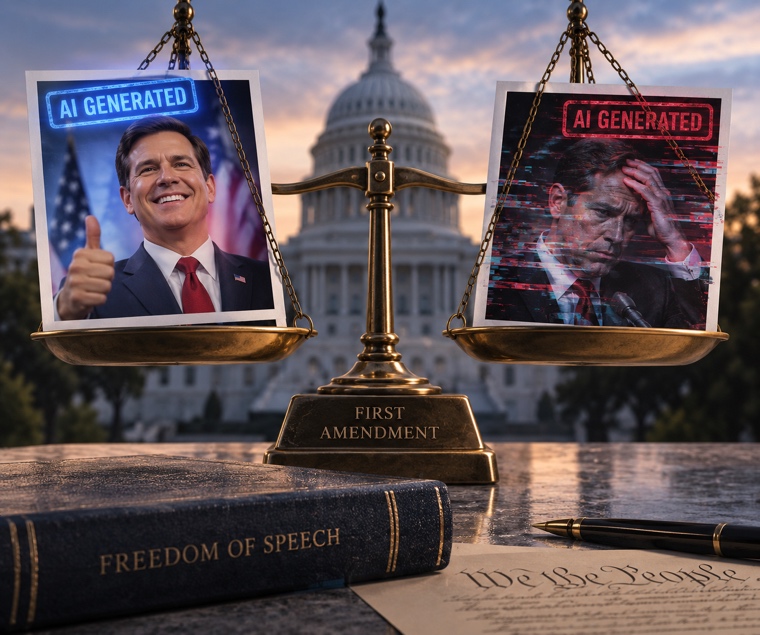
Consider two equally fabricated AI-generated images of the same candidate. One portrays the candidate favorably and is intended to improve the candidate’s reputation. The other portrays the candidate negatively and is intended to damage that reputation. Both images may be equally artificial and equally capable of misleading voters, but the reputation-injury portion of SB 25 expressly reaches the second. The distinction therefore does not turn solely on whether the content is false or deceptive; it also turns on whether the message is favorable or critical.
This distinction resembles the viewpoint discrimination addressed in Matal v. Tam. There, the Supreme Court rejected the argument that a restriction on disparaging trademarks was viewpoint neutral because it applied equally to disparagement of any person or group.[xxi] Judge Watters relied on that reasoning in analyzing SB 25. A restriction does not necessarily become viewpoint neutral simply because speakers are equally prohibited from criticizing all candidates. The constitutional concern is that criticism itself receives different treatment from praise.
Montana responded that the statute also covers deepfakes intended to “otherwise deceive a voter,” language that does not expressly distinguish between favorable and unfavorable political messages.[xxii] That argument has some force because the broader language appears to target deception itself rather than the viewpoint of the speaker. But, the court concluded that the catchall provision does not eliminate the viewpoint-based distinction created by the reputation-injury language.[xxiii] According to the court, placing a viewpoint-neutral provision alongside a viewpoint-based restriction does not cure the latter’s constitutional problem.[xxiv]
Because SB 25 regulates protected political speech based on its content and, according to the district court’s preliminary analysis, likely discriminates based on viewpoint, the statute faces demanding First Amendment scrutiny.[xxv] Montana argued that SB 25 serves a compelling governmental interest in protecting the integrity and reliability of elections, in which the court agreed. But the problem for Montana was whether SB 25 is narrowly tailored to accomplish that goal. The plaintiffs identified less restrictive alternatives, including counter speech, voter education, defamation remedies, and existing laws prohibiting interference with voting.[xxvi] The court concluded that Montana had not sufficiently demonstrated why those alternatives were inadequate to address deceptive AI-generation election content.
Yet the existence of less restrictive alternatives does not mean that Montana must leave deceptive AI-generated political content entirely unregulated. The larger problem is the fit between the harm Montana seeks to prevent and the distinction SB 25 draws. If the concern is that AI-generated content can deceive voters about something a candidate said or did, the law should focus on whether the content is materially deceptive, not whether it harms the candidate’s reputation. A fabricated image designed to make a candidate look favorable can mislead voters just as much as one designed to make that candidate look unfavorable. Treating those images differently does little to advance the State’s stated interest in preventing voter deception and instead creates the unconstitutional viewpoint-discrimination problem.
A more narrowly focused law could target materially deceptive synthetic content regardless of whether the message benefits or harms a candidate. Under that approach, the relevant question would be whether AI-generated content materially misrepresents a candidate’s words or conduct, rather than whether the speaker intended to injure the candidate’s reputation. Such an approach would more directly address Montana’s stated concern about voter deception while avoiding a statutory distinction between favorable and unfavorable political speech. As states continue to confront AI-generated election content, the First Amendment does not necessarily prevent regulation, but it does require that the government regulate the deception rather than the viewpoint.
[i] See Accountability in State Government v. Knudsen, No. 6:26-cv-00038-SPW, at slip op. 5–6 (D. Mont. Sept. 16, 2026).
[ii] Id.
[iii] Id at 2.
[iv] Id. at 39–40.
[v] See Mont. Code Ann. § 13-35-801(1) (2025).
[vi] See Accountability in State Government at 25–26.
[vii] See Citizens United v. FEC, 558 U.S. 310, 329 (2010) (describing political speech as “speech that is central to the meaning and purpose of the First Amendment”).
[viii] See Jonathon Ambarian, Judge Restricts Enforcement of Montana Law Against AI ‘Deepfakes’ in Campaign Ads, KTVH (Sept. 17, 2026), https://www.ktvh.com/news/montana-politics/judge-restricts-enforcement-of-montana-law-against-ai-deepfakes-in-campaign-ads [https://perma.cc/VFY6-MKXY].
[ix] See Accountability in State Government at 2.
[x] See Mont. Code Ann. § 13-35-802(1)(a) (2025).
[xi] Id. at § 13-35-801(3).
[xii] Id. at § 13-35-801(3)(a)–(b).
[xiii] Id. at § 13-35-802(1)(b)–(c), (2)(c).
[xiv] See Accountability in State Government at 5.
[xv] Id. at 5–6.
[xvi] See Reed v. Town of Gilbert, 576 U.S. 155, 163 (stating that the First Amendment “prohibits the enactment of laws ‘abridging the freedom of speech’ . . . [and] a government, including a municipal government vested with state authority, ‘has no power to restrict expression because of its message, its ideas, its subject matter, or its content’”).
[xvii] See Rosenberger v. Rector & Visitors of the Univ. of Va., 515 U.S. 819, 828–829 (1995).
[xviii] Id.
[xix] See Accountability in State Government at 25–26.
[xx] Id.
[xxi] See Matal v. Tam, 582 U.S. 218, 249 (2017).
[xxii] See Mont. Code Ann. § 13-35-801(3) (2025).
[xxiii] See Accountability in State Government at 27.
[xxiv] Id.
[xxv] Id. at 28.
[xxvi] Id. at 29.