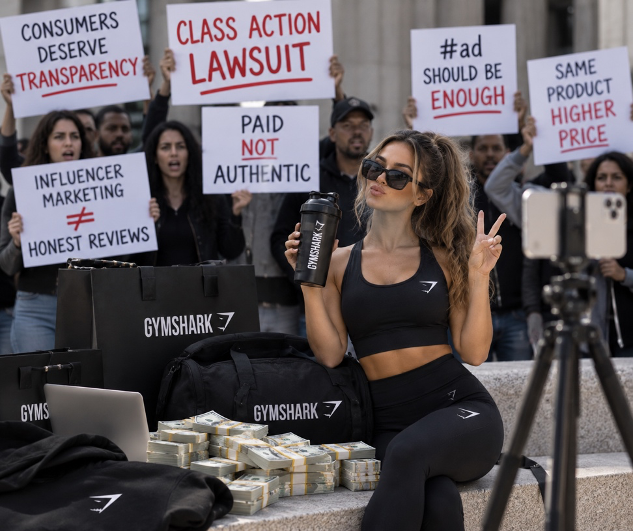
What makes an influencer influential? It is not simply the number of followers, likes, or views. It is the authenticity they portray, creating the belief that the person behind the screen genuinely likes what they are recommending. A favorite pair of leggings, a skincare routine, or an energy drink feels different when it appears in someone’s everyday life rather than in a traditional advertisement. That appearance of authenticity has transformed social media into a powerful marketing tool. But what happens when the recommendation that looks organic is actually bought, controlled, and contractually restricted?
That question now sits at the center of a proposed class action against Gymshark USA, Inc. filed on June 16, 2026.[i] The plaintiff alleges that Gymshark built its marketing strategy around paid influencers whose endorsements appeared to reflect genuine product preferences.[ii] More significantly, the complaint alleges that some influencers maintained exclusive relationships with Gymshark that prevented them from endorsing, advertising, or even wearing competing brands, without disclosing those restrictions to consumers.[iii] The case pushes influencer litigation beyond the familiar question of whether “#ad” appeared prominently enough.[iv] Instead, it asks whether a brand can be liable when the appearance of independent enthusiasm is itself part of what the brand is selling.
The Federal Trade Commission (“FTC”) has long required disclosure of material connections between advertisers and endorsers when those relationships could affect how consumers evaluate an endorsement.[v] Payments are an obvious example, but material connections extend beyond direct compensation. The underlying principle is straightforward: consumers evaluate a recommendation differently when they know the person making it has an incentive to promote the product. Although the FTC Act does not provide consumers with a private right of action, its disclosure standards remain relevant in private litigation.[vi] Plaintiffs may instead pursue claims under state consumer protection laws while looking to the FTC’s Endorsement Guides as a benchmark for whether influencer advertising is deceptive.[vii]
Gymshark is only the latest brand to confront this strategy. Since early 2025, proposed class actions have targeted Celsius, Shein, Revolve, ALO Yoga, Beach Bunny, and other brands for allegedly disguising sponsored endorsements as independent recommendations.[viii] The allegations follow a common theory: consumers claim that they purchased products believing influencer recommendations were genuine and that, had the sponsorship been disclosed, they either would not have made the purchase or would have paid less.[ix] In the ALO Yoga litigation, for example, plaintiffs sought to recover the difference between the prices they paid and the alleged market value of the products, claiming that seemingly impartial influencer opinions allowed the company to charge a premium.[x]
That theory presents a difficult line for consumer protection law. A hidden sponsorship may make an advertisement deceptive, but deception does not necessarily establish economic injury. A consumer who buys leggings after viewing an undisclosed sponsored post may still receive the exact leggings she expected, at the price advertised, with no defect in their quality or performance. The emerging lawsuits therefore depend on something less tangible: the argument that perceived authenticity itself influenced demand and increased what consumers were willing to pay.[xi] Courts considering similar theories have not decided uniformly, with some accepting comparable allegations at the pleading stage and others requiring a more concrete connection between the challenged marketing and the alleged overpayment.[xii]
Gymshark may present a stronger version of that argument. If the allegations are true, consumers were not merely missing a technical sponsorship label. An influencer repeatedly wearing Gymshark while contractually prohibited from promoting competitors could create the impression that the brand had earned that loyalty through product quality or actual personal preference. Disclosure changes the meaning of that conduct. “I always wear Gymshark because I love it” communicates something fundamentally different from “I always wear Gymshark because I am paid to promote it and contractually cannot promote its competitors.”
That difference matters because modern brands increasingly sell more than physical products; they sell an image surrounding those products. For brands built through influencer marketing, part of that image is the perception that influencers genuinely use and recommend their products. The more a company relies on seemingly independent endorsements to establish popularity, desirability, and consumer trust, the harder it becomes to characterize the financial relationship behind those endorsements as irrelevant to the transaction.
Still, courts should resist treating every inadequate influencer disclosure as a compensable injury. Doing so risks allowing state consumer protection laws to function as a private enforcement mechanism for FTC standards despite the absence of a private right of action under the FTC Act.[xiii] Plaintiffs should therefore have to show that the undisclosed relationship actually affected their decision to purchase the product or the price they were willing to pay, rather than simply point to an influencer’s failure to properly disclose a sponsorship.
Ultimately, the Gymshark litigation reflects a larger shift in what consumers are actually buying in the social media marketplace. Influencers are valuable precisely because their recommendations can feel personal, independent, and authentic.[xiv] Brands are entitled to capitalize on that influence, but the legal consequences should change when paid loyalty is presented as genuine preference. If authenticity helps sell the product, the relationship behind that authenticity cannot simply disappear when courts measure consumer harm. The Gymshark case may help determine where marketing ends and misrepresentation begins.
[i] See Complaint at 1, Lupea v. Gymshark USA, Inc., No. 1:26-cv-05073 (S.D.N.Y. June 16, 2026).
[ii] See id. at 16–17.
[iii] See id. at 2.
[iv] See Fed. Trade Comm’n, Disclosures 101 for Social Media Influencers 5 (2019), https://www.ftc.gov/system/files/documents/plain-language/1001a-influencer-guide-508_1.pdf [https://perma.cc/K6VT-4BZ6] [hereinafter FTC Influencers Disclosure Guide].
[v] See id. at 5.
[vi] See Michael D. Meuti & Allyson Cady, Influencer Marketing Under Fire: Gymshark Sued in New Class Action as Plaintiffs Target Undisclosed Paid Endorsements, Benesch Law (July 1, 2026), https://www.beneschlaw.com/insight/influencer-marketing-under-fire-gymshark-sued-in-new-class-action-as-plaintiffs-target-undisclosed-paid-endorsements/ [https://perma.cc/HF8Z-4J8F] (stating that the FTC Act does not create a private cause of action for consumers harmed by allegedly unfair or deceptive practices).
[vii] Complaint at 6–7, 24, Lupea v. Gymshark USA, Inc., No. 1:26-cv-05073 (S.D.N.Y. June 16, 2026).
[viii] See Meuti & Cady, supra note vi; see also Grace Lamendola, Influencer Marketing Is Reshaping the Brand Protection Playbook, The Fashion Law (Aug. 28, 2026), https://www.thefashionlaw.com/influencer-marketing-is-reshaping-brand-protection-playbook/ [https://perma.cc/ZCD2-GDKH] (describing proposed class actions alleging consumer deception arising from influencers’ failure to adequately disclose paid relationships with brands).
[ix] See Complaint at 11, Negreanu v. Revolve Group, et. al., No. 2:25-cv-03186 (C.D. Cal. Apr. 11, 2025); see also Complaint at 10, Dubreu v. Celsius Holdings Inc. et al., No. 5:25-cv-00180 (C.D. Cal. Jan. 22, 2025).
[x] See Complaint at 3, Sulici v. Color Image Apparel d/b/a Alo Yoga, No. 1:25-cv-03928 (N.D. Ill. Apr. 11, 2025).
[xi] See id. at 2–3.
[xii] See Carole E. Reagan & Darian McMillan, The Business of Influence: Navigating Risk in a Creator-Fueled, Brand-Driven Economy, Orange Cnty. Law., Apr. 2026, at 30, 31, https://www.virtualonlineeditions.com/publication/?i=862733&p=32&view=issueViewer [https://perma.cc/3DF3-PJRL].
[xiii] See Meuti & Cady, supra note vi.
[xiv] See generally Maitri Ramwala, Why We Trust Strangers on the Internet More Than We Trust Ads, Medium (June 29, 2026), https://medium.com/@maitri.ramwala123/why-we-trust-strangers-on-the-internet-more-than-we-trust-ads-670a00630c36 [https://perma.cc/A6BW-4AY9] (discussing how influencer marketing leverages relatability, authenticity, and consumer trust to influence purchasing behavior).