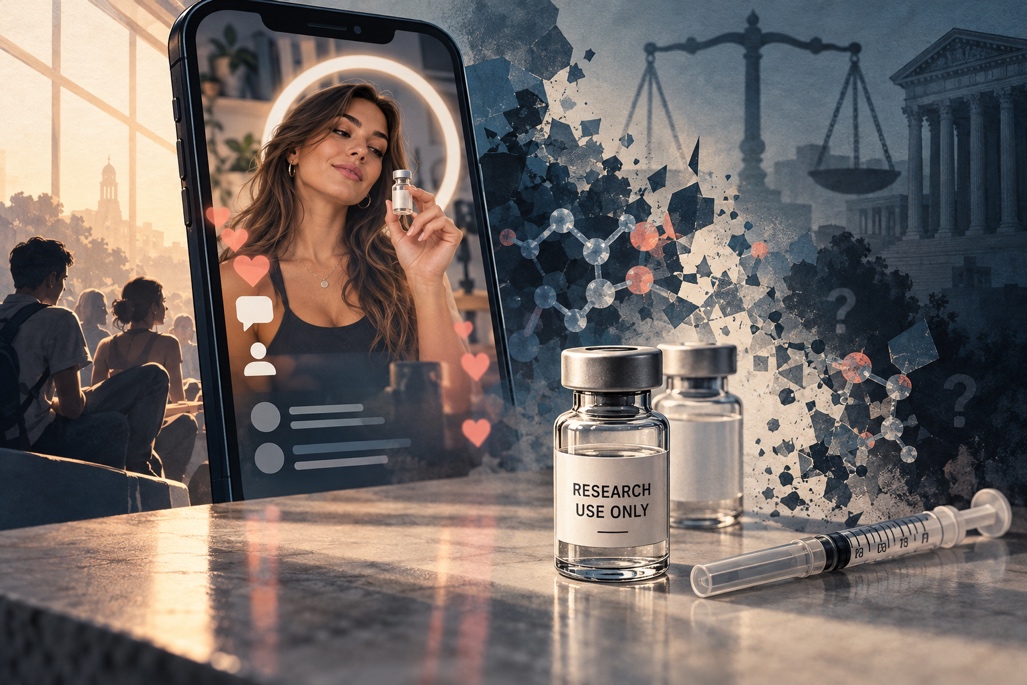
Social media wellness influencers have drawn growing attention for promoting injectable peptides as a route to better health. The promised benefits range from improved sleep and weight loss to muscle growth. Peptides are short chains of amino acids that act as chemical messengers in the body, helping control things like hormones, digestion, inflammation, and the body’s ability to fight infections and repair itself.[i] Their legitimate medical uses are well established. For example, insulin, an injectable peptide, has helped millions of people manage their blood sugar. More recently, similar medications such as glucagon-like peptide-1 (“GLP-1”) medications have helped people manage appetite and weight by mimicking the body’s natural hunger-regulating signals, as hormones such as ghrelin and leptin do. These drugs have become widely available only after extensive clinical trials and FDA approval.[ii]
Peptides are drugs, meaning injectable substances intended to improve health or prevent illness that require FDA approval before they can be sold in the United States.[iii] For a new peptide to get the FDA’s approval, its manufacturer must provide evidence proving how well the medication works and what risks it has.[iv] To evaluate that evidence, the FDA reviews results from lab tests and clinical trials to determine whether a medication’s benefits justify the risks it may pose.[v] Additionally, the FDA publishes product-specific guidance documents for certain peptides that suggest the best practices for how the product should be made, labeled, promoted, and tested.[vi] However, many peptides now circulating online are newer or experimental compounds that have not undergone the testing necessary to establish safety and efficacy.[vii] Without clinical trials, there is little reliable data on proper dosing, long-term effects, or interactions with other medications. Despite this, demand for these unapproved products continues to climb, driven by the benefits users hope to achieve.
Injectable peptides are marketed primarily on social media platforms, where young people are the most common users. This group may be especially susceptible to appearance-based pressure and less equipped to evaluate medical claims.[viii] The growing engagement by young users makes this exponentially more concerning. Minors and young adults are still developing physically, making them more vulnerable to the hormonal effects of these substances as introducing them during puberty may interfere with the body’s natural hormone regulation.[ix] They are also less likely to consult a physician before using them, and less able to recognize when a claim is too good to be true. Health and fitness influencers promote these unapproved peptides on social media platforms like TikTok and through podcasts, despite the lack of scientific studies and human clinical trials.[x] Further, social media has long promoted unrealistic lifestyles and beauty standards that ordinary people strive to meet. Injectable peptides are the latest tool people have turned to potentially enhance their quality of life or possibly address physical insecurities.[xi]
Moreover, product quality is a major concern with these unapproved injectable peptides, as buyers have no assurance that a given medication vial contains what it claims. These compounds, often made and sold without FDA approval and inspection, may contain ingredients or doses that differ from those listed on their labels and may also contain contaminants.[xii] Traditional, orally taken peptides must survive the digestive tract and cross the intestinal membrane before they are absorbed into the bloodstream.[xiii] Conversely, injectable products carry particular risk because they are inserted directly into the bloodstream, bypassing many of the body’s natural defenses. Contamination, incorrect dosing, and improper storage can lead to infection or other serious harm. These injectable peptides are being sold through the gray market with no guarantee of their safety or effectiveness.[xiv] Many of these products are sold with a “for research use only” label, which indicates that they are not intended for human consumption.[xv] The gray market is used to circumvent liability, giving sellers a channel to sell their product with only a “research use only” label.[xvi] This ecosystem exposes a serious gap in the regulatory framework. That label can shield sellers from the stricter rules governing drugs marketed for human use, even though the surrounding marketing makes the true purpose unmistakable.[xvii] A seller may satisfy the letter of the law while disregarding its purpose, leaving enforcement agencies to chase an ever-shifting online marketplace. Essentially, consumers are effectively told that a product is not for human use by the same sellers who know it is being purchased for that very use.
It is almost impossible for the FDA to keep up with the rapid growth of these commercially available unapproved injectable peptides. Uniformed users who disregard the risks associated with these medications help normalize the use of unapproved compounds, making increasingly risky peptides seem more acceptable to try. Absent meaningful change in the widespread unchecked market availability of such unapproved injectable peptides, society runs the risk of these harmful medications reaching the hands of more young and susceptible users. As injectable peptides continue to spread through social media, the law must decide whether and how to keep pace.
[i] See Marygrace Taylor, Peptides: What They Are, Potential Benefits, and Safety Concerns, Harv. Health (July 7, 2026), https://www.health.harvard.edu/medications-and-treatments/peptides-what-they-are-potential-benefits-and-safety-concerns [https://perma.cc/GX9D-XXE7].
[ii] See Caitlin Dow, What Are Injectable Peptides, and Are They Safe?, CSPI (June 24, 2026), https://www.cspi.org/article/what-are-injectable-peptides-and-are-they-safe [https://perma.cc/J2K7-VY8W].
[iii] See Matthew Perrone, A Closer Look at the Unapproved Peptide Injections Promoted by Influencers and Celebrities, AP News (Nov. 14, 2025, at 08:48 ET), https://apnews.com/article/peptide-injections-risks-side-effects-6f0d391b270f5008932cba909b8fef07 [https://perma.cc/8Y6T-VYVU] (“The [FDA] considers many peptides to be biologics, the most complicated and potentially high-risk type of drugs, requiring extra precautions in their manufacture and storage.”).
[iv] See Stacia Woodcock, FDA-Approved Peptides vs. Unapproved Wellness Peptides, GoodRX (Sep. 24, 2026), https://www.goodrx.com/health-topic/peptides/fda-approved-peptides [https://perma.cc/S45J-CZZR].
[v] See id.
[vi] See Sophia Lee, Peptides: What They Are, and Why the FDA is Paying Attention, Rupa Health (Feb. 26, 2025), https://www.rupahealth.com/post/peptides-what-they-are-and-why-the-fda-is-paying-attention [https://perma.cc/2FZG-Q8HG].
[vii] See Sara Berg, What Doctors Want Patients to Know About Injectable Peptides, AMA (Apr. 29, 2026), https://www.ama-assn.org/public-health/prevention-wellness/what-doctors-want-patients-know-about-injectable-peptides [https://perma.cc/KA6Q-G9KJ].
[viii] See id.
[ix] See Louis Antoniou, Peptides for Teenagers: Benefits, Risks, and What You Need to Know, BioOptimal (Apr. 29, 2025), https://www.biooptimalsupplements.com/blogs/article/peptides-for-teenagers-benefits-risks-and-what-you-need-to-know-1 [https://perma.cc/6VKX-7J5V].
[x] See Mark Harden, Influencers Love Peptides, But Are They Safe and Effective?, Anschutz (June 15, 2026), https://news.cuanschutz.edu/emergency-medicine/zuckerman-peptides-regulation [https://perma.cc/VB5Q-ZJNJ].
[xi] See Sara Ashley O’Brien, Teen Boys and Young Men Are Injecting Peptides in Search of Perfection, Wall St. J. (May 11, 2026, at 12:09 ET), https://www.wsj.com/health/wellness/boys-peptides-stacks-looksmaxxing-trevor-larcom-835e58cd [https://perma.cc/Z63A-2HK6].
[xii] See Denise Dador, As Unregulated Peptides Grow in Popularity, Doctors Warn of Unknown Risks, Abc7news (Apr. 24, 2026), https://abc7news.com/post/unregulated-peptides-grow-popularity-doctors-warn-unknown-risks/18936453/ [https://perma.cc/HF82-4Q3R]; see also Kevin Jones, What Are Grey Market Peptides? (And Why Doctors Warn Against Them), Flow Wellness, https://flowwellness.com/what-are-grey-market-peptides/ [https://perma.cc/47RF-FTE5]. (last visited Oct. 19, 2026).
[xiii] See Pearl Steinzor, Oral Peptides: FAQs on Bioavailability, Safety, and Clinical Use, Ajmc (Mar. 25, 2026), https://www.ajmc.com/view/oral-peptides-faqs-on-bioavailability-safety-and-clinical-use [https://perma.cc/NJ2U-4WD2].
[xiv] See Joseph Choi, Inside the Booming, Gray-Market World of Injectable Peptides, The Hill (Apr. 30, 2026, at 06:00 ET), https://thehill.com/policy/healthcare/5855883-injectable-peptides-health-concerns-kennedy/ [https://perma.cc/VM7E-MEPK].
[xv] See Taylor, supra note i.
[xvi] See Jones, supra note xii.
[xvii] See Emily Gaines Buchler, The Compounding Problem of Peptides, John Hopkins U. (Sep. 16, 2026), https://hub.jhu.edu/2026/09/16/what-to-know-about-gray-market-peptides/ [https://perma.cc/5BUU-L5WD].