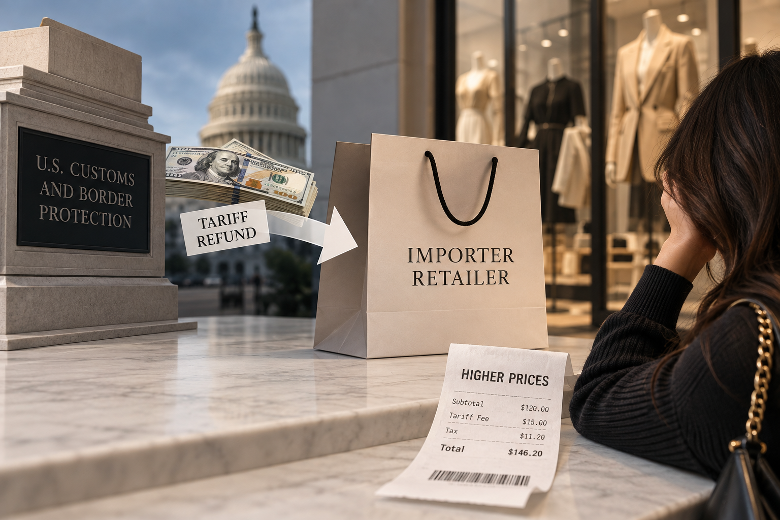
After President Trump established general import taxes under the International Emergency Economic Powers Act (“IEEPA”), many businesses responded by increasing their prices or imposing tariff-related fees and passing the burden on to the end consumer.[i] Although, importers directly paid the import duties to U.S. Customs and Boarder Protection (“CBP”), consumers argue that importers were not the ultimately burdened party, as they passed some or all of these expenses through the supply chain to the end consumer.[ii] After the Supreme Court’s holding that the IEEPA did not authorize the president to impose such tariffs, CBP began returning unlawfully collected tariffs to importers.[iii] However, the importer had allegedly already recovered this money via price increases and fees. This begs the question: is the retailer entitled to both the increased revenue and the tariff refund, or should the refund go to the consumer just like the economic burden of tariffs did?
As a fellow consumer, the immediate answer would be to reimburse the consumer for everything. However, the answer to this inquiry is a bit more nuanced. Since the importer is the one that paid the duties to CBP, the agency must issue the repayment to them.[iv] Therefore, consumers have no direct claim against CBP, even if they can show that retail prices were raised in response to tariffs and in turn burdened them.[v] The current administrative procedure that entitles an importer to refunds fails to identify who absorbed the economic burden, as it only looks at who paid the tariff. This distinction should not inherently entitle either party to the returned charge. Instead, it is important to look at the traceability of the charge to determine entitlement to a repayment. When the connection between the tariff payment and price increase can be made, it would be unjust for the retailer to retain both the increased revenue and the refund. Conversely, when tariffs were only one of several contributing factors to the price increase determining the consumer’s entitlement to the reimbursement, if any at all, becomes substantially more difficult.[vi]
As tariff refunds have begun rolling in, so have consumer class actions against retailers and manufacturers.[vii] The lawsuits focus on importers that have allegedly imposed additional charges or increased their prices and publicly attributed the additional charges to tariffs.[viii] Majority of complaints filed thus far claim unjust enrichment, breach of contract, and consumer protection theories. In the cases where the merchant added an itemized “tariff fee,” plaintiffs have a stronger claim, because the upcharge is traceable and can be compared with the merchant’s tariff repayment. Consumers may argue that the additional charge was presented to them as a reimbursement for a governmental obligation. Now that the obligation has been found improper, allowing the seller to retain both the returned charge and increased revenue would reimburse them for the same expense twice.[ix] By separately identifying the tariff charge in the final price the consumer paid, the retailer effectively distinguished the amount attributable to a government obligation from the product’s cost. Therefore, if a retailer receives a tariff refund but retains the additional fees collected from consumers, the retailer may effectively be compensated twice for an expense it didn’t incur.
In contrast, cases involving retailers that increased their prices and publicly attributed it to tariffs, rather than imposing a separate fee on products, represent a greater challenge to plaintiffs seeking reimbursement. Even if the retailer explicitly claimed the increase was due to tariffs, the statement by itself does not give indication as to what portion of the increase is attributable to import duties. Businesses contemplate transportation, labor, exchange rates, anticipated costs, market demand, and profit margins when setting retail prices.[x] Therefore, courts cannot automatically attribute a tariff to an increase in retail price. Automatically accrediting the refund to consumers could also promote injustice, as it could overcompensate consumers by attributing to them costs that they did not bear. To strengthen their claims, consumers should gather pricing history, company statements, pricing records, and calculations isolating the tariff related portion of the purchase price.[xi]
Among the most notable lawsuits are against companies like Lululemon, Costco, and Nintendo, in which plaintiffs are pursuing different legal theories for recovery of tariff repayments to consumers.[xii] In the suit against Lululemon, plaintiffs claim that the retailer increased certain products’ prices in relation to tariff recovery, and argue that Lululemon should not keep both the increased revenue and tariff refunds because it would constitute double recovery.[xiii] However, the strength of the plaintiffs’ claims rests on the traceability of the price increase to the tariffs. This might prove difficult, because the challenged increase falls in the category of a markup in the final retail price occurring while the tariffs were in effect. In the dispute against Costco, consumers allege that lower prices in the future do not constitute compensation to consumers who had allegedly overpaid in the past due to tariffs.[xiv] Costco is challenging the lawsuit on standing, ripeness, and causation grounds.[xv] This argument poses a separate question, since future price reductions may benefit different consumers than those who allegedly bore the burden of the tariffs. Consequently, consumers who previously paid higher prices due to tariffs may face additional challenges in obtaining reimbursement, particularly if future price reductions benefit different consumers rather than those who originally incurred the costs. Similarly, Nintendo is pushing back on its lawsuit arguing that consumers voluntarily purchased their products at the advertised price and have no legal interest to a government repayments issued to the importer.[xvi] This argument is stronger when traceability of the cost is at issue, however it fails to promote equity because the consumer’s choice to purchase an item despite its elevated cost is not dispositive of entitlement to refunds.
These competing arguments reflect that an importer receiving tariff refunds does not automatically entitle the consumer to a returned charge, nor does it show that the importer was unjustly enriched. Unjust enrichment generally requires the plaintiff to “show that the defendant was unjustly enriched at the plaintiff’s expense.”[xvii] Therefore, to be entitled to recovery of tariff refunds, consumers must show a connection between the tariff obligations and the reimbursement the importer received. A showing that prices were increased while the tariffs were in effect is insufficient to raise to proof of unjust enrichment.
The cases against importers are in the early stages of litigation and courts have yet to determine how these claims should be evaluated. Courts should focus on traceability of the costs incurred to ensure that the party who bore the burden of the unlawful tariffs is justly compensated for it. To do so, courts should distinguish between cases involving expressly itemized tariff charges and prices allegedly increased due to tariffs incorporated into the retail price. Consumers who are able to accurately trace the charge corresponding to the government refund should be equitably entitled to reimbursement, while consumers seeking recovery for tariffs costs embedded in a product’s final price should bear a higher burden of proof for causation and damages. This approach would prevent double recovery by both the consumer and the retailer without attributing entitlement to tariff reimbursements to consumers based solely on a price increase during the tariff’s effective period. In conclusion, the refund should be awarded to the party to whom the economic burden can be traced back to.
[i] See Christopher A. Casey, Jennifer K. Elsea & Liana W. Rosen, Federal Government Management & Organization; Foreign Affairs; Law, Constitution & Civil Liberties; Trade & International Finance, Libr. of Cong., 2 (Sep. 1, 2025) (“IEEPA grants the President extensive power to regulate a variety of economic transactions during a state of national emergency.”); see also Sinem Hacıoğlu-Hoke, Sarojini Malladi & Leo Feler, The Slow Climb: How Tariffs Gradually Raised Retail Prices in 2025, Fed. Rsrv. (Mar. 5, 2026), https://www.federalreserve.gov/econres/notes/feds-notes/the-slow-climb-how-tariffs-gradually-raised-retail-prices-in-2025-20260305.html [https://perma.cc/QR9K-L9PJ] (“Prices of everyday household items began increasing a few months after tariffs were implemented.”).
[ii] See Brian L. Heidelberger, Steven S. Rosenthal & John D. Taliaferro, Tariff Refund Litigation May Be Next Major Wave of Consumer Class Actions Against Brands, Loeb & Loeb LLP (May 2026), https://www.loeb.com/en/insights/publications/2026/05/tariff-refund-litigation-may-be-next-major-wave-of-consumer-class-actions-against-brands [https://perma.cc/EF9B-PMYC] (“According to the complaints, companies raised prices, imposed tariff-related charges or otherwise passed increased tariff costs on to consumers.”).
[iii] See Learning Res., Inc. v. Trump, 607 U.S. 229, 255 (2026) (holding that the “IEEPA does not authorize the President to impose tariffs”); see also Ashley Akers & Austin Rainwater, Tariff Consumer Class Actions: What Businesses Need to Know, Holland & Knight (June 18, 2026), https://www.hklaw.com/en/insights/publications/2026/06/tariff-consumer-class-actions [https://perma.cc/Q3B3-5Y6P] (“Following the Supreme Court’s decision, the U.S. Court of International Trade (CIT) issued a nationwide ‘Refund Order’ directing CBP to refund IEEPA tariffs to every importer of record.”).
[iv] See Brett W. Johnson et al., Tariff Pass-Through Practices Are Drawing Consumer Class Action Scrutiny, Snell & Wilmer (July 6, 2026), https://www.swlaw.com/publication/tariff-pass-through-practices-are-drawing-consumer-class-action-scrutiny/ [https://perma.cc/VG9V-999K] (“Because tariffs are paid to CBP by the importer of record, government refunds flow to the listed importer, rather than to downstream customers who may have borne some or all of the economic cost through higher prices.”).
[v] See Stephanie A. Sheridan, Meegan Brooks & Brendan K. Collins, Tariff-ied of a Refund Lawsuit? Takeaways From the Early Complaints, Ballard Spahr (Mar. 23, 2026), https://www.ballardspahr.com/insights/alerts-and-articles/2026/03/tariff-ied-of-a-refund-lawsuit-takeaways-from-the-early-complaints [https://perma.cc/C9HT-47XZ] (explaining that passing tariff costs entirely to consumers through higher prices does not transfer government refund rights to those consumers).
[vi] See Roger D. Blair, Javier D. Donna & Gunnar Heins, Unlawful Tariffs: Incidence, Damages, and Remedies, 7–8 (Apr. 10, 2026) (unpublished manuscript) (on file with SSRN) https://ssrn.com/abstract=6556498 [https://perma.cc/VY3C-ZHZW] (explaining that “[t]he burden of the tariff is shared between importers and exporters” based on domestic import demand and foreign supply but “[t]he burden that is ultimately passed on to domestic consumers through higher retail prices is addressed separately . . .”).
[vii] See Akers et al., supra note iii (“The U.S. Supreme Court’s February 20, 2026, decision in Learning Resources . . . invalidating the [IIEPA] tariffs has resulted in a wave of consumer class action litigation.”).
[viii] See id. (“[C]lass actions against businesses . . . alleging that companies passed tariff costs on to consumers . . . .”).
[ix] Accord Sheridan et al., supra note v (“[A]t least five different plaintiffs’ firms have already filed four lawsuits against companies pursuing tariff refunds, with each suit alleging that the defendant is poised to obtain an improper ‘double recovery.’”); see Akers et al., supra note iii (explaining that the main legal theories plaintiffs are using in their lawsuits against importers allege “that companies cannot both pass tariff costs to consumers and retain government refunds for the same tariffs.”); see also Johnson et al., supra note iv (discussing how consumer litigation regarding tariff refunds is targeting companies that increased prices because of tariffs and arguing they passed those increased costs to consumers).
[x] See id. (“[P]ricing often reflects multiple business inputs, including freight, labor, inflation, supplier pricing, currency movements, demand, and margin pressure.”).
[xi] Accord Heidelberger et al., supra note ii (“[P]laintiffs may face challenges proving that particular price increases were actually caused by tariffs as opposed to inflation, supply chain pressures, inventory costs or ordinary pricing decisions.”).
[xii] See Lululemon Lawsuit Shows How Tariff Refund Fight Is Taking Shape, The Fashion Law (Sep. 10, 2026), https://www.thefashionlaw.com/lululemon-lawsuit-shows-how-tariff-refund-fight-is-taking-shape [https://perma.cc/28W6-ZEKG] (providing context of the ongoing class action lawsuit in Alsaady v. Lululemon USA, Inc., 3:26-cv-05708 (W.D. Wash.)); see also Maura Webber Sadovi, Costco Fights Customer’s Tariff Suit as Refunds Flow, CFO Dive (Aug. 24, 2026), https://www.cfodive.com/news/costco-fights-customers-tariff-suit-refunds-flow/828644/ [https://perma.cc/2GJP-A7KC] (discussing the ongoing class action lawsuit against Costco regarding tariff-related price increases); see also Jon Brodkin, Nintendo Says Users Voluntarily Paid Higher Prices, Have No Right To Tariff Refunds, Ars Technica (July 21, 2026, at 15:09 ET), https://arstechnica.com/tech-policy/2026/07/nintendo-customers-have-no-legal-right-to-tariff-refunds-company-tells-judge/ [https://perma.cc/UA4X-UCGT] (discussing the current class action lawsuit against Nintendo in relation to tariff refunds).
[xiii] See Lululemon Lawsuit Shows How Tariff Refund Fight Is Taking Shape, supra note xii (explaining the plaintiff’s argument in the Lululemon class action).
[xiv] See Webber Sadovi, supra note xii (explaining the plaintiff’s argument in the complaint filed against Costco).
[xv] See id. (discussing Costco’s initial response to the lawsuit).
[xvi] See Brodkin, supra note xii (discussing Nintendo’s argument in response to the class action lawsuit filed against it).
[xvii] Unjust Enrichment, Legal Info. Inst., https://www.law.cornell.edu/wex/unjust_enrichment [https://perma.cc/A6HB-T7VL] (last visited Oct. 21, 2026).