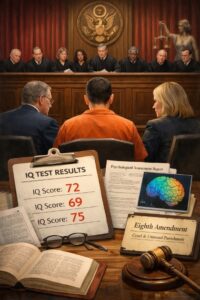
Over twenty years ago, the Supreme Court held that the Eighth Amendment’s prohibition on cruel and unusual punishment forbade states from executing individuals with intellectual disabilities.[i] In Atkins v. Virginia, the Court issued a landmark ruling recognizing that diminished culpability, the absence of meaningful deterrence, and an increased risk of wrongful execution render capital punishment constitutionally impermissible for this class of defendants.[ii] However, Atkins provided little guidance on how courts should determine eligibility, leaving implementation to the states.[iii] By leaving implementation largely to the states, Atkins created space for divergent frameworks, some of which departed from clinical understanding and weakened the very protections the decision sought to establish.
Since Atkins, the Court’s death penalty jurisprudence has highlighted a persistent tension between the law’s demand for administrable precision and the scientific complexity of intellectual disability. Although later decisions narrowed states’ discretion and rejected simplistic approaches, lower courts continued to grapple with the same core inquiry: what exactly constitutes an intellectually disabled person for purposes of death penalty eligibility?[iv] That struggle is especially pronounced in cases involving multiple IQ test scores, particularly when a defendant’s scores fluctuate over time or straddle the traditional cutoff score associated with intellectual disability.[v]
Intellectual disability resists rigid or formulaic classification as it is difficult to conclusively determine. Modern clinical practice relies on a combination of IQ tests, intellectual functioning, adaptive functioning, and developmental onset, each requiring professional judgment.[vi] IQ testing, while relevant, is inherently imprecise as scores fluctuate over time, vary by instrument, and are subject to a recognized standard error of measurement (“SEM”).[vii] Thus, while a score of seventy has served as the traditional benchmark for subaverage intellectual functioning, courts must interpret scores in light of the SEM.[viii] Adaptive functioning is even less susceptible to quantification as it concerns how an individual manages conceptual, social, and practical demands of everyday life.[ix] It encompasses skills such as communication, independent living, judgment, and social reasoning, none of which can be meaningfully captured by a bright-line rule.[x]
Given the complexity of determining intellectual disability, it is unsurprising that courts have struggled to determine how to evaluate various fluctuating IQ scores. That issue was squarely presented in Hamm v. Smith, a case argued before the Supreme Court on December 10, 2025, which asks how courts may weigh multiple IQ test scores when determining intellectual disability under Atkins.[xi] The Defendant, Joseph Clifton Smith (“Mr. Smith”), is an Alabama death row inmate who has been convicted of capital murder and sentenced to death.[xii] Since Mr. Smith’s various IQ scores range between seventy-two and seventy-eight, he has argued in subsequent federal habeas proceedings that he is intellectually disabled and thus constitutionally ineligible for execution.[xiii] Mr. Smith’s case has brought renewed scrutiny as to how courts evaluate multiple IQ test scores, particularly whether a single score within the SEM range may be privileged or whether all scores must be aggregated.
In Atkins, the Court concluded that evolving standards of decency reflected in national consensus and clinical understanding demonstrated that capital punishment was inappropriate for those with intellectual disabilities.[xiv] Specifically, the Court explained that the core justifications for the death penalty collapse in this context. Retribution presumes heightened moral culpability, while deterrence relies on the capacity for deliberation and self-control.[xv] However, the cognitive impairments associated with intellectual disabilities undercut both assumptions.[xvi] Those same impairments informed the Court’s concern that intellectually disabled persons face a heightened risk of The Court’s ruling relied, in part, on contemporary clinical definitions of intellectual disability. Under these definitions, an intellectually disabled individual must show: (1) significant subaverage intellectual functioning; (2) concurrent deficits in adaptive functioning, and (3) the onset of these limitations during their developmental period.[xviii] Although the Court did not mandate strict adherence to this criteria, its reliance on contemporary medical standards implicitly signaled that determinations of intellectual disability must be informed by scientific consensus.[xix]
Twelve years after Atkins’ watershed holding, the Supreme Court limited state discretion in Hall v. Florida by rejecting Florida’s strict IQ cutoff of seventy.[xx] In that case, Florida courts had barred defendants with higher scores from presenting any additional evidence of intellectual disability, ignoring the SEM and foreclosing inquiry into adaptive functioning.[xxi] The Court held that such rigidity was While Hall rejected dispositive score cutoffs and held that individuals with borderline scores must be allowed to present additional evidence, it did not address how to assess those various differing scores. Subsequent decisions only reinforced that states’ implementation of Atkins must remain tethered to contemporary medical understandings and may not rely on nonclinical criteria that narrow constitutional protections.[xxiii] Specifically, the Supreme Court clarified that lower courts may not rely on lay perceptions, perceived adaptive strengths, or prison behavior.[xxiv] Rather, adaptive functioning analysis must focus on deficits and account for structure of prison environments.[xxv]
Now, in the pending Hamm v. Smith case, the Court must decide how courts should assess multiple IQ scores when determining intellectual disability. During oral arguments, the State contended that the lower courts improperly expanded Atkins by failing to aggregate Mr. Smith’s scores when assessing intellectual functioning.[xxvi] While Mr. Smith’s lowest score dips slightly below the traditional subaverage range once the SEM is applied, Alabama maintained that the median should be dispositive.[xxvii]
That argument is incongruent with a core clarification provided in Hall. By placing primary emphasis on IQ testing for determining intellectual functioning, Alabama disregards Hall’s express holding that no single IQ score or numerical formulation can conclusively define intellectual disability. Measurement error is an inherent feature of such testing, and scores may fluctuate for a range of reasons, including health, testing conditions, and the environment.[xxviii] The state essentially contended that Mr. Smith’s highest score should be afforded greater weight, reasoning that IQ tests are more likely to underestimate intelligence than to overestimate it.[xxix] Thus, Alabama’s position risks reinstating the rigid, outcome-determinative use of IQ scores that Hall held unconstitutional.
Additionally, Alabama’s position rested on the premise that IQ has always been the central criterion for intellectual disability, and that states should remain free to determine the “best” evidence of intelligence and make that evidence determinative.[xxx] However, Hall clarified that states do not possess “unfettered discretion” in implementing Atkins, warning that excessive deference risks hollowing out the constitutional prohibition altogether.[xxxi] Here, the state’s approach elevates selective weighing of IQ scores over holistic assessment, and fails to account for the exact dangers of arbitrariness and wrongful execution that Atkins sought to protect.
The Court’s impending decision in Hamm v. Smith has the potential to harmonize fractured lower court approaches and to reaffirm that intellectual disability determinations must remain clinically grounded. Amicus briefs filed in Hamm underscore the national significance of the case’s outcome.[xxxii] Various medical and mental health organizations warn that elevating IQ scores over clinical judgment departs from accepted diagnostic practice and risks unconstitutional execution of intellectually disabled individuals.[xxxiii]
Those concerns are further amplified by the federal government’s posture in this case. The United States appeared at oral arguments in support of Alabama, and recent executive action has signaled an affirmative commitment to encouraging aggressive capital punishment.[xxxiv] Additionally, the implications may be especially significant for Florida. In recent years, Florida has narrowed procedural protections in capital cases, heightening the importance of faithful Atkins enforcement. In 2020, the Florida Supreme Court abandoned proportionality review in death-penalty appeals.[xxxv] Three years later, Florida enacted legislation allowing death sentences based on an eight-juror majority, making it the lowest threshold in the nation.[xxxvi] Given these developments, there may be a correlation between Florida’s reduced safeguards and its recent surge in executions amid a national decline.[xxxvii]
While upholding defendant’s constitutional rights may increase procedural rigor by requiring more robust evidentiary hearings and expert testimony, that burden is a necessary cost.[xxxviii] If Atkins’ protections are diluted by rigid or scientifically unsound standards, the risk of executing individuals constitutionally exempt from capital punishment is substantially heightened. In doing so, the Court could risk narrowing Atkins and emboldening states to adopt increasingly restrictive frameworks rather than exercising constitutional restraint.[xxxix] Thus, Hamm v. Smith’s outcome is not only a matter of life and death for Mr. Smith, but for those whose constitutional protections depend on the continued integrity of the Eighth Amendment in capital cases.
[i] Atkins v. Virginia, 536 U.S. 304, 321 (2002).
[ii] Id. at 318–20.
[iii] See id. at 317 (observing that states may differ in how they determine intellectual disability and delegating implementation to the states).
[iv] See Victoria E. Broderick, Executing Defendants with Intellectual Disabilities: Unconstitutional in Theory, Persistent in Practice, 63 B.C. L. Rev. 301, 301 (2022) (asserting that states have opted for “superficial and oversimplified definitions of intellectual disability.”).
[v] See Hall v. Florida, 572 U.S. 701, 713–15 (2014) (acknowledging that different IQ tests may yield varying results and explaining that an IQ score of seventy functions as a reference point rather than a strict cutoff).
[vi] James W. Ellis, Hall v. Florida: The Supreme Court’s Guidance in Implementing Atkins, 23 Wm. & Mary Bill Rts. J. 383, 388 (2014) (explaining that clinical determinations are based on multiple measures and should be informed by professional judgment and expert evaluation rather than any single test score).
[vii] See Hall, 572 U.S. at 713–15 (2014) (explaining that the SEM reflects the inherent margin of error in IQ testing and that an individual’s true score lies within a statistically defined range rather than at a fixed number); see generally Kendra Cherry, What is an IQ Test?, Verywell Mind (Nov. 13, 2025), https://www.verywellmind.com/how-are-scores-on-iq-tests-calculated-2795584 [https://perma.cc/V396-WJ8N] (explaining that IQ tests assess intellectual functioning by measuring abilities such as reasoning, problem-solving, and comprehension through standardized testing).
[viii] See Atkins, 536 U.S. at 309 n.5 (noting that clinical definitions historically identified subaverage intellectual functioning as an IQ of approximately seventy or below).
[ix] See Hall, 572 U.S. at 710 (referring to deficits in adaptive functioning as the “inability to learn basic skills and adjust behavior to changing circumstances”).
[x] See id. at 723 (recognizing that severe deficits in adaptive functioning can render an individual with an IQ above seventy functionally equivalent to individuals who fall below the traditional IQ threshold).
[xi] Brandon Lowrey, High Court Mulls IQ Standards in Death Penalty Cases, Law 360 (Dec. 10, 2025, at 07:35 EST), https://www.law360.com/articles/2420399/high-court-mulls-iq-standards-in-death-penalty-cases [https://perma.cc/24EN-TQQY].
[xii] Id.
[xiii] See Mark Walsh, Supreme Court Weighs IQ Tests and Other School Records in Key Death Penalty Case, Ed. Wk. (Dec. 11, 2025), https://www.edweek.org/policy-politics/supreme-court-weighs-iq-tests-and-other-school-records-in-key-death-penalty-case/2025/12 [https://perma.cc/8RKY-58R8] (explaining that a writ of habeas corpus is a procedure used to challenge unlawful detention).
[xiv] Hall, 572 U.S. at 304–05, 312 (noting the widespread legislative adoption of such prohibitions and that the practice was uncommon even in states that allowed the execution of intellectually disabled offenders).
[xv] See id. at 319 (explaining that the death penalty must “measurably contribute” to such social purposes).
[xvi] Id. at 318–21 (reasoning that because such individuals often exhibit diminished capacities for reasoning, judgment, and impulse control, they are less able to process consequences or engage in premeditation).
[xvii] Id. at 318–21 (emphasizing that the possibility of wrongful conviction is larger due to their greater suggestibility, limited ability to assist counsel, and difficulty presenting mitigating evidence).
[xviii] Atkins v. Virginia, 536 U.S. 304, 308 n.3 (2002); see also Shei Lyn Johnson, John H. Blume & Brendan Van Winkle, Atkins v. Virginia at Twenty: Still Adaptive Deficits, Still in the Developmental Period, 29 Wash. & Lee J. C.R. & Soc. Just. 55, 96–101 (2022) [hereinafter Still Adaptive Deficits] (explaining that clinical diagnosis requires evidence of subaverage intellectual functioning, clinically defined adaptive deficits, and onset of those impairments during the developmental period).
[xix] See Atkins, 536 U.S. at 308 n.3 (referring to definitions by the American Association on Mental Retardation and the American Psychiatric Association); see also Ellis, supra note vi, at 311 (surveying state standards for determining intellectual disability and finding that all have centered their definitions on the same three criteria).
[xx] Hall, 572 U.S. at 704.
[xxi] Id. at 712 (explaining that Florida’s mandatory cutoff departed from the standard three-part intellectual disability analysis by using an IQ score above seventy to preclude any consideration of adaptive functioning or developmental onset).
[xxii] Id. at 724 (stressing that such defendants must be afforded the opportunity to present additional evidence of an intellectual disability as “[p]ersons facing that most severe sanction”).
[xxiii] See Shei Lyn Johnson, John H. Blume & Brendan Van Winkle, Atkins v. Virginia at Twenty: Still Adaptive Deficits, Still in the Developmental Period, 29 Wash. & Lee J. C.R. & Soc. Just. 55, 67–72 (2022).
[xxiv] Still Adaptive Deficits, supra note xviii, at 55, 100–03 (noting that the Supreme Court invalidated Texas’ reliance on judicially created, nonclinical factors such as a defendant’s perceived adaptive strengths, ability to perform simple tasks, or apparent adjustment to the highly structured prison environment).
[xxv] Id.
[xxvi] Hamm v. Smith Oral Argument Transcript, Sup. Ct. of the U.S. (Dec. 10, 2025), https://www.supremecourt.gov/oral_arguments/argument_transcripts/2025/24-872_b07d.pdf [https://perma.cc/U9Y2-3TCY].
[xxvii] Id. (arguing that the “combined effect of multiple IQ scores reduces error and yields a more accurate estimate.”).
[xxviii] Hall v. Florida, 572 U.S. 701, 712–13 (2014).
[xxix] Id. (stating that tests can underestimate IQ if the test taker intentionally underperforms to avoid the death penalty or is distracted, tired, or sick).
[xxx] Id. (contending that IQ has “always been the primary criterion”).
[xxxi] Hall, 572 U.S. at 702.
[xxxii] Brief for American Psychological Association et al. as Amici Curiae Supporting Respondent, Hamm v. Smith, No. 24-872 (U.S. Sep. 24, 2025) (emphasizing, in a joint filing by the American Psychological Association, the American Psychiatric Association, and the Alabama Psychological Association, that Alabama’s proposed approach would undermine clinical consensus and heighten the risk of executing individuals who meet the constitutional bar under Atkins).
[xxxiii] Ann E. Marimow, Supreme Court Grapples with Death Penalty Case on intellectual Disability, N.Y. Times (Dec. 10, 2025), https://www.nytimes.com/2025/12/10/us/politics/supreme-court-death-penalty-disability.html [https://perma.cc/WBV2-LL27].
[xxxiv] See id. (reporting that the Solicitor General appeared as amicus curiae at oral arguments urging the Court to rule in Alabama’s favor); see also Exec. Order No. 14164, 90 Fed. Reg. 8463 (Jan. 20, 2025) (directing the Department of Justice to pursue capital punishment more vigorously and to remove internal restraints that had limited the federal government’s use of the death penalty).
[xxxv] Florida, Death Penalty Info. Ctr., https://deathpenaltyinfo.org/state-and-federal-info/state-by-state/florida [https://perma.cc/67KG-U8FG] (last visited Feb. 11, 2026).
[xxxvi] Hayley Bedard, New Report Examines Florida’s Unprecedented Execution Pace and Trends in 2025, Death Penalty Info. Ctr. (Jan. 7, 2026), https://deathpenaltyinfo.org/new-report-examines-floridas-unprecedented-execution-pace-and-trends-in-2025 [https://perma.cc/4XAU-RR8D].
[xxxvii] Id. (noting that Florida carried out about forty percent of executions in 2025 and that four of those individuals did not have adequate legal representation).
[xxxviii] See Walsh, supra note xiii (noting that enforcement of Atkins has increased the number of evidentiary hearings and expert evaluations required in capital cases, thereby adding procedural demands to ensure constitutional compliance).
[xxxix] See Lowrey, supra note xi (observing that a group of nineteen states filed an amicus brief supporting Alabama’s position and that the federal government also backed Alabama’s position).