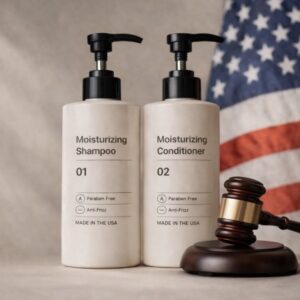
“Made in the USA” has long been more than a label. It is a promise of quality, ethics, and authenticity that influences how consumers shop and how brands price their products. In the beauty industry, where ingredient sourcing is increasingly global but branding remains deeply domestic, that representation is now under scrutiny.[i] Recent federal lawsuits against major haircare brands challenge whether unqualified “Made in the USA” claims mislead consumers when products rely on foreign sourced ingredients. What was once treated as harmless marketing language is quickly becoming a source of legal liability.[ii]
The legal stakes of origin claims have risen alongside renewed political and regulatory emphasis on domestic manufacturing. In July 2025, the Trump Administration formally proclaimed “Made in America Week,” framing U.S. origin as a matter of national integrity and consumer trust rather than mere branding.[iii] The proclamation emphasized that Americans want to support domestic workers and industries, and it expressly directed the Federal Trade Commission (“FTC”) to crack down on sellers who falsely claim their products are “Made in the U.S.A.”[iv] In doing so, the Administration made clear that “Made in the USA” is not a slogan or aspirational theme, but a representation that carries economic and legal meaning.[v]
That directive fits squarely within the FTC’s existing mandate. The FTC is responsible for protecting consumers from unfair or deceptive practices in the marketplace.[vi] Under the FTC Act, the agency has the authority to take enforcement action against false or misleading advertising, including representations that a product is of U.S. origin.[vii] To give substance to that authority, the FTC promulgated the Made in USA Labeling Rule, which permits an unqualified “Made in the USA” claim only when a product is “all or virtually all” made in the United States.[viii] This is not a flexible standard. All significant parts, processing, and labor must be domestic, and only negligible foreign content is allowed.[ix]
Crucially, the FTC’s framework is grounded in consumer perception.[x] The inquiry is not simply where final assembly occurs, but what an unqualified origin claim communicates to a reasonable consumer.[xi] When a product bears a prominent “Made in the USA” label, consumers are entitled to assume that the product’s essential components and value-driving ingredients are domestically sourced.[xii] That assumption now lies at the center of a growing wave of private consumer litigation.[xiii]
Recent federal decisions out of Illinois and California illustrate how courts are treating these claims. In both cases, consumers alleged that haircare companies used unqualified “Made in the USA” labels to signal quality and influence purchasing decisions, even though the products allegedly relied on foreign-sourced ingredients that were central to their formulation and marketing.[xiv] In the Illinois action against John Paul Mitchell Systems, plaintiffs challenged Tea Tree branded products marketed as American-made despite alleged reliance on ingredients such as tea tree oil and jojoba, which are not produced domestically in commercial quantities.[xv] According to the plaintiffs, the origin claim conveyed a narrative of American-made quality that the products’ sourcing could not support.[xvi]
In California, consumers brought suit against It’s a New 10, LLC over haircare products labeled “Made in the USA” while allegedly containing multiple foreign-derived ingredients, including hydrolyzed silk, that were emphasized as key, functional components.[xvii] In both cases, the alleged deception was not simply the presence of foreign ingredients. Rather, these unqualified domestic origin claims promoted a broader narrative of American identity, integrity, and value that consumers plausibly relied on when choosing between products.[xviii]
The courts’ responses reflect a clear doctrinal shift. Rather than dismissing these claims as immaterial or speculative, both courts treated “Made in the USA” as a representation capable of influencing consumer behavior and supporting economic injury. In the John Paul Mitchell Systems case, the court accepted allegations that consumers paid a price premium or selected the products over competitors because of the domestic-origin claim.[xix] Under Illinois consumer fraud law, those allegations were sufficient at the pleading stage to establish actual damages under a benefit-of-the-bargain theory.[xx] By crediting a price-premium theory, the court acknowledged that origin claims can be tied directly to product value, not merely brand aesthetics.[xxi]
The California court went further by engaging directly with the state’s statutory “Made in the USA” framework. California law permits limited foreign content only if it falls below strict percentage thresholds tied to wholesale value and, in some cases, only if the component cannot be sourced domestically.[xxii] In It’s a New 10, LLC, the court emphasized that plaintiffs are not required to plead precise cost percentages at the outset, particularly where sourcing information lies within the manufacturer’s exclusive control.[xxiii] Where foreign ingredients are featured in the product name, highlighted in marketing materials, and positioned as central to performance, it is reasonable to infer that those ingredients are more than de minimis. In that context, an unqualified domestic-origin claim cannot be brushed aside as harmless shorthand.
These cases illustrate a broader truth about modern consumer markets: a product’s origin has become part of the product itself.[xxiv] Just as ingredient transparency shapes consumer trust, so too does the narrative of where a product is made and what values it represents. The more a brand elevates domestic identity while relying on globally sourced inputs, the more legally significant that narrative becomes. Courts are increasingly unwilling to allow companies to enjoy the commercial benefits of “Made in the USA” branding without ensuring that the claim aligns with reality.[xxv]
That scrutiny is reinforced by enforcement beyond the FTC’s labeling rule. Industry-specific statutes impose country-of-origin requirements for textiles, wool, fur, and automobiles.[xxvi] The Buy American Act governs domestic preference in government procurement.[xxvii] Competitors may challenge deceptive origin claims under the Lanham Act, which allows for injunctive relief, damages, and corrective advertising upon a showing of competitive harm.[xxviii] Meanwhile, U.S. Customs and Border Protection applies a “substantial transformation” test under the Tariff Act to determine country of origin for imported goods, but satisfying that test that does not automatically meet the FTC’s more stringent “all or virtually all” standard for domestic marketing claims.[xxix]
As tariffs and trade policy return to the forefront of economic discourse, businesses may be more tempted than ever to lean into “Made in the USA” branding.[xxx] Yet, recent litigation demonstrates that compliance with origin laws is not optional. Beauty brands making unverified domestic-origin claims face significant legal and reputational risks, including FTC investigations, financial penalties, corrective advertising, and public enforcement actions.[xxxi] In an industry shaped by social media and influencer scrutiny, the reputational harm can spread quickly.[xxxii]
Ultimately, the rise of “Made in the USA” litigation reflects a recalibration of consumer protection law. Courts are not hostile to branding, storytelling, or differentiation. But they are drawing firmer lines between narrative and misrepresentation. When origin becomes a central feature of brand identity, accuracy matters.[xxxiii] In this environment, “Made in the USA” is no longer just a marketing choice. It is a legal claim, and one that carries real consequences for brands operating in a global supply chain.[xxxiv]
[i] See Francis M., Transparent Sourcing: Building Trust in Beauty Brands, Enyi (Apr. 14, 2025, at 12:19 PM), https://enyi.app/transparent-sourcing-building-trust-in-beauty-brands/ [https://perma.cc/X7X7-2JSX] (noting that beauty brands frequently rely on “natural” or “clean” marketing while providing little clarity on global ingredient sourcing or processing, even as consumers increasingly demand transparency).
[ii] See Daniel N. Anziska & Ryan Last, Label With Care: FTC Intensifies Focus on Misleading “Made in USA” Claims, Troutman Pepper Locke (July 21, 2025), https://www.troutman.com/insights/label-with-care-ftc-intensifies-focus-on-misleading-made-in-usa-claims/ [https://perma.cc/H3D8-ZKNN] (illustrating that “Made in the USA” marketing claims can now expose both manufacturers and online marketplaces to regulatory liability).
[iii] Proclamation No. 10961, 90 Fed. Reg. 36371 (July 25, 2025).
[iv] Id.
[v] Id.
[vi] 16 C.F.R. § 323.2 (2026).
[vii] Complying with the Made in USA Standard, Fed. Trade Comm’n (July 2024), https://www.ftc.gov/business-guidance/resources/complying-made-usa-standard [https://perma.cc/3DLH-PJ4X] [hereinafter FTC MUSA Guidance].
[viii] See 16 C.F.R. § 323.2 (2026).
[ix] FTC MUSA Guidance, supra note vii.
[x] Id.
[xi] Id.
[xii] Id.
[xiii] Id.
[xiv] See Corona v. It’s a New 10, LLC, No. 25CV377-GPC(BLM), 2025 U.S. Dist. LEXIS 595095, at *2 (S.D. Cal. Dec. 9, 2025); see also Lauer v. John Paul Mitchell Sys., No. 25 C 02438, 2025 U.S. Dist. LEXIS 572312, at 2 (N.D. Ill. Dec. 4, 2025) (alleging that defendant capitalized on consumer preference for American-made products).
[xv] See John Paul Mitchell Sys., 2025 U.S. Dist. LEXIS 572312, at 2.
[xvi] Id.
[xvii] It’s a New 10, LLC, 2025 U.S. Dist. LEXIS 595095, at *2.
[xviii] See John Paul Mitchell Sys., 2025 U.S. Dist. LEXIS 572312, at 9.
[xix] See id.
[xx] Id. at 8.
[xxi] Id.
[xxii] See It’s a New 10, LLC, 2025 U.S. Dist. LEXIS 595095, at *12.
[xxiii] Id.
[xxiv] See Francis, supra note i (recognizing that consumers increasingly evaluate products based on where and how they are made, not just on performance or packaging).
[xxv] See Emily Madoff, “Made In the USA” Labeling Cases Surge, Wolf Popper 1, 2 (June 20, 2025), https://www.wolfpopper.com/siteFiles/News/Made_in_the_USA.pdf [https://perma.cc/KY3X-SUQS] (demonstrating that repeated misuse of “Made in the USA” branding can result in civil penalties, court-ordered compliance measures, and heightened regulatory oversight).
[xxvi] Id. at 4.
[xxvii] Id.
[xxviii] Id.
[xxix] FTC MUSA Guidance, supra note vii (clarifying that CBP’s country-of-origin determinations focus on import marking requirements, while the FTC independently evaluates whether domestic-origin marketing claims would mislead consumers).
[xxx] Terry Lane, Price Trumps ‘Made In USA’ Labels As Tariffs Affect Consumer Choice, Investopedia (Aug. 12, 2025, at 03:43 PM EDT), https://www.investopedia.com/are-tariffs-lowering-support-for-made-in-u-s-a-labels-11789260 [https://perma.cc/W5RG-CBUV] (recognizing that heightened trade tensions and tariff-related costs may incentivize businesses to rely more heavily on domestic-origin marketing).
[xxxi] Cassandra Stern, Behind the Label: What “Made in USA” Really Means for Beauty Brands, CosmeticsDesign (May 20, 2025, at 15:25 GMT), https://www.cosmeticsdesign.com/Article/2025/05/20/what-made-in-usa-really-means-for-beauty-brands [https://perma.cc/3E62-UGQQ].
[xxxii] See Deinfluencing: Why Transparency Is the Future of Influence, Ansira (Oct. 22, 2025), https://ansira.com/blog/deinfluencing/ [https://perma.cc/C4JY-7RMK] (recognizing that social media accelerates the spread of reputational harm when product claims are publicly challenged).
[xxxiii] See Julie Waldow, The Limitations of ‘Made in America’ Labels, ModernRetail (Feb. 5, 2025), https://www.modernretail.co/marketing/the-limitations-of-made-in-america-labels/ [https://perma.cc/UE6C-MNQ4] (noting that “assembled in America” more accurately reflects modern global supply chains and avoids the ambiguity and potential deceptiveness of unqualified “Made in the USA” claims).
[xxxiv] See id. (warning that ambiguous “Made in the USA” labeling can mislead consumers and expose brands to regulatory scrutiny under FTC guidance).