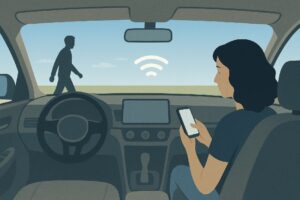
Technology continues to rapidly advance. As a result, vehicles with autonomous systems are more commonplace on Florida roadways. These autonomous vehicles (“AVs”) have systems that control everything: from steering, lane changing, to pedal control. In fact, soon, newer models will no longer require an individual to stay behind the wheel or keep attention on the road.[i] This rapid development of AV technology will force courts and legislatures to confront difficult questions about liability and culpability regarding the new generation of AVs. A particular consideration is when an intoxicated individual climbs into their new AV, engages the autonomous system, and the system fails, causing the death of another. Or alternatively, where an individual recklessly engages a system that they know is faulty, leading to the death of another. These scenarios put in question whether these individuals could be charged with Driving Under the Influence (“DUI”) Manslaughter or Vehicular Homicide.
In Florida, a DUI Manslaughter conviction arises when an intoxicated person is either driving or in “actual physical control” of a vehicle that causes the death of another human being.[ii] Similarly, a Vehicular Homicide conviction requires that the death of an individual occur as a result of another’s reckless operation of a vehicle.[iii] Both offenses presuppose some level of human operation or control of the vehicle. This is where the difficulty arises: If the AV is making all decisions on the road, then the individual is not likely in “control” or “operating” the vehicle, within the meaning of these statutes. However, Florida courts have historically interpreted “actual physical control” and “operation” very broadly and, as a fact-sensitive inquiry, it raises the concern that the act of engaging the autonomous system may constitute sufficient control or operation.
In Baltrus v. State, the Fourth District Court of Appeal found that an intoxicated individual holding his car keys constituted sufficient “actual physical control” of the vehicle to be charged with DUI.[iv] Although AVs often have remote start features or voice commands rather than actual physical keys, this new technology directly parallels the function of a key and can logically be considered one for purposes of DUI Manslaughter.[v] Similarly, in Lenhart v. Federated National Insurance Co., the court explained that “the word ‘operation’ denotes the manipulation of the car’s controls in order to propel it as a vehicle.”[vi] Drivers who engage an autonomous system do not directly control the car, but it can be understood that the act of engaging the system manipulates “the car’s controls in order to propel it as a vehicle.” This liberal understanding of control and operation further places into question whether an individual who engages an AV system, through an application or with physical buttons, would satisfy the necessary elements for the criminal charges of DUI Manslaughter or Vehicular Homicide.
The Florida Legislature seemingly resolved this conflict with Florida Statute section 316.85, which governs AVs. This statute sets forth that, “[f]or purposes of this chapter, unless the context otherwise requires, the automated driving system, when engaged, shall be deemed to be the operator of an autonomous vehicle, regardless of whether a person is physically present in the vehicle while the vehicle is operating with the automated driving system engaged.”[vii] At first glance, the statute would provide a complete shield against DUI Manslaughter when an AV system is engaged because the AV system “shall be deemed the operator.”[viii] This is further emphasized by the fact that the legislature confined the applicability of this statute to Chapter 316, which contains DUI Manslaughter.[ix] However, the intentional use of the phrase “unless the context otherwise requires” creates an exception, likely to be implemented by courts, depending on the facts before it. This signifies that the legislature foresaw situations where an individual should be held criminally culpable. Yet, it is unclear what context would lead to such a finding. Certainly, if courts continue to implement a liberal understanding of “actual physical control” for purposes of DUI Manslaughter, then section 316.85 would, in effect, be irrelevant as a shield for criminal culpability.
Further, the statute also states that, “[u]nless otherwise provided by law, applicable traffic or motor vehicle laws of this state may not be construed to: [p]rohibit the automated driving system from being deemed the operator of an autonomous vehicle operating with the automated driving system engaged.”[x] This section in the statute is not expressly restrained to Chapter 316 as the prior section was, but instead it creates a vague extension of applicability to “traffic or motor vehicle laws.” Seemingly, Vehicular Homicide would fall squarely within the category of motor vehicle laws, given that it was the legislature’s intent “to cover the hiatus between section 782.071 manslaughter and the traffic offense of reckless driving [in] section 316.029.”[xi] Contrastingly, it could be argued and understood that Vehicular Homicide is a criminal statute that goes beyond “traffic or motor vehicle laws.” Particularly because the legislature could have added a comma and included criminal law in the list, if they so intended.[xii]
Ultimately, the solutions posed by Florida Statute section 316.85 create confusion as to its applicability and scope, specifically for the criminal charges of DUI Manslaughter and Vehicular Homicide. On its face, it would seem that the legislature intends to encourage the use of AVs and created 316.85 to serve as a shield for individuals. However, when looking at Florida’s caselaw and the unexplained exceptions within 316.85, it becomes unclear if the legislature intended to shield AV owners from civil liability, criminal culpability, or both.
As the use of AVs increase, and inevitably the deadly accidents that will follow, courts should utilize public policy, traditional legislative intent, and the principles of justice to reach solutions for these impending cases. Considering the situation of an intoxicated individual who engaged their AV system and is accused of DUI Manslaughter, public policy indicates that the safest option for intoxicated individuals would be to avoid driving, and typically, engaging an AV system does just that. Yet, courts should continue applying a case-by-case analysis, as they have prior to AVs, because the “context [may] otherwise require[].”[xiii] Context that calls for criminal culpability would likely involve some semblance of retained control over the vehicle after engaging the AV system, but this does not lend itself to a brightline rule given the complexities of “control.”
Further, when considering Vehicular Homicide, public policy favors less leniency, given the recklessness element required for such a conviction.[xiv] If an individual, without any regard for the lives of others, engages a faulty system, or commands the AV system to break traffic laws, then the recklessness element would be easily satisfied. In this circumstance, public policy and the principles of justice indicate that allowing such an individual to escape criminal culpability would encourage and affirm those behaviors.
Ultimately, the Florida Legislature has the authority to adapt the law to the modern realities, ensuring that accountability keeps pace with AV technology. The legislature should seek to amend and clarify section 316.85 to avoid confusion and keep individuals from fully escaping criminal culpability, particularly when they have acted recklessly. Until such reforms are enacted, defendants in AVs may find themselves in a gray area of criminal law, where human culpability is uncertain, and where victims’ families are denied justice.
[i] See Dustin Dorsey, Silicon Valley AI Company Unveils First Fully Autonomous Car You Can Buy: Here’s a Look, ABC News (Aug. 13, 2025), https://abc7news.com/post/tensor-robocar-silicon-valley-ai-company-unveils-first-fully-autonomous-vehicle-available-purchase-consumers/17527411/ [https://perma.cc/7S7D-2JNF ] (“You can take the wheel itself and drive it just like any other car. But when you’re ready, . . . you can sit back, relax and let the car handle the travel for you.”); see also Sean Tucker, Self-Driving Cars: Everything You Need To Know, Kelley Blue Book (May 21, 2025, 8:00AM), https://www.kbb.com/car-advice/self-driving-cars/ [https://perma.cc/LX5X-8XQ2] (explaining the different levels of autonomous systems).
[ii] See Fla. Stat. § 316.193(3)(c)(3) (2025).
[iii] See Fla. Stat. § 782.071 (2025).
[iv] See Baltrus v. State, 571 So. 2d 75, 76 (Fla. Dist. Ct. App. 1990).
[v] See B. Padmaja, Exploration of Issues, Challenges and Latest Developments in Autonomous Cars, 10 J. Big Data 1, 8 (2023) (“Unlike ordinary cars, autonomous cars do not require keys, but they operate with finger prints, retina scan and voice recognition software. It is also equipped with finger-print enabled door-lock system to provide more security.”).
[vi] See Lenhart v. Federated Nat’l Ins. Co., 950 So. 2d 454, 459 (Fla. Dist. Ct. App. 2007).
[vii] Fla. Stat. § 316.85(3)(a) (2025).
[viii] See id.
[ix] Compare Fla. Stat. § 316.193(3)(c)(3) (criminalizing the act of drinking and driving if it results in the death of another in Chapter 316), with Fla. Stat. § 316.85(3)(a) (limiting scope to Chapter 316, “unless context otherwise requires”).
[x] Fla. Stat. § 316.85(3)(b).
[xi] McCreary v. State, 371 So. 2d 1024, 1027 (Fla. 1979).
[xii] Cf. Understanding Expressio Unis Est Exclusio Alte: Legal Implications and Insights, USLegal, https://legal-resources.uslegalforms.com/e/expressio-unis-est-exclusio-alte [https://perma.cc/M9JF-Q683] (last visited Sep. 22, 2025) (“Expressio unis est exclusio alterius . . . suggests that when a law, contract, or legal document explicitly mentions certain items, it implies that other items not mentioned are excluded from consideration.”).
[xiii] See Fla. Stat. § 316.85(3)(a).
[xiv] Fla. Stat. § 782.071 (2025) (requiring “recklessness” for a vehicular homicide conviction).