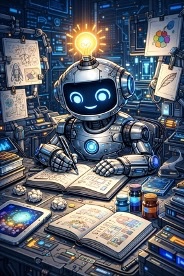
With just a few words entered into ChatGPT, a painting can materialize, raising the question of whether artificial intelligence (“AI”) is the author or merely a tool. In March of 2025, the U.S. Court of Appeals for the District of Columbia answered that an author must be human.[i] The holding arose in Thaler v. Perlmutter, where Dr. Stephen Thaler (“Thaler”) appealed the denial of his copyright application for an AI created image titled A Recent Entrance to Paradise.[ii] The Copyright Office refused to register the image because Thaler’s application listed his machine as the author. Thaler argued that authorship was vested in the creativity machine he built and owns. However, the district court was unpersuaded that the machine could be recognized as an independent author.[iii]
While the Copyright Act of 1976 does not expressly require authors to be human, the court found several statutory provisions that support its conclusion.[iv] Most notably, the Copyright Act’s provision vesting ownership initially in the author implies the existence of a human agent capable of holding rights.[v] The court also pointed to the statute’s copyright term which lasts seventy years after the author’s death as further evidence of the assumption that authors are human, as machines neither die nor leave heirs entitled to termination rights.[vi] Finally, the court emphasized provisions referring to an author’s domicile, national identity, and intent, all of which presuppose human attributes.[vii]
Despite this reasoning, Thaler continued to challenge the human-authorship requirement. Following the D.C. Circuit affirming the denial of Thaler’s copyright application, he petitioned the Supreme Court of the United States for certiorari.[viii] He argues that as the owner and programmer of the AI system, he should hold the copyright either under the work-for-hire doctrine or through the principle of accession.[ix] Thaler rejects the government’s position against non-human authorship, noting that corporations and governments are treated as authors for copyright purposes.[x] In his view, the Copyright Office’s refusal to register AI-generated works amounts to impermissibly “policing methods of creation.”[xi]
Given the continuing influx of AI-generated art and content, Thaler’s position presents a significant and unresolved legal issue. AI is now used to create films for major corporations such as Netflix, as well as everyday advertisements and content across social media platforms. The U.S. Copyright Office has issued guidance clarifying that only human authors may claim copyright protection for AI-assisted works, and only to the extent that the work reflects the author’s own control and creative expression.[xii] The Copyright Office declines to consider AI systems as authors because they are trained on vast amounts of human-created content and therefore lack independent creative agency.[xiii]
The legal challenges are not limited to authorship alone; they also encompass the way AI systems are trained since the use of copyrighted material in training datasets creates its own set of copyright conflicts. The legal implications of AI-generated content have already reached major players with TikTok, The New York Times, Getty Images, and Universal Music all entangled in copyright disputes.[xiv] In Universal Music’s case against Anthropic, a federal judge in San Francisco found that Anthropic had acquired some of its training data in a manner that constituted piracy, resulting in one of the largest settlements in the history of U.S. copyright litigation.[xv]
Although Universal Music’s case against Anthropic focuses on the opposite end of the creative process, it operates alongside Thaler by applying the same human-authorship principle to a different stage of AI creation. Under Thaler, AI outputs fall outside the scope of copyright protection, whereas Universal Music illustrates how the use of copyrighted works in training AI systems may give rise to infringement liability. Taken together, these cases demonstrate how copyright law treats AI differently at each stage of creation. AI-generated works are denied protection, but developers remain accountable for how human authored works are used to train those systems.[xvi]
Beyond litigation, these disputes have forced federal institutions to confront the limits of existing copyright doctrine. The U.S. Copyright Office evaluates AI-generated works on a case-by-case basis, allowing applicants to appeal denials. This appeals process means that as AI-generated content continues to grow, courts will repeatedly confront unresolved questions about authorship and ownership until the Supreme Court intervenes.[xvii]
Although the government urges the Supreme Court to reject Thaler’s appeal, the rapid expansion of AI technology makes clear that questions of authorship and ownership cannot be ignored. If the Supreme Court denies Thaler’s petition, Congress may be compelled to amend or clarify portions of the Copyright Act of 1976. Without legislative guidance, uncertainty surrounding AI-generated arts and other works will persist, leaving creators, corporations, and courts without clear rules for navigating this new creative landscape.
[i] Jayashreee Mitra, No Copyright Protection for AI-Assisted Creations: Thaler v. Perlmutter, Cartlton Fields (Mar. 26, 2025), https://www.carltonfields.com/insights/publications/2025/no-copyright-protection-for-ai-assisted-creations-thaler-v-perlmutter [https://perma.cc/F69W-9THE].
[ii] Ivan Moreno, AI Image Is Not Copyrightable, Gov’t Tells High Court, Law 360 (Jan. 26, 2026), https://www.law360.com/technology/articles/2434087/ai-image-is-not-copyrightable-gov-t-tells-high-court [https://perma.cc/8NMM-HF5B].
[iii] Mitra, supra note i.
[iv] Moreno, supra note ii.
[v] Christopher Zirpoli, Cong. Rsch. Serv., LSB10922, Generative Artificial Intelligence and Copyright Law 2 (July 18, 2025); see also 17 U.S.C. § 201(a) (“Copyright in a work protected under this title vests initially in the author or authors of the work. The authors of a joint work are coowners of copyright in the work.”).
[vi] See 17 U.S.C. § 302(a) (“Copyright in a work created on or after January 1, 1978, subsists from its creation and, except as provided by the following subsections, endures for a term consisting of the life of the author and 70 years after the author’s death.”).
[vii] See 17 U.S.C. § 104(b)(1) (“[O]ne or more of the authors is a national or domiciliary of the United States, or is a national, domiciliary, or sovereign authority of a treaty party, or is a stateless person, wherever that person may be domiciled . . . .”).
[viii] Petition for Writ of Certiorari at 6, Stephen Thaler v. Shira Perlmutter, No. 25-449 (U.S. Oct. 9, 2025).
[ix] Moreno, supra note ii.
[x] Id.
[xi] See Kyle Jahner, High Court Shouldn’t Weigh AI’s Copyright Author Status US Says, Bloomberg Law (Jan. 26, 2026), https://news.bloomberglaw.com/daily-labor-report/high-court-shouldnt-weigh-ais-copyright-author-status-us-says [https://perma.cc/8Z83-KTB5].
[xii] See Ellen Glover, AI-Generated Content and Copyright Law: What We Know, Builtin (Jan. 20, 2026), https://builtin.com/artificial-intelligence/ai-copyright [https://perma.cc/RZ4R-Q7XN].
[xiii] Id.
[xiv] Id.
[xv] Id.
[xvi] See Chloe Veltman, Anthropic settles with authors in first-of-its-kind AI copyright infringement lawsuit, NPR (Sep. 5, 2025), https://www.npr.org/2025/09/05/nx-s1-5529404/anthropic-settlement-authors-copyright-ai [https://perma.cc/F3CZ-LFP5] (stating that AI companies can use copyrighted works to train their models if they obtain the works legally).
[xvii] U.S. Copyright Office, Circular 20: Request for Reconsideration, https://www.copyright.gov/circs/circ20.pdf [https://perma.cc/6AN2-AJKE] (last visited Mar. 2, 2026).