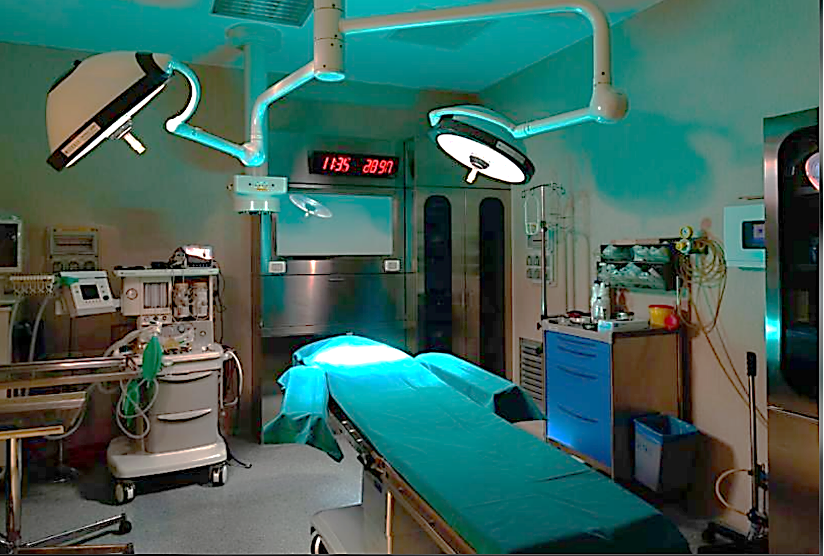
During an arduous and painful labor, Cherise Doyley (“Doyley”) was compelled to defend her reproductive autonomy before a court while bringing new life into the world.[i] Her hearing took place at her hospital bedside, on a tablet screen, as her contractions continued.[ii] Doyley’s case exposes a constitutional contradiction that Florida law has yet to resolve: when a competent patient in labor refuses a cesarean section, who decides: the patient or the state? Doyley, a trained doula and mother of three, had undergone three prior cesarean sections, with difficult recoveries that included infection and hemorrhage.[iii] She understood that the risks of a vaginal birth after cesarean (“VBAC”) include uterine rupture, which occurs in approximately 0.15% to 2.3% of cases.[iv] She clearly expressed to hospital staff that she would accept surgery in a genuine emergency but wished to attempt a vaginal delivery within safe limits.[v] Twelve hours into her labor, a nurse wheeled a tablet into her room.[vi] The tablet screen revealed a judge, several attorneys, and hospital staff that were gathered for an emergency virtual hearing that would last approximately three hours during Doyley’s active labor. [vii]
Throughout the hearing, Doyley repeatedly asserted that she was competent, that her baby was stable, and that the decision about her body was hers to make. She asked for counsel, but the judge told her that there is no constitutional right to an attorney in such proceedings.[viii] The federal lawsuit Doyley filed on September 8, 2026, alleges that hospital staff falsely told the court she was suicidal, even though a hospital psychiatrist had evaluated her only hours earlier as “not suicidal and capable of making her own medical decisions.”[ix] The complaint further alleges that the hospital distorted her statement that, if forced to choose between her own life and the life of the fetus, she would choose to live so that she could care for her three other children.[x] According to the complaint, the hospital presented Doyley’s statement to the judge as indifference to whether her baby survived.[xi]
Ultimately, the judge allowed Doyley to continue laboring but authorized a cesarean if “certain emergency conditions” arose such as terminal bradycardia, signs of uterine rupture, or a persistent category 3 fetal heart tracing. [xii] That night, the hospital reported the fetal heart rate as terminal bradycardia and transferred Doyley to the operating room.[xiii] Doyley’s current lawsuit alleges that the tracing actually showed a low heart rate episode that was not terminal and did not meet the emergency threshold in the court’s order.[xiv] The legal core of the case is a question that has long troubled courts: when pregnancy binds one person’s body to a potential life, does her constitutional right to control that body diminish?
Currently, Florida has no statute that expressly authorizes court ordered cesarean sections. The practice has instead grown out of constitutional doctrine, common law precedent, and procedural gaps that together carve pregnancy out of ordinary constitutional protection. The leading Florida authority for compelled obstetric intervention is Pemberton v. Tallahassee Memorial Regional Center.[xv] After a state court ordered Laura Pemberton to undergo a cesarean against her wishes, she challenged the order in federal court and lost.[xvi] The district court concluded that her constitutional rights did not outweigh Florida’s interest in preserving the life of the unborn child.[xvii] The court’s decision quietly converted a prohibitive state power —the ability to restrict abortion—into an affirmative one: the power to compel surgery on a patient’s body.
Unlike the federal Constitution, Florida’s constitution expressly protects the right to privacy. Article I, Section 23 provides that “[e]very natural person has the right to be let alone and free from governmental intrusion into the person’s private life.”[xviii] In In re Dubreuil, the Florida Supreme Court set out a procedure for cases in which a patient’s refusal of treatment may implicate a compelling state interest: the health care provider notifies the State Attorney, who decides whether to seek a court order.[xix] Building on that framework, the First District Court of Appeal held in Burton v. State that the state may override a pregnant woman’s right to refuse medical intervention only when its compelling interest is sufficient to outweigh her constitutional right to control her person and only through means narrowly tailored in the least intrusive manner possible.[xx]
When the state seeks to compel treatment over a competent patient’s refusal, it must satisfy strict scrutiny. Burton itself shows how little that standard protects a patient in real time. A Leon County circuit court confined Samantha Burton to the hospital until delivery and ordered her to comply with her physician’s orders, including bed rest, medication to postpone labor and prevent infection, and the eventual performance of a cesarean section.[xxi] The First District reversed and held that the state’s interest becomes compelling only after a finding of fetal viability, which the trial court failed to establish before overriding Burton’s rights.[xxii] However, the ruling came too late. Despite medical intervention, Burton’s fetus was stillborn and she was vindicated only after the harm was complete.[xxiii]
Historically, court ordered medical intervention has shown to consist of a racial disparity. Doyley verbally expressed her discomfort and concern regarding the quality of her medical care and representation because she only Black person present in her hearing with the Court.[xxiv] Her requests for a patient advocate were denied, and an armed security guard was stationed outside her room to keep her from leaving.[xxv] The lawsuit further alleges that her epidural left her physically limited and that staff conditioned help with repositioning on her consent to surgery.
The racial disparity in these cases is well documented. A 1987 study in the New England Journal of Medicine found that 81% of the women subjected to court ordered obstetric interventions were women of color.[xxvi] Doyley’s experience was not isolated. In 2023, Brianna Bennett faced nearly the same process at Tallahassee Memorial HealthCare: a virtual hearing conducted during labor, with neither lawyer nor advocate present, which resulted in a court ordered cesarean she vehemently expressed she did not want.[xxvii]
Both cases follow Florida’s gradual embrace of fetal personhood, the legal concept that a fetus possesses the same rights as an already born human being from the moment of conception. . Florida law already defines an “unborn child” as “a member of the species Homo sapiens, at any stage of development, who is carried in the womb.”[xxviii] Reproductive justice organizations warn that such laws build the legal infrastructure for removing pregnant people’s control over their own bodies and health decisions.[xxix] Doyley’s federal lawsuit alleges violations of her constitutional rights to bodily integrity and due process, along with racial discrimination and civil conspiracy, and seeks compensatory and punitive damages.[xxx] Regardless of the outcome, the case exposes a contradiction at the center of Florida’s approach: a constitutional framework that expressly protects privacy and demands strict scrutiny, yet an obstetric intervention practice that denies the patient counsel, a challenge to the state’s evidence, and meaningful appellate review before the surgery is over.
The answer to “who decides?” is uncomfortable and seemingly unsettled. As the Illinois Appellate Court held in In re Baby Boy Doe, a pregnant woman’s right to refuse invasive medical treatment is not diminished during pregnancy.[xxxi] Florida’s express privacy right should offer even stronger protection. Court ordered cesarians are not grounded in statutory authorization but arise from judicial precedent that has treated pregnancy as an exception to strict scrutiny review. This practice has enabled a procedural vacuum where state attorneys and hospital staff are able to confront an unrepresented expectant mother in active labor. Doyley entered the hospital to give birth and instead found herself before a judge in a proceeding over her own body. The judicial precedent that led to Doyley’s hearing rest on a fundamental contradiction: they invoke the argument of protecting of fetal life while disregarding the bodily autonomy of the woman who makes fetal life possible. A doctrine built on such a contradiction cannot fulfill the promise of Florida’s express right to privacy nor can it uphold the very value it claims to protect. When the question is who decides what happens to a woman’s body during childbirth, Florida’s Constitutional promise of privacy provides an answer: the woman herself.
[i] See Amy Yurkanin, She Was in Labor at a Florida Hospital. Then She Was in Zoom Court for Refusing a C-Section., Propublica (Mar. 20, 2026), https://www.propublica.org/article/florida-court-hearing-c-section [https://perma.cc/4RA9-GRCK] (describing the virtual court hearing Doyley attended from her hospital bed during labor after refusing a cesarean section).
[ii] See Amy Yurkanin & Sarahbeth Maney, They Didn’t Want to Have C-Sections. A Judge Would Decide How They Gave Birth., Propublica A (Mar. 14, 2026), https://www.propublica.org/article/florida-court-ordered-c-sections [https://perma.cc/3WMS-Z6ZP] (describing Florida hearings, held during labor, in which judges decided whether women would be compelled to undergo cesarean sections).
[iii] Id. (reporting that one of Doyley’s three prior cesarean sections “resulted in a hemorrhage”).
[iv] Id. (reporting that studies found that “0.15% to 2.3%” of labors after a prior cesarean section resulted in uterine rupture).
[v] See Tiffany Salameh & Jenese Harris, Jacksonville Mother Files Lawsuit Over Court-Ordered C-Section, Alleges UF Health Falsely Reported She Was Suicidal, News4Jax (Sept. 9, 2026), https://www.news4jax.com/news/local/2026/09/09/jacksonville-mother-files-lawsuit-over-court-ordered-c-section-alleges-uf-health-falsely-reported-she-was-suicidal/ [https://perma.cc/S886-T5R8] (reporting Doyley’s position that she would choose surgery to preserve her own life in a true emergency).
[vi] See Yurkanin, supra note i (describing how the hearing was brought into Doyley’s hospital room during labor).
[vii] See Yurkanin & Maney, supra note ii (describing “the beginning of what would be a three-hour hearing,” at which Doyley, seeing a judge on the screen, remarked, “Now this is the craziest thing I’ve ever seen”).
[viii] See Yurkanin, supra note i (“Florida courts don’t require lawyers for pregnant women in hearings about their medical decisions.”).
[ix] See Salameh & Harris, supra note v (reporting Doyley’s attorney alleges that a hospital “psychiatrist determined that Doyley was not suicidal and had the capacity to make her own medical decisions”).
[x] See Complaint at 8, Doyley v. Shands Jacksonville Med. Ctr., Inc., No. 3:26-cv-02358 (M.D. Fla. Sept. 8, 2026) (alleging that the hospital mischaracterized Doyley’s statement about choosing her own life in an emergency).
[xi] See Salameh & Harris, supra note v (reporting the allegation that Doyley’s statement, “if her baby dies, so be it,” was taken out of context).
[xii] See id. (reporting the conditions under which the court’s order permitted a cesarean section without Doyley’s consent).
[xiii] See id. (reporting that hospital staff documented the fetal heart tracing as terminal bradycardia).
[xiv] See Complaint, supra note x, at 9 (alleging that staff “incorrectly charted Doyley’s fetal heart tracing as ‘terminal bradycardia’ when in fact the tracing that prompted the entry reflected only a low, non-terminal bradycardia event”).
[xv]See Pemberton v. Tallahassee Mem’l Reg’l Med. Ctr., Inc., 66 F. Supp. 2d 1247, 1249–1250 (N.D. Fla. 1999) (describing the court ordered cesarean section performed on Laura Pemberton after she attempted a vaginal birth at home).
[xvi] See Pemberton, 66 F. Supp. 2d at 1257 (rejecting Pemberton’s constitutional claims against the hospital).
[xvii] See id. at 1250 (concluding that Florida’s interest in preserving the life of the unborn child outweighed Pemberton’s interest in bodily integrity).
[xviii] See Fla. Const. art. I, § 23.
[xix] See In re Matter of Dubreuil, 629 So. 2d 819, 823 (Fla. 1993) (directing a health care provider that seeks to override a patient’s refusal of treatment to notify the State Attorney).
[xx] See Burton v. State, 49 So. 3d 263, 265 (Fla. Dist. Ct. App. 2010) (“[T]he state must then show that the method for pursuing that compelling state interest is ‘narrowly tailored in the least intrusive manner possible to safeguard the rights of the individual.’”).
[xxi] Id. at 264 (describing Burton’s prescribed order of treatment which included “detention in the hospital for enforcement of bed rest, administration of intra-venous medications”).
[xxii] See Burton, 49 So. 3d at 266 (holding that “[o]nly after the threshold determination of viability has been made may the court weigh the state’s compelling interest to preserve the life of the fetus against the patient’s fundamental constitutional right to refuse medical treatment,” and that “[e]ven if the State had made the threshold showing of viability and the court had made the requisite determination, the legal test recited in the order on appeal was a misapplication of the law”).
[xxiii] Id. at 264 (“Two days after entry of the order, Appellant’s deceased fetus was delivered by Cesarean section”).
[xxiv] See ProPublica, A Deadline Set, at 00:26 (YouTube, Dec. 2, 2023), https://www.youtube.com/watch?v=xb8T2LOeFZ0 [https://perma.cc/GR3T-XMB4] (quoting Doyley’s statement “[h]istorically Black people do better when they have health care providers that look like them. So even though you don’t think so, statistically speaking, I have a better chance of having better care”); see also Yurkanin, supra note i (reporting that Doyley, “a Black woman,” faced “nearly a dozen doctors and lawyers, most of them white”).
[xxv] See Salameh & Harris, supra note v (reporting the allegations that Doyley was denied a patient advocate, confined by an armed security guard, and denied help repositioning unless she consented to surgery).
[xxvi] See Veronika E.B. Kolder et al., Court-Ordered Obstetrical Interventions, 316 New Eng. J. Med. 1192, 1192 (1987) (finding that 81% of the women subjected to court ordered obstetrical interventions were Black, Asian, or Hispanic).
[xxvii] See generally Yurkanin & Maney, supra note ii (describing the court ordered cesarean section performed on Brianna Bennett at Tallahassee Memorial HealthCare in 2023).
[xxviii] Fla. Stat. § 775.021(5)(e) (2026); see also Christine Sexton, Wrongful Death for Fetuses, Elimination of Pregnancy Crisis Centers on Tap for 2026 Session, Fla. Phoenix (Oct. 13, 2025), https://floridaphoenix.com/2025/10/13/wrongful-death-for-fetuses-elimination-of-pregnancy-crisis-centers-on-tap-for-2026-session/ [https://perma.cc/T6ZM-H6CN] (reporting that Senate Bill 164 would allow parents to sue for the wrongful death of a fetus at any stage of development).
[xxix] See Pressure Builds on FL Hospitals to Stop Forced C-Sections After Delivery of Petition with 30,000 Signatures, Pregnancy Just., (Apr. 15, 2026), https://www.pregnancyjusticeus.org/press/petition-delivered-to-stop-forced-csections-at-florida-hospitals-cherise-doyley-brianna-bennett/ [https://perma.cc/R6MA-8MJJ] (warning that fetal personhood laws “can be used to strip pregnant people of control over their own bodies”).
[xxx] See Salameh & Harris, supra note v (describing the claims asserted and the damages sought in Doyley’s lawsuit).
[xxxi] See In re Baby Boy Doe, 632 N.E.2d 326, 332 (Ill. App. Ct. 1994) (holding that “a woman’s right to refuse invasive medical treatment, derived from her rights to privacy, bodily integrity, and religious liberty, is not diminished during pregnancy”).