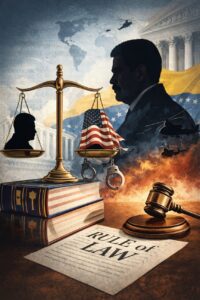
For nearly 25 years, Venezuela has been controlled by “Chavismo,” a socialist movement first established by Hugo Chávez in 1999 and continued by his successor, Nicolás Maduro (“Maduro”). Under their governance, Venezuela’s oil-dependent economy collapsed, with its Gross Domestic Product (“GDP”) shrinking by roughly three-quarters between 2014 and 2021[i] and poverty surging amid shortages of food, medicine, and electricity.[ii] Mass migration inevitably followed with nearly 8 million Venezuelans fleeing, creating one of the largest displacement crises in history.[iii] In March 2020, Maduro was indicted on federal narcotics and related charges, accusing him and several co-defendants of leading a decades-long narco-terrorism and cocaine importation conspiracy that used Venezuelan state power to protect and move tons of cocaine into the U.S. and enrich corrupt officials.[iv]
On January 3, 2026, at approximately 1 a.m. ET, Delta Force agents stormed Maduro’s compound in Caracas, Venezuela, capturing him and his wife before departing the country at 3:29 a.m. ET.[v] Video footage showed over 150 aircrafts roaring over Caracas with plumes of smoke rising into the night sky, creating a distraction while U.S. forces stayed on the ground completing their mission.[vi] The raid did not result in any U.S. deaths. Unfortunately, two Venezuelan civilians were killed that morning.[vii] News of Maduro’s capture broke early on Saturday, January 3, 2026, with President Donald Trump announcing it on social media around 4:30 a.m. ET.[viii] By 6 a.m. ET., Venezuelans across the world who had fled their beloved country took to the streets to celebrate the fall of Maduro.
The capture of Venezuelan “president” Maduro has ignited intense debate among legal scholars, diplomats, and international law practitioners. At the core of the debate is a fundamental legal question: To what extent does sovereign immunity affect the legality of arresting a foreign leader? For American courts and prosecutors, the answer has hinged in part on the longstanding policy that the U.S. does not recognize Maduro as the legitimate, democratically elected president of Venezuela. This position is shared by more than fifty countries and numerous foreign policy institutions, and 67% of Venezuelan people.[ix]
It is well-established that under “international law, a serving Head of State enjoys inviolability and full immunity from the criminal jurisdiction of foreign courts.”[x] The rationale is rooted in state sovereignty: allowing one government’s courts to prosecute another’s leader would expose officials to politically motivated prosecutions and would undermine inter-state relations. This principle was affirmed in the International Court of Justice’s Arrest Warrant decision, concluding incumbent leaders enjoy complete immunity for both official and private acts.[xi] Such immunity is procedural and does not determine guilt or innocence but rather solely bars prosecution in foreign domestic courts while a leader holds office.[xii]
However, international law also acknowledges mechanisms for accountability. International tribunals like the International Criminal Court (“ICC”) have statutory frameworks that expressly waive immunity for serious international crimes such as genocide, crimes against humanity, and war crimes.[xiii]
Because of these principles, the legality of capturing Maduro depends entirely on U.S. recognition of his government. Under U.S. law and practice, the Executive Branch has exclusive authority to recognize foreign governments and their leaders.[xiv] If the U.S. does not recognize an individual as a sovereign head of state, then American courts generally do not extend immunity to that individual.[xv] This approach was applied in the 1989 case United States v. Noriega, where the U.S. did not recognize Panamanian leader Manuel Noriega as the legitimate head of state and successfully prosecuted him in Florida on drug trafficking charges.[xvi] Similarly to Maduro, “Noriega surrendered to U.S. troops who had surrounded the Vatican embassy in Panama City during an invasion ordered by President George H.W. Bush.” [xvii] While Noriega argued lack of jurisdiction, District Judge William M. Hoeveler stated the U.S.
had jurisdiction to try Noriega for acts taken outside of its borders as a matter of international law and statutory construction. “The United States has long possessed the ability to attach criminal consequences to acts occurring outside this country which produce effects within the United States,” he concluded. Hoeveler traced the theory of extraterritorial jurisdiction to Strassheim v. Daily (1911), where Justice Oliver Wendell Holmes determined that acts done by a person “outside a jurisdiction, but intended to produce or producing effects within it, justify a State in punishing the cause of the harm as if he had been present at the effect, if the State should succeed in getting him within its power.[xviii]
Since 2019, the U.S. and more than fifty other nations have declined to recognize Maduro as Venezuela’s legitimate president, characterizing elections under his leadership as flawed and lacking democratic legitimacy.[xix] More recently, the U.S. has recognized Edmundo González as Venezuela’s president-elect following the 2024 election, and previously recognized Juan Guaidó as interim president of Venezuela.[xx] That longstanding position gives rise to the legal argument that Maduro, in the eyes of U.S. law, was not a head of state with sovereign immunity at the time of his arrest, but rather a private individual subject to U.S. criminal jurisdiction.
As early as 2011, the U.S. had filed criminal charges against Maduro indicting him on narcotics trafficking, narco-terrorism, and related offenses.[xxi] Once in U.S. custody, Maduro appeared in federal court in New York, for his arraignment. Prosecutors argue that even if the arrest raises international legal concerns, U.S. courts retain jurisdiction to prosecute because of doctrines like the Ker-Frisbie, which permits prosecution of defendants brought before a court regardless of the legality of their capture.[xxii]
Courts have historically upheld prosecutions under this framework, as seen in case of Noriega.[xxiii] Supporters of President Trump’s approach argue that because Maduro was not recognized as Venezuela’s lawful leader, his capture did not undermine a legitimate government’s authority and therefore did not trigger traditional head-of-state immunity. Furthermore, while consistent with U.S. precedent, such action remains controversial in international legal circles, where legitimacy is often tied to effective control over territory and population rather than foreign recognition alone. Nonetheless, the U.S.’s refusal to recognize Maduro is central to the claim that he is not entitled to immunity under U.S. law, illustrating how executive recognition can fundamentally alter an individual’s legal status for purposes of jurisdiction.
Beyond sovereign immunity and recognition, this capture raises constitutional questions about the Executive Branch’s authority to use military force without explicit congressional approval. Under Article I of the Constitution, Congress has the power to declare war, while the President serves as Commander in Chief under Article II.[xxiv] Historically, presidents have engaged in limited military operations without formal declarations of war, but a forcible operation inside another state to arrest a foreign leader may test the limits of that authority. A Department of Justice legal memorandum released in connection with the operation argued that President Trump possessed inherent constitutional authority to order the mission without Congress’s authorization, and that international law considerations were not dispositive for domestic legality.[xxv]
Therefore, the arrest and prosecution of Nicolás Maduro challenges traditional legal frameworks governing sovereign immunity, jurisdiction, and the use of force. The U.S.’s decision not to recognize Maduro as Venezuela’s legitimate president plays a pivotal role in the legal reasoning used by U.S. courts and policymakers to justify moving forward with his prosecution. While international law experts remain deeply divided on the broader legality of the operation, the intersection of recognition policy, domestic jurisdictional doctrine, and sovereign immunity offers a compelling legal narrative that will inform future debates on how democracies respond to leaders accused of serious crimes.
[i] See Diana Roy, Venezuela: The Rise and Fall of a Petrostate, Council on Foreign Rel. (July 31, 2024, at 2:55), https://www.cfr.org/backgrounders/venezuela-crisis [https://perma.cc/NWS4-LS5R].
[ii] See id. (“In recent years, Venezuela has suffered economic collapse, with output shrinking significantly and rampant hyperinflation contributing to a scarcity of basic goods, such as food and medicine.”).
[iii] See Venezuela Humanitarian Crisis, The UN Refugee Agency, https://www.unrefugees.org/emergencies/venezuela/ [https://perma.cc/46Z9-FGBF] (last visited Feb. 17, 2026) (“More than 7.9 million Venezuelans have left the country since 2014. This is the largest exodus in Latin America’s recent history and one of the largest displacement crises in the world (as of December 2025).”).
[iv] See generally Jay Clayton, Sealed Superseding Indictment, U.S. Dep’t of Just. https://www.justice.gov/opa/media/1422326/dl [https://perma.cc/M3GG-76DD] (last visited Feb. 17, 2026).
[v] See generally Peter Nicholas et al., A CIA Team, Steel Doors and a Fateful Phone Call: How The U.S. Captured Maduro in Venezuela, NBC News (Jan. 4, 2026, at 2:02 p.m.), https://www.nbcnews.com/politics/donald-trump/us-venezuela-strike-nicolas-maduro-captured-how-timeline-trump-rcna252041 [https://perma.cc/PRK3-HUYK].
[vi] See Stefano Pozzebon et al., The US has Captured Venezuelan Leader Maduro. Here’s What to Know, CNN World (Jan. 3, 2026), https://www.cnn.com/2026/01/03/americas/venezuela-explosions-intl-hnk [https://perma.cc/S3E7-SRLF] (“US Joint Chiefs Chairman Gen. Dan Caine later described an extensive overnight operation to capture Maduro and his wife that involved more than 150 aircraft launching from bases across the Western Hemisphere.”).
[vii] Charli Carpenter, Whether War or Police Action, the U.S. Strike on Venezuela Was Illegal, World Pol. Rev. (Jan. 13, 2026), https://www.worldpoliticsreview.com/us-venezuela-maduro-international-law/ [https://perma.cc/6LRC-JTRY] (“At this time, it is not truly known how many civilians were harmed by the operation. Two direct deaths have been confirmed . . .”).
[viii] See Anne Flaherty et al., US captures Maduro, Carries Out ‘Large Scale Srike’ in Venezuela: Trump, ABC News (Jan 3, 2026, at 5:03 p.m., https://abcnews.go.com/International/explosions-heard-venezuelas-capital-city-caracas/story?id=128861598 [https://perma.cc/TES3-DXTV] (“The announcement on Trump’s social media platform came shortly before 4:30 a.m.”).
[ix] See Center Finds Democracy Thwarted in Venezuela, The Carter Ctr. (Feb. 18, 2025), https://www.cartercenter.org/stories/center-finds-democracy-thwarted-in-venezuela/ [https://perma.cc/MH9V-5B95] (explaining Maduro again claimed victory without releasing precinct-level results and opposition copies from over 80% of precincts showed Edmundo González Urrutia winning decisively, which The Carter Center labeled a “serious breach of electoral principles”).
[x] See Sir Arthur Watts & Joanne Foakes, Heads of State, Oxford Pub. Int’l L. (July 2023), https://opil.ouplaw.com/display/10.1093/law:epil/9780199231690/law-9780199231690-e1418 [https://perma.cc/M9K5-GBX9].
[xi] See id.
[xii] See id. (explaining the ICJ has held that once officials leave office, they no longer enjoy personal immunity and may be prosecuted in foreign courts for acts committed before, after, or during their tenure in a private capacity).
[xiii] See How the Court Works, International Criminal Court, https://www.icc-cpi.int/about/how-the-court-works [https://perma.cc/7YXU-MNDV] (last visited Feb. 17, 2026) (“[T]he ICC can prosecute crimes against humanity, which are serious violations committed as part of a large-scale attack against any civilian population. . . . [Including] offences such as murder, rape, imprisonment, enforced disappearances, enslavement, particularly of women and children, sexual slavery, torture, apartheid and deportation.”)
[xiv] See Zivotofsky v. Kerry, 576 U.S. 1, 21 (2015) (recognizing “judicial precedent and historical practice teach that it is for the President alone to make the specific decision of what foreign power he will recognize as legitimate . . ..”).
[xv] See id. at 11
Legal consequences follow formal recognition. Recognized sovereigns may sue in United States courts, and may benefit from sovereign immunity when they are sued. The actions of a recognized sovereign committed within its own territory also receive deference in domestic courts under the act of state doctrine. Recognition at international law, furthermore, is a precondition of regular diplomatic relations. Recognition is thus “useful, even necessary,” to the existence of a state.
(internal citations omitted).
[xvi] See Scott Bomboy, Looking Back: The Noriega Case as Legal Precedent, Nat’l Const. Ctr. (Jan. 8, 2026), https://constitutioncenter.org/blog/looking-back-the-noriega-case-as-legal-precedent [https://perma.cc/Y7V7-97QC] (explaining Noriega was the landmark case where former Panamanian dictator Manuel Noriega was tried and convicted in the U.S. for drug trafficking, marking the first time a U.S. court prosecuted a foreign leader, with courts upholding jurisdiction despite Noriega’s claims of POW status).
[xvii] See id.
[xviii] See id.
[xix] See Nicolás Maduro Moros (Captured), U.S. Dep’t of State (Jan. 6, 2026), https://www.state.gov/nicolas-maduro-moros [https://perma.cc/KM2N-EZCY] (“Since 2019, more than 50 countries, including the United States, have refused to recognize Maduro as Venezuela’s head of state.”); see also Meredith Deliso, What to Know About Nicolas Maduro, the Ousted Venezuelan President, ABC News (Jan. 5, 2026, at 9:57 p.m.), https://abcnews.go.com/International/nicolas-maduro-ousted-venezuelan-president/story?id=128913024 [https://perma.cc/75M3-CZVQ] (explaining Venezuela’s opposition argues that Edmundo González Urrutia won the last election by a wide margin, citing exit polls and U.S. statements supporting his victory, while Maduro claimed reelection and refused to relinquish power).
[xx] See Regina Garcia Cano & Jorge Rueda, U.S. Recognizes Venezuela’s Opposition Candidate Edmundo González as President-Elect, PBS News (Nov. 19, 2024), https://www.pbs.org/newshour/world/u-s-recognizes-venezuelas-opposition-candidate-gonzalez-as-president-elect [https://perma.cc/E8WQ-8UYU] (“The U.S. government recognized Venezuelan opposition candidate Edmundo González as the ‘president-elect’ of the South American country on Tuesday, months after President Nicolás Maduro claimed to have won the July election.”).
[xxi] See Nicolás Maduro Moros and 14 Current and Former Venezuelan Officials Charged with Narco-Terrorism, Corruption, Drug Trafficking and Other Criminal ChargesI, U.S. Dep’t of Just. (Feb. 5, 2025), https://www.justice.gov/archives/opa/pr/nicol-s-maduro-moros-and-14-current-and-former-venezuelan-officials-charged-narco-terrorism [https://perma.cc/7EBY-U9LU] (“‘Today we announce criminal charges against Nicolás Maduro Moros for running, together with his top lieutenants, a narco-terrorism partnership with the FARC for the past 20 years,’ said U.S. Attorney Geoffrey S. Berman.”); see also Edward Helmore, The Guardian (Jan. 5, 2026), https://www.theguardian.com/world/2026/jan/05/nicolas-maduro-venezuela-criminal-indictment [https://perma.cc/8324-HU9U] (explaining U.S. prosecutors allege that as early as 2011, Maduro coordinated with FARC and drug traffickers, including facilitating cocaine shipments protected by armed groups and linked to the Sinaloa Cartel, conduct later cited in U.S. narcotics indictments against him).
[xxii] Kirk J. Henderson, Fighting the War on Drugs in the “New World Order”: The Ker-Frisbie Doctrine As A Product of its Time, 24 Vand. L. Rev. 535, 537 (1991) (explaining under Ker v. Illinois (1886) and Frisbie v. Collins (1952), U.S. courts retain jurisdiction over defendants even if they were illegally seized or abducted, meaning unlawful arrest does not bar prosecution); see also T. Elliot Gaiser, Memorandum for Legal Advisor, National Security Council Re: Proposed War Department Operation to Support Law Enforcement Efforts in Venezuela, U.S. Dep’t of Just. (Dec. 23, 2025), https://www.justice.gov/olc/media/1423306/dl?inline [https://perma.cc/KX95-8CXL] (relying on the Ker-Frisbie doctrine, the DOJ argued that federal courts retain jurisdiction over criminal defendants even if brought before them by forcible abduction, absent a statute or treaty limiting Congress’s grant of jurisdiction).
[xxiii] See supra, note xviii.
See U.S. Const. art. I, §8 (“The Congress shall have Power . . . To declare War”); see also U.S. Const. art. II, § 2 (“The President shall be Commander in Chief of the Army and Navy of the United States, and of the Militia of the several States, when called into the actual Service of the United States”).
[xxv] See T. Elliot Gaiser, Memorandum For Legal Advisor, National Security Council, U.S. Dep’t of Just. (Dec. 23, 2025), https://www.justice.gov/olc/media/1423306/dl?inline [https://perma.cc/VM3U-5QH7] (“The current projected figures are within the range of activities that we have found to be within the President’s unilateral constitutional authority.”); see also id. (“But the law does not permit the President to order troops into Venezuela without congressional authorization if he knows it will result in a war. As of December 22, 2025, we have not received facts indicating it will, but our legal advice is premised on such predictions.”).