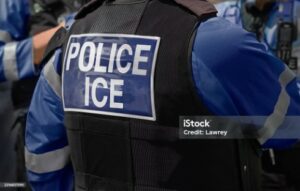
Immigration and Customs Enforcement (“ICE”) has expanded interior enforcement efforts through large-scale operations, including early-morning home arrests and increased encounters in public spaces.[i] These practices have renewed scrutiny of the constitutional standards governing immigration searches, particularly when officers act without judicial warrants. Recent public discourse has also revealed widespread confusion regarding the scope of immunity available to ICE agents, especially in the wake of high-profile enforcement incidents.[ii] In response to these concerns, members of Congress have introduced the Ending Qualified Immunity for ICE Agents Act (“The Act”), a proposal aimed at altering how civil claims against ICE officers are adjudicated.[iii]
The Act’s introduction reflects a broader institutional tension. Although the Supreme Court has articulated clear Fourth Amendment principles governing searches of homes and seizures in public spaces,[iv] courts confronting challenges to ICE searches frequently encounter unsettled questions about how those principles apply in the civil immigration context.[v] Instead of resolving these questions, courts frequently invoke qualified immunity to dispose of claims, leaving the constitutional limits of ICE enforcement unresolved.[vi] The Act thus emerges against a backdrop of judicial restraint and doctrinal uncertainty.
The Fourth Amendment affords its greatest protection to the home, rendering warrantless entry presumptively unreasonable absent a judicial warrant, valid consent, or exigent circumstances.[vii] In immigration enforcement, ICE officers routinely rely on administrative warrants issued by the agency itself. While these warrants authorize civil immigration arrests, they are not issued by neutral magistrates and do not permit entry into a private residence without consent.[viii] As a result, challenges to ICE home entries frequently turn on whether consent was obtained and whether that consent was voluntary.[ix]
Courts evaluating such claims emphasize the fact-specific nature of consent inquiries, focusing on how officers presented their authority and how residents understood their rights.[x] This approach often resolves disputes narrowly, without producing broader constitutional guidance applicable to future encounters. That tendency is shaped in part by qualified immunity, a doctrine that shields government officials from civil liability unless their conduct violates a clearly established constitutional right.[xi] Even where courts express concern about officers’ conduct, they may decline to decide whether a Fourth Amendment violation occurred if qualified immunity applies.[xii]
Public encounters raise a different set of Fourth Amendment considerations. In public spaces, officers may briefly detain individuals based on reasonable suspicion.[xiii] Immigration enforcement complicates this framework because civil immigration violations do not correspond directly to criminal offenses. Courts have recognized that immigration status alone does not justify detention, yet they have permitted limited questioning under certain circumstances.[xiv] The resulting case law reflects variation in how courts assess reasonable suspicion in the immigration context, further contributing to doctrinal inconsistency.[xv]
Qualified immunity plays a pivotal role in how these cases are resolved. The doctrine shields government officials from civil liability unless their conduct violates a constitutional right that was clearly established at the time of the alleged violation.[xvi] Following Pearson v. Callahan, courts may grant qualified immunity without deciding whether a constitutional violation occurred, and frequently do so.[xvii] In challenges to ICE searches, this framework allows courts to dispose of claims without clarifying the constitutional limits of immigration enforcement.
The structure of federal officer liability reinforces this dynamic. Unlike state officials, federal immigration officers are not subject to suit under 42 U.S.C. § 1983.[xviii] Instead, plaintiffs must rely on the limited Bivens framework, which allows implied constitutional claims against federal officers in narrow circumstances.[xix] The Supreme Court has significantly narrowed that framework in recent years.[xx] Today, qualified immunity operates within this constrained remedial scheme, further reducing the likelihood that courts will reach the merits of Fourth Amendment claims arising from ICE enforcement.
It is within this context that lawmakers introduced The Act. The Act would remove qualified immunity as a defense in civil actions against ICE officers, thereby eliminating a procedural barrier that has frequently prevented courts from addressing constitutional claims on the merits.[xxi] Importantly, the proposal does not alter substantive Fourth Amendment standards or expand ICE’s enforcement authority. Rather, it reflects legislative concern that existing doctrine has limited judicial engagement with the constitutional boundaries of immigration enforcement.[xxii]
Whether the Act will be enacted remains uncertain. The Supreme Court has declined to revisit qualified immunity in recent terms, leaving the doctrine intact despite sustained criticism.[xxiii] The bill’s introduction nonetheless underscores growing recognition that qualified immunity, as applied in the immigration context, may function less as a shield for reasonable mistakes and more as a structural obstacle to constitutional clarification. As ICE enforcement activity continues, the interaction between qualified immunity and Fourth Amendment doctrine will remain a central, and unresolved, feature of immigration enforcement litigation.
[i] See Rebecca Santana & Michael Balsamo, 2000 Federal Agents Sent to Minneapolis Area to Carry Out ‘Largest Immigration Operation Ever,’ ICE says, PBS News (Jan. 6, 2026), https://www.pbs.org/newshour/politics/2000-federal-agents-sent-to-minneapolis-area-to-carry-out-largest-immigration-operation-ever-ice-says? [https://perma.cc/AY8T-89AB].
[ii] See Devan Cole, Do ICE Agents Have Absolute Immunity? No, Experts Say, but It’s Not Easy for a State to Prosecute, CNN (Jan. 9, 2026), https://www.cnn.com/2026/01/08/politics/ice-immunity-jd-vance-minneapolis [https://perma.cc/WKF2-48XC].
[iii] Ending Qualified Immunity for ICE Agents Act, H.R. 4944, 119th Cong. (2025).
[iv] See Payton v. New York, 445 U.S. 573, 585–86 (1980); see also Terry v. Ohio, 392 U.S. 1, 19–22 (1968).
[v] Issue Brief Qualified Immunity in Immigration, Nat’l Immigr. Project of the Nat’l Lawyers Guild (June 24, 2021), https://nipnlg.org/sites/default/files/2023-03/2021_24June_qualified-immunity-brief.pdf [https://perma.cc/GE4X-6VPV].
[vi] See Nathaniel Sobel, What Is Qualified Immunity, and What Does It Have to Do With Police Reform?, Lawfare (June 6, 2020), https://www.lawfaremedia.org/article/what-qualified-immunity-and-what-does-it-have-do-police-reform [https://perma.cc/GSR9-EKRN].
[vii] See U.S. Const. amend. IV.
[viii] See United States v. Santa, 236 F.3d 662, 668–69 (11th Cir. 2000) (holding that an administrative immigration warrant does not authorize entry into a private residence absent consent or exigent circumstances); see also 8 C.F.R. § 287.5(e)(2) (authorizing immigration officers to make arrests based on administrative warrants issued by DHS officials).
[ix] Santa, 236 F.3d at 668–69.
[x] See Schneckloth v. Bustamonte, 412 U.S. 218, 226–27 (1973) (holding that voluntariness of consent is determined by the totality of the circumstances, including the characteristics of the accused and the details of the interaction).
[xi] See Sobel, supra note vi.
[xii] City of Tahlequah v. Bond, 595 U.S. 9, 11 (2021) (per curiam) (reversing denial of qualified immunity without addressing whether officers’ conduct violated the Fourth Amendment).
[xiii] Terry, 392 U.S. at 21–22.
[xiv] See INS v. Lopez-Mendoza, 468 U.S. 1032, 1038 (1984) (“A deportation proceeding is a purely civil action to determine eligibility to remain in this country, not to punish an unlawful entry . . . . The deportation hearing looks prospectively to the respondent’s right to remain in this country in the future.”).
[xv] Nat’l Immigr. Project of the Nat’l Lawyers Guild, supra note v.
[xvi] Harlow v. Fitzgerald, 457 U.S. 800, 818 (1982).
[xvii] See Pearson v. Callahan, 555 U.S. 223, 236 (2009) (holding that courts have discretion to grant qualified immunity without deciding whether a constitutional violation occurred); see also Nat’l Immigr. Project, supra note v (observing that courts routinely resolve cases on qualified-immunity grounds without reaching the underlying constitutional question).
[xviii] See Nat’l Immigr. Project, supra note 5.
[xix] See Bivens v. Six Unknown Named Agents of Federal Bureau of Narcotics, 403 U.S. 388, 396–97 (1971) (recognizing an implied cause of action for damages against federal officers for certain constitutional violations); see also Ziglar v. Abbasi, 582 U.S. 120, 136 (2017) (describing Bivens remedies as available only in limited circumstances and cautioning against their expansion).
[xx] See Ziglar, 582 U.S. at 148.
[xxi] H.R. 4944 § 2.
[xxii] Id.
[xxiii] See Nat’l Immigr. Project, supra note v (documenting the Court’s repeated refusals to grant certiorari in qualified-immunity cases despite widespread criticism of the doctrine).