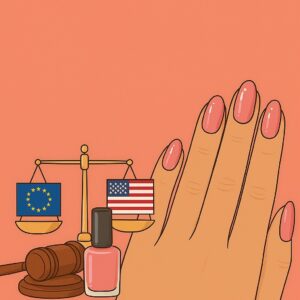
In September 2025, the European Union (“EU”) banned a key ingredient in gel nail polish, sparking headlines that gel manicures are now illegal in Europe.[i] Meanwhile, the product remains available on the market and in salons across the United States. Why the discrepancy? What does this reveal about each system’s approach to cosmetic safety? It is critical to understand why the EU decided to ban gel nail polish in the first place.
The EU banned trimethylbenzoyl diphenylphosphine oxide (“TPO”) on September 1, 2025. [ii] Any gel nail polish with TPO cannot be sold or used by nail technicians, who must discard any such products immediately. TPO is the ingredient in gel nail polish that gives nails a glossy finish under ultraviolet (“UV”) or light emitting diode (“LED”) light. Gel polish has gained popularity as patrons can leave the salon with a fresh manicure and no downtime.
But why is TPO considered so dangerous in Europe? TPO is classified as a Carcinogenic Mutagenic Reprotoxic (“CMR”) Category 1B reproductive toxicant by the EU’s Commission Delegated Regulation.[iii] These 1B classifications are presumed to have adverse CMR effects and are banned for use in cosmetic products in the EU.[iv] The quantities of TPO that are found in a full manicure session lend support to these bans.[v] Acting as a photo-initiator, TPO is broken down under UV and LED light to create free radicals that trigger polymerization, which cures the gel layer into a solid, glossy coat.[vi] This polymerization process under UV light is completed in approximately two to three minutes and is often repeated for multiple coats (base, color, and top layer).[vii] Over the course of a full manicure, an estimated 200 milligrams of TPO gets distributed to a human’s nail plates, which the Scientific Committee on Consumer Safety considers safe for isolated uses.[viii] However, manicures are a usual routine and applications are commonly repeated every two to three weeks.[ix] For EU regulators, this repeated, long-term exposure to a presumed carcinogenic and reproductive toxicant is enough to justify precaution, which is why TPO no longer appears on the approved list of cosmetic ingredients.[x]
The ban follows research linking the substance to high levels of fertility and reproductive health issues in rats.[xi] The EU’s approach to health regulation lies in hazard-based, precautionary framework. Given the updated CMR Category 1B classification, EU regulators were legally required under the EU Cosmetics Regulation to add TPO to the list of prohibited substances.[xii] To carry out that requirement, the EU adopted its 2025 “Omnibus VII” amendment, which placed TPO in Annex II, the list of prohibited ingredients.[xiii]
This EU regulation stands in sharp contrast to the United States, where gel nail polishes containing TPO remains completely legal. In the United States, the U.S. Food and Drug Administration (“FDA”) govern cosmetic products under the Federal Food, Drug and Cosmetic Act, but its approach is fundamentally different from the European system.[xiv] As mentioned, the EU is known for applying a hazard-based, precautionary framework when it comes to chemical regulation. This means that once a substance is classified as inherently hazardous, like TPO being reclassified as a Category 1B reproductive toxicant, regulators move quickly to ban it from cosmetics, regardless of the specific exposure levels consumers might face.[xv]
By contrast, the United States takes a risk-based approach, as regulators in the United States focus on whether a substance poses an actual risk of harm under real-world usage.[xvi] For nearly a century, federal oversight of cosmetics in the United States stayed largely the same. That changed on December 29, 2022, when President Biden signed the Modernization of Cosmetics Regulation Act (“MoCRA”) into law.[xvii] This became the first major update to U.S. cosmetic regulation in more than eighty years, bringing cosmetic safety back into the national spotlight.[xviii]
This difference in regulation explains why gel nail polish containing TPO is still perfectly legal in the United States. Unlike drugs or medical devices, cosmetics in the U.S. generally do not require a premarket approval.[xix] Cosmetic manufactures are responsible for ensuring the safety of their products, and the FDA typically only becomes involved after a harm is reported or if a product is found to be misbranded.[xx] Therefore, unless there is clear evidence that TPO causes health problems in consumers or salon workers in the United States, the FDA really has little reason and little authority to ban TPO preemptively.
In response to the EU’s ban, many brands have been proactive in reformulating their polishes to be TPO free.[xxi] While the ban presents challenges for manufacturers, viable alternatives to TPO already exist.[xxii] Because of the EU’s market size and influence, TPO-free gel formulas are expected to become the industry standard rather than the exception. Many companies began reformulating well before the ban took effect.[xxiii] Manicurist Paris, for instance, eliminated TPO from its Green Flash LED Nail Polish back in 2019.[xxiv] OPI followed suit, launching a TPO-free gel color line in July 2024, and Aprés recently announced the removal of TPO from its Gel Couleur products.[xxv]
Proponents of the American system argue that this risk-based model avoids unnecessary bans and allows consumers and companies more freedom.[xxvi] They argue that most of the TPO in the nail polish gets polymerized, or essentially “locked in” during the curing process, leaving little residual chemical that would reach the nail bed.[xxvii] Moreover, while the hazard exists in theory, the “real-world” risk is likely minimal for most gel polish users.
On the other hand, critics argue that this approach may overlook vulnerable groups.[xxviii] Nail salon technicians are repeatedly exposed to uncured gels, vapors, and nail dust every day. Repeated exposure to this environment could create risks that do not appear in short-term consumer studies. Some may argue that the EU’s tougher precautionary stance better protects workers in these environments while the United States’ system places more burden on individuals.[xxix]
American consumers will continue to see gel nail polishes containing TPO on the market. However, because global nail brands strive to maintain uniform product lines, many have already begun reformulating their polishes to comply with EU standards.[xxx] In practice, this means U.S. consumers may soon have access to TPO-free gel nail polish, not due to FDA regulation, but rather to the European market’s influence. Ultimately, whether TPO disappears from American shelves will depend less on U.S. regulators and more on global-market forces shaped by the EU’s precautionary approach.
[i] See generally Jacqueline Howard, Europe Bans Chemical Used in Some Gel Nail Polishes, Classifying it as a ‘Reproductive Toxicant,’ CNN (Sep. 4, 2025), https://www.cnn.com/2025/09/04/health/gel-nail-polish-chemical-ban-europe-wellness [https://perma.cc/JC8C-YAHH].
[ii] See Reda Wigle, Why Gel Nail Polishes are Banned in Europe Starting Today – But Not in the US, N.Y. Post (Sep. 1, 2025), https://nypost.com/2025/09/01/health/why-gel-nail-polish-is-banned-in-europe-starting-today [https://perma.cc/L4EP-ETTF].
[iii] See TPO in Nail Products – Questions and Answers, Eur. Comm’n (Aug. 7, 2025), https://single-market-economy.ec.europa.eu/sectors/cosmetics/tpo-nail-products-questions-answers_en [https://perma.cc/C7YV-YN8Z].
[iv] See generally CMR Substances, Eur. Comm’n, https://single-market-economy.ec.europa.eu/sectors/cosmetics/cosmetic-products-specific-topics/cmr-substances_en [https://perma.cc/N9FH-6ULN] (last visited Nov. 11, 2025).
[v] See Opinion of the Scientific Committee on Consumer Safety on the “Safety of Trimethylbenzoyl Diphenylphosphine Oxide (TPO) in Cosmetic Products,” at 8, COM (Mar. 27, 2014).
[vi] Id. at 25–26.
[vii] Id. at 25.
[viii] Id. (recognizing that TPO can make up 5% of the total nail polish bottle’s contents for a manicure to be considered safe).
[ix] See Safety Assessment of Trimethylbenzoyl Diphenylphosphine Oxide as Used in Cosmetics, Cosm. Ingredient Rev. (Nov. 21, 2024), https://www.cir-safety.org/sites/default/files/SLR_TrimethylbenzoylDiphenylphosphineOxide_122024.pdf [https://perma.cc/J823-MWZW].
[x] See generally Brianna Barbu, The EU Banned a Common Nail Polish Ingredient. But Don’t Panic, chem. Eng’g News (Sep. 16, 2025), https://cen.acs.org/safety/consumer-safety/EU-banned-common-nail-polish/103/web/2025/09 [https://perma.cc/6JQP-KPVR]; see also COM, supra note v.
[xi] See COM, supra note v, at 28.
[xii] See Commission Regulation 2025/877 of May 12, 2025, Amending Regulation (EC) No 1223/2009 of the European Parliament and of the Council as Regards to the Use in Cosmetic Products of Certain Substances Classified as Carcinogenic, Mutagenic, or Toxic for Reproduction, 2025 O.J. (L 219) 15, recitals 2 and 7.
[xiii] Id.
[xiv] See Cosmetics & U.S. Law, U.S. Food & Drug Admin., https://www.fda.gov/cosmetics/cosmetics-laws-regulations/cosmetics-us-law [https://perma.cc/4NED-NS7X] (last visited Nov. 11, 2025).
[xv] See generally ProNails Gels are 100% TPO Free, ProNails, https://pronails.com/naily-news/tpo [https://perma.cc/XJS7-DDC7] (last visited Nov. 11, 2025).
[xvi] See Prohibited & Restricted Ingredients in Cosmetics, U.S. Food & Drug Admin. (Feb. 25, 2022), https://www.fda.gov/cosmetics/cosmetics-laws-regulations/prohibited-restricted-ingredients-cosmetics? [https://perma.cc/8PLZ-AHHY].
[xvii] See Modernization of Cosmetics Regulation Act, Pub. L. No. 117-328, 136 Stat. 4459; See generally Evelyn Woo, et al., A New Era of Cometic Safety Regulation, The Regl. Rev. (June 28, 2025), https://www.theregreview.org/2025/06/28/seminar-a-new-era-of-cosmetics-safety-regulation/ [https://perma.cc/57WA-BWKJ]; see also Federal Advocacy Efforts, Pers. Care Prod. Council, https://www.personalcarecouncil.org/public-policy/federal-and-state-advocacy/ [https://perma.cc/JC7J-MSCL] (last visited Nov. 11, 2025).
[xviii] See Evelyn Woo, et al., supra note xvii.
[xix] See id.
[xx] Id.
[xxi] See Kara Jillian Brown, Here’s the Latest on the Gel Nail Polish Ban in Europe—and What It Means for the U.S., InStyle (Sep. 3, 2025), https://www.instyle.com/tpo-gel-ban-europe-11802245# [https://perma.cc/TYT6-BPHX].
[xxii] Id.
[xxiii] Id.
[xxiv] Id.
[xxv] Id.
[xxvi] See FDA’s Risk-Based Approach to Inspections, U.S. Food & Drug Admin. (Jan. 17, 2024), https://www.fda.gov/inspections-compliance-enforcement-and-criminal-investigations/inspection-basics/fdas-risk-based-approach-inspections [https://perma.cc/28MA-FTVD].
[xxvii] See generally Marci Robbins, The Stuff You’ve Heard About the “Gel Nail Polish Ban” Is Wrong, ALLURE (Sep. 3, 2025), https://www.allure.com/story/eu-gel-nail-polish-ban [https://perma.cc/GZA4-LW4W].
[xxviii] See generally Nail Technicians: Workplace Safety and Health, Ctr. for Disease Control & Prevention (July 25, 2024), https://www.cdc.gov/niosh/nail-technicians/about/index.html [https://perma.cc/MEY6-EW7G].
[xxix] Id.
[xxx] See Brown, supra note xxi.