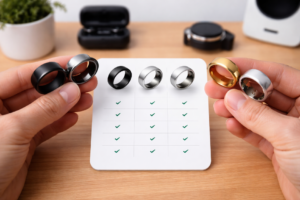
Everywhere you look lately, there’s a shiny ring on someone’s finger—and it’s not the kind that comes with a white dress, vows and a lifetime of commitment. The newest phenomenon are smart rings, wearable technology that quietly tracks everything from movement and health metrics to sleep.[i] Its small sleek design with built-in sensors promises users constant insight without the constant screen-checking.[ii] Popular smart ring brands, such as Oura, Ultrahuman, RingConn, and Samsung, are now competing in a market worth upwards of $400 million[iii] and it’s safe to say these smart ring companies have the masses wrapped around their fingers, literally and figuratively.
With lots of competition comes the inevitable litigation for intellectual property infringement. Oura filed a complaint to the International Trade Commission (“ITC”) in April of 2024 naming Ultrahuman and RingConn as respondents.[iv] In September 2025, the ITC ruled in favor of Oura, finding that Ultrahuman and RingConn violated Oura’s patent[v] and “bann[ed] the companies’ infringing smart rings and components from being imported into and sold in the U.S. market effective as of October 21, 2025.”[vi] As a result, Ultrahuman’s rings disappeared from the U.S. market, with Ultrahuman no longer able to sell them on their U.S. website and retailers no longer able to receive new inventory.[vii] Meanwhile RingConn opted to settle with Oura and entered into a patent license agreement, allowing RingConn to continue selling their rings in the U.S. while making royalty payments to Oura.[viii]
Traditionally in an intellectual property claim, a plaintiff will sue in federal court when a party makes an unlawful claim upon the plaintiff’s patented invention without permission.[ix] U.S. patent litigation is usually costly and lengthy, spanning on average between three to five years and costing millions.[x] Oura Ring instead made a more strategic choice in its forum selection by choosing to file their complaint with the ITC. This is called a Section 337 patent investigation, which is significantly quicker, taking around seventeen to eighteen months.[xi] The ITC is an independent agency which “investigates and makes determinations in proceedings involving imports claimed to injure a domestic industry or violate U.S. intellectual property rights . . . .”[xii]
A key difference between a federal patent case and a Section 337 ITC investigation, and why it’s not an avenue available to everyone, is that the ITC only has jurisdiction over articles imported into the U.S., not the parties.[xiii] Additionally, the ITC cannot award monetary damages like federal courts, but instead can bar the infringing product from entering the U.S.[xiv] Although injunctive relief is available in federal patent cases, patentees must meet the four factor test established in eBay, Inc. v. MercExchange, L.L.C.[xv]
Although Courts “may grant injunctions in accordance with the principles of equity to prevent the violation of any right secured by patent” which courts deem reasonable, the Ebay factors are a high standard to meet to assess the adequacy of injunctive relief.[xvi] This is because “[g]ranting an order to completely stop any type of activity was deemed to be an extraordinary remedy since its effects may be difficult to undo.”[xvii]
On the other hand, although Section 337 investigations still require a complaint to “be detailed and specific, and . . . include substantial supporting evidence to clearly demonstrate that a domestic industry is being harmed,” patentees do not have to meet the four eBay factors for the ITC to issue exclusion or cease and desist orders.[xviii] “The ITC . . . is statutorily required to issue an exclusion order once the patent holder proves infringement unless the ‘public health and welfare’ or certain economic conditions weigh against it.”[xix]
Notably, unlike in federal court, the ITC tries all issue before an administrative law judge with there being no right to a jury trial.[xx] In addition, filing a complaint with the ITC does not automatically start a case, the six ITC commissioners must decide whether to initiate an investigation in the matter of public interest in international trade, not just a private dispute. The Office of Unfair Import Investigation, a group within the ITC, becomes a full party in the case participating in discovery, motions, and trial alongside the complaint and respondent. An Administrative Law Judge conducts a trial and issues an Initial Determination on the merits and a non-binding recommendation on remedies, but only the Commission can issue final remedies. “If the Commission issues a Final Determination finding a violation of Section 337 and imposing a remedy, there is a 60-day period during which the President of the United States . . . may veto the Commission’s remedy.”[xxi]
A party unhappy with an ITC decision can only appeal directly to the U.S. Court of Appeals for the Federal Circuit, following the Federal Rules of Appellate Procedure. The losing party at the ITC becomes the appellant, while the ITC—previously a neutral fact finder—acts as the appellee defending its decision. The winning party must formally intervene in the appeal to help defend the ITC’s determination.
In the ITC investigation with Ourau and its competitors, the ITC ruled in Oura’s favor and issued exclusion and cease and desist orders, with no presidential veto in the review period.[xxii] Presently, Ultrahuman’s smart rings, which were the basis of Oura’s ITC investigation, and components are banned from being imported into and sold in the U.S. market. This is a major win for Oura, but why did Oura forego the possible money damages that federal courts could’ve provided in addition to injunctive relief?
Ultrahuman was one of Oura’s biggest competitors, offering their smart ring for a lesser price and not requiring a subscription such as Oura.[xxiii] The biggest downside for Oura smart rings is that consumers could own their ring but still need to pay a monthly subscription to access any of the health insights a consumer buys the smart ring to track.[xxiv] This is why Oura’s choice to file a complaint with the ITC was strategic and a power move. The ITC is mandated by statute to have a quick timeline[xxv] allowing Oura to exclude Ultrahuman from the U.S. market much sooner, getting rid of its biggest competitor. Although Oura could have received damages from Ultrahuman’s patent infringement, it could be argued that it was more valuable to remove the competition, limiting consumer’s options which will possibly bring them more profit in the long run.
Ultrahuman’s protest is that Oura received their patent family[xxvi] from a different company in 2023, who also acquired it from another company in 2020. Patent US 11,868,178 (“‘178 patent”) was issued to Oura only 63 days before the filing of their complaint to the ITC. [xxvii] Ultrahuman argues that “none of [the] building blocks originated with Oura or its proxy company [and] [t]he ’178 patent is about bundling well-known parts into a ring and calling that bundle proprietary.”[xxviii] Nonetheless, Oura is the owner of the ‘178 patent.
However, Ultrahuman should not be dismissed altogether from the fight. Ultrahuman announced in February 27, 2026 their new Ring Pro, which promises to have triple the battery life and improved sensors and processors.[xxix] “Ultrahuman needed to create a product different enough in its internal hardware arrangement to avoid the specific patent claims that sank the Ring Air in the U.S. market.”[xxx] Whether Ultrahuman managed to do so is still undetermined with the patent dispute pushing back its U.S. launch date. CEO and Co-founder Mohit Kumar has confirmed that “the device has been submitted to the U.S. Customs and Border Protection for clearance to confirm it can legally be imported into the country.”[xxxi] In a market defined by constant innovation and fierce competition, the smart ring space makes one thing clear: success is not just about building the next breakthrough device, but about securing and defending the ground beneath it.
[i] Simon Hill & Adrienne So, The Best Smart Rings to Rule Them All, Wired (Feb. 18, 2026, at 7:00 AM), https://www.wired.com/gallery/best-smart-rings/ [https://perma.cc/59CS-FNBG].
[ii] AnnieLily, What Is a Smart Ring and What Does It Do?, Nova Smart (Sep. 22, 2025), https://www.novaring.com/blogs/journeys/what-is-a-smart-ring-and-what-does-it-do [https://perma.cc/36WQ-B64R].
[iii] Smart Rings Market (2026 – 2033), Grand View Research, https://www.grandviewresearch.com/industry-analysis/smart-rings-market-report [https://perma.cc/6QKB-DT5M] (last visited Apr. 10, 2026).
[iv] Amanda Chu, Why Washington’s All-in on Smart Rings, Politico (Feb. 9, 2026, at 5:55 ET), https://www.politico.com/news/2026/02/09/oura-ring-lobbying-rfk-maha-washington-00770320 [https://perma.cc/5CGN-65A2]; see Certain Smart Wearable Devices, Systems, and Components Thereof, Inv. No. 337-TA-1398, USITC (Apr. 18, 2025) (final).
[v] Chu, supra note iv.
[vi] U.S. International Trade Commission Rules in Favor of ŌURA in Patent Case Against Ultrahuman and RingConn, Business Wire (Sep. 9, 2025, at 1:51 ET), https://www.businesswire.com/news/home/20250909387922/en/U.S.-International-Trade-Commission-Rules-in-Favor-of-URA-in-Patent-Case-Against-Ultrahuman-and-RingConn [https://perma.cc/NGA9-F2J8].
[vii] See Ultrahuman is here for long, Ultrahuman: Blog (Oct. 22, 2025), https://blog.ultrahuman.com/blog/ultrahuman-is-here-for-long/ [https://perma.cc/E4VD-WP36].
[viii] See ŌURA Secures Licensing Agreements with RingConn and OMATE, Oura (Oct. 21, 2025), https://ouraring.com/blog/oura-secures-licensing-agreements-with-ringconn-and-omate/ [https://perma.cc/47M8-MH6U].
[ix] See Patent Litigation 101, Thomson Reuters (Oct. 27, 2022), https://legal.thomsonreuters.com/blog/patent-litigation-101/ [https://perma.cc/UJ2D-L8M9].
[x] See id.
[xi] MoFo@ITC ITC Overview, Morrison Foerster, https://www.mofo.com/itc/itc-lifecycle [https://perma.cc/2G2A-WNK7] (last visited Apr. 9, 2026).
[xii] See Press Release, U.S. Int’l Trade Comm’n, USITC Institutes Section 337 Investigation of Certain Smart Wearable Devices, Systems, and Components Thereof (Apr. 12, 2024), https://www.usitc.gov/press_room/news_release/2024/er0412_65060.htm [https://perma.cc/T9XE-BRZH].
[xiii] Erik Milch & Michelle M. Ovanesian, Litigating Patents in the ITC: When and Why Companies Take the Section 337 Route, Proscauer: The Patent Playbook (Apr. 15, 2025), https://www.proskauer.com/blog/litigating-patents-in-the-itc-when-and-why-companies-take-the-section-337-route [https://perma.cc/EG7V-FSUH].
[xiv] Milch & Ovanesian, supra note xiii; see H. Mark Lyon & Sarah E. Piepmeier, ITC Section 337 Patent Investigations: Overview 2 (2021) https://www.gibsondunn.com/wp-content/uploads/2021/02/Lyon-ITC-Section-337-Patent-Investigations-Overview-Thomson-Reuters-Practical-Law-02-2021.pdf [https://perma.cc/2LYU-8KCB].
[xv] eBay, Inc. v. MercExchange, L.L.C., 547 U.S. 388, 391 (2006) (requiring patentees to prove “(1) that it has suffered an irreparable injury; (2) that remedies available at law . . . are inadequate to compensate for that injury; (3) that . . . a remedy in equity is warranted; and (4) that the public interest would not be disserved by a permanent injunction.”); see Nathan A. Skop, Patent Law: Four Factors to Injunctions in the Wake of eBay, eBay, Inc. v. MercExchange, L.L.C., 12 J. Tech. L. & Policy 135, 136 (2007).
[xvi] 35 U.S.C. § 283 (2026); see Engey Elrefaie, Injunctive Relief Post eBay and the Various Applications of the Four-Factor Test in Differing Technological Industries, 2 Hastings Sci. & Tech. L. J. 219, 239 (2010) (“Recall that a ‘strong’ patent system, which grants automatic injunctions, is preferred because most products in the biotechnology/pharmaceutical industries are one component patents and because financial investments in research are especially costly.”).
[xvii] Elrefaie, supra note xvi, at 241.
[xviii] Milch & Ovanesian, supra note xiii; Lyon & Piepmeier, supra note xiv, at 2.
[xix] Mark Kressel, Protecting Intellectual Property Rights with the ITC, L.A. Law. 10 (Dec. 2011), https://www.horvitzlevy.com/R5FD3S351/assets/files/News/attachment646.pdf [https://perma.cc/4WN2-7TFJ].
[xx] Id.
[xxi] MoFo@ITC ITC Overview, supra note xi.
[xxii] See Oura Secures Decisive Legal Victory with ITC Patent Ruling, Oura (Oct. 21, 2025), https://ouraring.com/blog/oura-itc-case/ [https://perma.cc/RPL6-U7HQ].
[xxiii] See Hill & So, supra note i.
[xxiv] See id.
[xxv] See 19 U.S.C. §1337(b)(1) (“The Commission shall conclude any such investigation and make its determination under this section at the earliest practicable time after the date of publication of notice of such investigation.”).
[xxvi] What Is a Patent Family? An Intro to Simple and Extended Patent Families, InQuartik (May 9, 2019), https://www.inquartik.com/blog/basic-simple-extended-patent-families/ [https://perma.cc/B3F4-2K5R] (“[A] patent family is a group or collection of patent applications covering either similar or the same technical content.”).
[xxvii] See So what’s the patent that Oura is suing everyone for?, Ultrahuman: Blog (May 7, 2026), https://blog.ultrahuman.com/blog/so-whats-the-patent-that-oura-is-suing-everyone-for/ [https://perma.cc/32SJ-R4XR].
[xxviii] Id.
[xxix] See Rei Padla, America Banned This Smart Ring, It Just Came Back, The Gadgeteer (Mar. 2, 2026), https://the-gadgeteer.com/2026/03/02/america-banned-this-smart-ring-it-just-came-back/ [https://perma.cc/FU8H-A9FN] (“Ultrahuman redesigned the heart rate sensor architecture for cleaner signal quality during sleep, swapped in a dual-core processor for faster on-device machine learning, and expanded local data storage to 250 days.”).
[xxx] Id.
[xxxi] Jagmeet Singh, Ultrahuman Bets on Redesigned Smart Ring to Win Back US Market After Oura Dispute, TechCrunch (Feb. 27, 2026, at 3:00 PT), https://techcrunch.com/2026/02/27/ultrahuman-unveils-new-smart-ring-as-it-awaits-u-s-clearance-after-oura-dispute/.