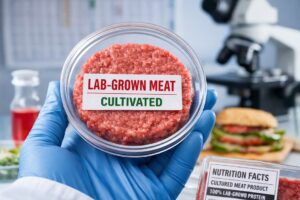
Lab-grown meat, also known as cultivated or cell-cultured meat, is no longer a futuristic concept. Several companies have already received federal approval to sell lab-grown chicken and other lab-grown meat products in the United States.[i] These developments raise important questions, not only about whether these products are safe to consume, but also about how they should be regulated and labeled. The Food and Drug Administration (“FDA”) has established a scientific framework for approving the lab-grown meat. However, their regulatory scheme fails to address how consumers will understand and trust these products. This results in a disconnect between safety assurances and consumer transparency.
Lab-grown meat is produced by harvesting animal cells and growing them in controlled environments until they form edible tissue.[ii] Unlike plant-based meal alternatives, these products are biologically identical to traditional meat but are produced without slaughtering animals. This hybrid formation places lab-grown meat at the intersection of biotechnology and traditional food production. Because of this, the FDA and the U.S. Department of Agriculture (“USDA”) have entered into a formal agreement to divide oversight responsibilities between the two agencies.[iii] While this cooperative model shows a practical regulatory approach, it also creates uncertainty about whether current laws adequately protect consumers and promote informed choices.
At first glance, the division in responsibilities appears logical. The FDA has expertise in biotechnology and food additives, while the USDA regulates meat and poultry products. But this shared jurisdiction leads to inconsistent regulation, which risks undermining consumer trust. Lab-grown meat does not involve conventional farming, yet it is subject to the same statutory definitions and inspection regimes as traditional meat once it reaches the processing stage. At the same time, although the FDA evaluates the product’s biological safety, it lacks direct authority over labeling, which plays a critical role in shaping consumer perception and understanding.
The FDA’s safety standard for food is that there must be a “reasonable certainty of no harm” under the intended conditions of use.[iv] For lab-grown meat, this standard is applied through a voluntary pre-market consultation process rather than formal approval.[v] While this process is scientifically rigorous, it focuses primarily on biological safety and manufacturing controls. It does not address consumer perception, cultural expectations, or the ethical concerns that often accompany unconventional food technologies or developments. As a result, even a product deemed safe by the FDA may still generate consumer confusion or discomfort if it is not clearly distinguished from traditionally produced meat. Therefore, labeling becomes an important regulatory tool.
Several states have enacted laws restricting the use of the word “meat” to products derived from slaughtered animals.[vi] These laws require lab-grown meat producers to use terms such as “cell-cultured,” “cultivated,” or “lab-grown” rather than simply “meat.”[vii] While critics argue that such requirements stigmatize lab-grown meat or protect traditional agriculture, distinct labeling serves a legitimate consumer protection function by disclosing material information about the product’s origin and production method.
This debate mirrors earlier disputes over plant-based milk and meat alternatives. In those cases, courts often held that consumers were not misled by terms such as “almond milk” or “veggie burger,” provided the labels were truthful and not deceptive.[viii] However, lab-grown meat presents a different regulatory challenge. Unlike plant-based products, lab-grown meat is biologically derived from animal cells, which makes the distinction between traditional and lab-grown meat less obvious to consumers. Without clear labeling, consumers may reasonably assume that a product labeled “chicken” or “beef” was produced through traditional farming and slaughter, rather than in an experimental laboratory setting. This assumption is material to purchasing decisions, particularly for consumers motivated by ethical, religious, health, or environmental considerations.
Distinct labeling does not necessarily conflict with First Amendment protections for commercial speech. Under Central Hudson Gas & Elec. Corp. v. Public Serv. Comm’n, the government may regulate truthful commercial speech if it has a substantial interest, and the regulation directly advances that interest in a narrowly tailored manner.[ix] Protecting consumers from confusion and ensuring transparency in the food supply constitute substantial governmental interests. Requiring modifiers such as “cultivated” or “cell-cultured” directly advances those interests by disclosing production methods without preventing companies from marketing their products. Rather than suppressing speech, distinct labeling enhances it by providing additional relevant information.
The FDA may determine that a lab-grown meat product is safe, but that determination does not translate into uniform, consumer friendly labeling standards that communicate the product’s experimental origin. Meanwhile, USDA labeling oversight remains rooted in statutory definitions developed for traditional meat, creating uncertainty about whether and how cultivated products should be differentiated. This is what undermines consumer trust by allowing products that are legally safe to be perceived as deceptive or misleading.
The absence of a clear federal labeling standard invites a patchwork of state laws, increasing compliance costs and legal uncertainty for producers. While some argue that such burdens may slow innovation, regulatory clarity should not require regulatory leniency. Instead, a uniform federal standard requiring distinct labeling would promote consistency, reduce risk of litigation, and provide producers with predictable rules while still prioritizing consumer transparency.
From a public policy perspective, transparency is essential to the legitimacy of emerging food technologies. Lab grown meat implicates deeply held values regarding food, nature, and human intervention in biological processes. Even if these products are safe, consumers have a right to know how their food is produced. Distinct labeling respects consumer autonomy by allowing individuals to make informed decisions based on their values, whether those values relate to animal welfare, environmental sustainability, religious practice, or personal comfort with biotechnology.
Accordingly, Congress should intervene to modernize food law by establishing a unified regulatory framework for lab-grown meat that integrates safety oversight with clear labeling requirements. Such legislation should codify the FDA’s role in evaluating biological safety while directing USDA to implement standardized labeling rules that require clear disclosure of production methods. This approach would align scientific regulation with consumer protection, ensuring that safety determinations are communicated meaningfully to the public.
Courts also have a role to play in evaluating constitutional challenges to distinct labeling requirements. States may require disclosures that prevent consumer deception.[x] Courts should recognize that labeling lab-grown meat as distinct from traditional meat is not misleading or discriminatory but rather reflects material differences in production.
Ultimately, the regulation of lab-grown meat presents an opportunity to rethink how food law balances safety, transparency, and technological progress. The FDA’s current oversight ensures that cultivated meat is biologically safe, but safety alone does not guarantee consumer trust. Food law must evolve not only to regulate what we eat, but also to ensure that consumers understand what they eat. Lab-grown meat challenges traditional categories and expectations, demanding a regulatory framework that prioritizes transparency alongside safety. By requiring distinct labeling, Congress and regulatory agencies can promote informed choice, preserve public trust, and allow cultivated meat to enter the marketplace honestly and responsibly.
[i] Lisa S Benson & Joel L. Greene, Cell-Cultivated Meat: An Overview, Cong. Rsch. Serv., Rep. No. R47697 1, 1 (Sep. 19, 2023) (describing USDA’s issuance of first grants of inspection and label approval to UPSIDE Foods and GOOD Meat to sell lab-grown chicken in the United States).
[ii] Becks Shepherd, Lab-Grown Meat: How It’s Made, Sustainability and Nutrition, Live Science (Sep. 26, 2022), https://www.livescience.com/lab-grown-meat [https://perma.cc/3PT2-LVPL].
[iii] Benson & Greene, supra note i, at 8 (noting the March 2019 formal agreement dividing regulatory oversight between the FDA and USDA).
[iv] Understanding How the FDA Regulates Food Additives and GRAS Ingredients, U.S. Food & Drug Admin., https://www.fda.gov/food/food-additives-and-gras-ingredients-information-consumers/understanding-how-fda-regulates-food-additives-and-gras-ingredients [https://perma.cc/ES8S-NZCJ] (last visited Feb. 23, 2026).
[v] Benson & Greene, supra note i, at 9 (outlining the FDA’s process for regulating lab-grown meat including its premarket consultation process).
[vi] Genevieve Razick et al., Alternative Proteins: Navigating the Maze of U.S. Federal and State Meat Labeling Requirements, Food & Drug Law Inst. (2023), https://www.fdli.org/2023/05/alternative-proteins-navigating-the-maze-of-u-s-federal-and-state-meat-labeling-requirements [https://perma.cc/S8ZX-DBA8].
[vii] Id.
[viii] Elaine Watson, Term ‘Soymilk’ Is Not Misleading, Says Judge in Trader’s Joe’s Lawsuit, FoodNavigator-USA (Dec. 4, 2015), https://www.foodnavigator-usa.com/Article/2015/12/04/Term-soymilk-not-misleading-says-judge-in-Trader-s-Joe-s-lawsuit [https://perma.cc/HLA9-953S].
[ix] Cent. Hudson Gas & Elec. Corp. v. Public Serv. Comm’n, 447 U.S. 557, 566 (1980) (establishing that, for commercial speech that is truthful and not misleading, a government regulation may be upheld only if it serves a substantial interest, directly advances that interest, and is not more extensive than necessary to serve it).
[x] Am. Meat Institute v. U. S. Dep’t. of Agric., 760 F.3d 18, 21–22 (D.C. Cir. 2014) (discussing and applying Zauderer v. Office of Disciplinary Counsel to uphold a compelled labeling requirement and explaining that requiring truthful, factual disclosures does not violate the First Amendment even when the government’s interest extends beyond merely preventing deception).