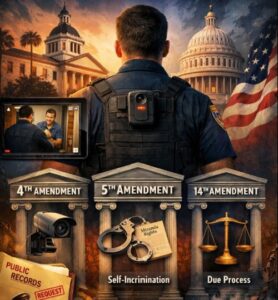
What happens when a police officer activates his body-worn camera while responding to a disturbance at a private residence and weeks later, without the homeowner’s knowledge or consent, the owner learns that the footage of his living room, arrest, and emotional reactions was reviewed by officers and used to shape testimony? This commonplace inquiry illustrates the complex constitutional issues raised by body-worn cameras in Florida. Their use affects privacy, consent, and notice, risks selective recording by officers, and creates evidentiary and Brady-related concerns that can undermine individuals’ constitutional rights. Body-worn cameras (“BWCs”) are “portable electronic recording device[s] . . . worn on a law enforcement officer’s person that records audio and video data of the officer’s law-enforcement-related encounters.”[i] BWCs directly implicate core constitutional protections, including the Fourth Amendment’s safeguard against unreasonable searches when recording inside private homes, the Fifth Amendment’s privilege against self-incrimination during potentially coercive encounters, and the Fourteenth Amendment’s due process guarantees when footage is preserved or selectively disclosed in criminal proceedings.
In Florida, these concerns are further complicated by permitting law enforcement discretion in applying statutory requirements that govern body-worn camera use and public records disclosure. Florida’s BWC laws reflect a tension between transparency and individuals’ constitutional rights, and without rigorous enforcement of constitutional limits, the widespread use of BWCs risks undermining the due process protections they are intended to promote. Their use is governed primarily by Florida Statute § 943.1718, which requires law enforcement agencies to “adopt policies and procedures addressing the proper use, maintenance, and storage of body cameras and the data recorded by body cameras” and allows officers to review footage before writing reports or giving statements.[ii] Public access to BWC recordings is regulated by Florida Statute § 119.07(2), which creates a public records exemption to protect privacy in sensitive locations such as private homes and medical facilities.[iii] This footage is confidential and exempt from disclosure unless the individual consents, the court orders release, or disclosure is authorized by law.[iv] The statute attempts to protect recordings made in places where individuals have a heightened expectation of privacy, balancing transparency with constitutional and privacy interests.
Governmental actions that intrude on a person’s reasonable expectation of privacy constitutes a “search” under the Fourth Amendment, which protects against unreasonable searches and seizures.[v] In Katz, the Supreme Court established that “[t]he Fourth Amendment protects people, not places” and introduced a two-part reasonable expectation of privacy test.[vi] The first prong requires “that a person have exhibited an actual (subjective) expectation of privacy” and the second requires “that the expectation be one that society is prepared to recognize as ‘reasonable.’”[vii] Applying this framework, public interactions are generally not protected because individuals have a diminished expectation of privacy in open spaces. Observations made in plain view, including recordings by police body cameras in public, do not constitute a search and therefore do not require a warrant.[viii] The analysis changes when law enforcement enters private spaces, such as homes, where privacy expectations are heightened. Warrantless entries are presumptively unreasonable unless an exception applies, such as consent, exigent circumstances, or hot pursuit of a fleeing suspect.[ix] Therefore, if an officer has consent or a valid warrant, the recording of items in plain view is permissible.
The Fifth Amendment, which provides that “[n]o person . . . shall be compelled in any criminal case to be a witness against himself,” protects individuals from being forced to provide incriminatory testimonial evidence.[x] BWCs do not automatically violate this right, but recordings of suspects during coercive interactions or custodial interrogations implicate self-incrimination concerns, requiring Miranda warnings before questioning.[xi] While BWCs can enhance due process, deter misconduct, and improve police-community relations, they also risk capturing sensitive information about victims and bystanders.
Oftentimes, “[p]rosecutors rely on bodycams to support police reports or a witness’s testimony.”[xii] Florida law generally follows a two-party consent rule under Florida Statute § 934.03 which prohibits recording oral communications without the consent of all parties, yet a law enforcement exception exists allowing officers to record interactions conducted in the course of official duties.[xiii] BWCs provide investigative and evidentiary benefits such as permitting documentation of encounters, preservation of exculpatory material under Brady law,[xiv] and detrimental evidence in sensitive cases such as domestic violence. Policies, however, must balance comprehensive evidence collection with constitutional protections. Using BWC “footage as evidence in Florida’s criminal courts is a subject that deserves close examination.”[xv]
In Florida, BWC footage is admissible only if it is relevant, authenticated, more probative than prejudicial, and supported by a verified chain of custody.[xvi] However, the ongoing issue is that officers “forget or choose not to activate the camera, or the camera may malfunction, leading to gaps in the footage that could be crucial to the case.”[xvii] Therefore, although BWCs may provide a seemingly objective record of police encounters that can deter misconduct and unfounded claims, their selective framing and inherent perspective limitations create a substantial risk of unfair prejudice or misinterpretation, requiring careful scrutiny by courts and counsel to prevent the improper use of video evidence.[xviii]
Furthermore, while BWCs should be evaluated through the framework of the Fourteenth Amendment’s Due Process Clause, which guarantees fundamental fairness in criminal proceedings, the United States Constitution does not impose an affirmative constitutional duty on law enforcement to create evidence.[xix] Due process protects defendants from the State’s suppression or destruction of materially exculpatory evidence, but not from every failure to record an encounter. “Unless a criminal defendant can show bad faith on the part of the police, failure to preserve potentially useful evidence does not constitute a denial of due process of law.”[xx] This affords law enforcement agencies considerable discretion to shield themselves from scrutiny and potential accountability.
While BWCs can enhance transparency, deter misconduct, and produce reliable documentation of police–citizen interactions, the Constitution does not turn BWCs into a mandatory evidentiary safeguard. Instead, the constitutional inquiry focuses on whether the State’s handling of recordings renders a trial fundamentally unfair. While under Brady law, “a prosecutor should turn over all exculpatory evidence,” the issue is that “the officer who has the video might not turn it over.”[xxi] When officers anticipate that recorded footage may reveal deviations from established protocol, they may engage in delay tactics or offer pretextual justifications, allowing the retention period to expire and facilitating the destruction of potentially incriminating evidence. And although Florida Statute § 943.1718(2) requires law enforcement agencies whose police officers wear BWC to set “policies and procedures addressing the proper use, maintenance, and storage of body cameras and the data recorded by body cameras,” this is discretionary to the individual agency, allowing officers to circumvent production of evidence when the retention period lapses.[xxii]
While Florida encourages the use of BWCs without making them mandatory, law enforcement agencies do not rigorously enforce constitutional liberties when recording police encounters. Without clear Florida judicial enforcement of constitutional limits, BWCs risk infringing the very rights they are meant to protect, underscoring the delicate tension between law enforcement transparency and civil liberties.
[i] Fla. Stat. § 943.1718(1)(a) (2025).
[ii] See Fla. Stat. § 943.1718 (2025).
[iii] See Fla. Stat. § 119.07(2) (2025).
[iv] See Fla. Stat § 119.07(2).
[v] See Legal Clarity Team, Do Body Cameras Violate the 4th Amendment? Legal Clarity, https://legalclarity.org/do-body-cameras-violate-the-4th-amendment/ [https://perma.cc/MR3F-38X8] (last visited Mar. 17, 2026).
[vi] See Katz v. United States, 389 U.S. 347, 351 (1967)
[vii] See id. at 361.
[viii] See Legal Clarity Team, supra note v; see also Katz, 389 U.S. at 361 (“ [A] man’s home is . . . a place where he expects privacy, but [things] he exposes to the ‘plain view’ of outsiders are not ‘protected’” and “conversations in the open would not be protected against being overheard, for the expectation of privacy under the circumstances would be unreasonable.”).
[ix] See Katz, 389 U.S. at 348 (“The mandate of the Fourth Amendment requires adherence to judicial processes, and searches conducted outside the judicial process, without prior approval by judge or magistrate, are per se unreasonable under the Fourth Amendment, subject only to a few specifically established and well-delineated exceptions.”).
[x] See U.S. Const. amend. v.
[xi] See Miranda v. Arizona, 384 U.S. 436, 439 (1966) (“A defendant was required to be warned before questioning that he had the right to remain silent, and that anything he said can be used against him . . . a defendant could knowingly and intelligently waive these rights and agree to answer questions or make a statement.”).
[xii] See Luke Newman, The Impact of Body-Worn Camera Footage in Florida Criminal Cases. Luke Newman Law (Sep. 20, 2023), https://www.lukenewmanlaw.com/the-impact-of-body-worn-camera-footage-in-florida-criminal-cases/ [https://perma.cc/33YJ-H59J].
[xiii] See Fla. Stat. § 934.03 (2025).
[xiv] See generally Brady v. Maryland 373 U.S. 83 (1963) (requiring prosecutors to disclose exculpatory evidence to ensure defendants a fair trial under the Due Process Clause).
[xv] See Stechlaw Criminal Defense, Body Worn Cameras as Evidence: What to Know. Stechschulte Nell Attorneys at Law (Aug. 6, 2020), https://criminaldefenseattorneytampa.com/legal-defenses/body-camera/ [https://perma.cc/J7G7-Y35V].
[xvi] See id.
[xvii] See id.
[xviii] See id.
[xix] See U.S. Const. amend xiv.
[xx] See Arizona v. Youngblood, 488 U.S. 51, 52 (1988).
[xxi] See Stechlaw Criminal Defense, supra note xv.
[xxii] See Fla. Stat. § 943.1718(2).