On July 29, 2025, a federal court approved a 6.13 million dollar settlement after video footage and student testimony confirmed that protestors had cordoned off auditorium entrances during a demonstration, creating a self-labeled “Jew Exclusion Zone” at the University of California Los Angeles (“UCLA”).[i] Jewish students and faculty reported being verbally harassed, blocked from accessing parts of campus, and made to feel unsafe when entering classrooms or dormitories, all as protestors chanted slogans delegitimizing Jewish identity and calling for Israel’s elimination.[ii] Although the university professes a commitment to free speech, officials acknowledged that it failed to intervene quickly or effectively enough to prevent a hostile educational environment.[iii]
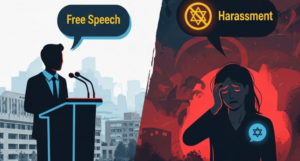
This incident raises a core question for campus policymakers: When targeted exclusion of Jewish students through harassment is allowed under the pretext of free expression, are universities protecting speech or enabling discrimination? This analysis argues that antisemitic intimidation which obstructs Jewish students’ access to education exceeds permissible bounds, demanding meaningful enforcement of both constitutional limits and Title VI anti-discrimination obligations.
The First Amendment is a cornerstone of American democracy, and courts have consistently emphasized its broad protection of speech.[iv] This protection extends to words that many people find offensive, controversial, or deeply unsettling.[v] The Supreme Court has long recognized that offensive or unpopular expression is still constitutionally protected, noting that the government may not prohibit speech merely because society finds it distasteful.[vi] Words that may shock, anger, or insult are nevertheless permitted because the foundation of free expression rests on the idea that open debate must include all viewpoints, not just those that are polite or widely accepted.[vii]
Universities play a critical role in upholding this principle. They have traditionally been viewed as marketplaces of ideas where students are exposed to diverse perspectives and encouraged to challenge prevailing norms. Protecting speech, even when it is harsh or unsettling, ensures that universities remain places of intellectual exploration and debate. However, First Amendment protection is not unlimited.[viii] The Constitution does not shield every action that someone might label as speech. True threats, incitement to imminent unlawful action, and targeted harassment are outside its scope.[ix] When expression ceases to serve the exchange of ideas and instead becomes a tool of intimidation or exclusion, it no longer enjoys constitutional protection.[x] This distinction is crucial in understanding the difference between offensive expression, which the First Amendment protects, and conduct that actively undermines the rights of others to learn in a safe environment, which it does not.[xi]
While the First Amendment protects offensive expression, it does not extend to conduct that denies others equal access to education.[xii] On college campuses, this distinction becomes especially important. Chanting political slogans, holding signs, or voicing opposition to government policies, even when those messages include sharp criticism of Israel, falls within the realm of constitutionally protected expression. These forms of speech may be unsettling or uncomfortable for some students, but they remain part of the open debate that universities are obligated to preserve. However, when expression shifts from advocacy to targeted conduct, it exceeds First Amendment protections. Actions such as blocking Jewish students from entering classrooms, surrounding dormitories while shouting antisemitic epithets, or repeatedly directing slurs at students, cross the line into harassment.[xiii] These behaviors are not about exchanging ideas or engaging in debate; they are about intimidating and excluding peers from campus life. Courts have long recognized that harassment of this nature, especially when it is severe, pervasive, and objectively offensive, can create a hostile educational environment that institutions are legally required to address.[xiv]
This distinction underscores why universities must carefully separate protected expression from unlawful conduct. A student carrying a sign that criticizes Israeli policy is engaged in permissible political speech. A group preventing Jewish students from entering a library by chanting slurs is not. The former represents speech that should be tolerated in a democratic society, while the latter undermines the ability of targeted students to learn, participate, and feel safe in their educational community. Such harassment masqueraded as speech is not a test of free expression but a violation of civil rights.
Universities are not left to navigate these distinctions on their own. Federal law provides clear guidance on when offensive expression becomes actionable harassment.[xv] Title VI of the Civil Rights Act of 1964 prohibits discrimination on the basis of race, color, or national origin in any program or activity receiving federal financial assistance.[xvi] The Department of Education and the Department of Justice have clarified that Title VI protections extend to students who experience antisemitic harassment, recognizing Jewish identity as a protected shared ancestry.[xvii]
Under Title VI, schools must take prompt and effective action to eliminate harassment that is severe, pervasive, and objectively offensive enough to deny students equal access to educational opportunities.[xviii] This obligation does not mean that universities must police all offensive remarks. Rather, it means that when conduct creates a hostile environment, such as blocking Jewish students from entering classrooms, repeatedly shouting slurs in residential halls, or isolating students from campus spaces, the institution has a duty to respond.[xix] Failure to do so not only harms affected students but also exposes the university to potential liability for permitting discrimination to persist. These guidelines reinforce the distinction between protected speech and unprotected harassment. Universities cannot punish students merely for expressing unpopular views, even when those views are critical of Israel or Jewish identity. However, once expression crosses into conduct that denies Jewish students an equal opportunity to participate in campus life, the First Amendment no longer shields it. In such cases, enforcing civil rights law is not censorship—it is compliance with a statutory mandate to provide a nondiscriminatory educational environment.
Universities cannot stand by in the name of free expression when impermissible conduct occurs. The law is clear: Title VI requires institutions that receive federal funding to act when harassment based on shared ancestry, including Jewish identity, denies students equal access to education.[xx] A failure to intervene is not neutrality; it is complicity in discrimination. Protecting the rights of Jewish students is not in conflict with the First Amendment, it is required by civil rights law and by the very principles of equal opportunity that higher education must embody.[xxi]
Therefore, universities must draw a firm line. Political protest and unpopular speech must be protected. Antisemitic harassment must not. To treat the two as the same is to distort Constitutional law and erodes the safety of Jewish students. Campuses cannot claim to value free inquiry while permitting intimidation that shuts Jewish students out of the classroom. The responsibility of university leaders is clear: Uphold free speech but never allow it to become a shield for hate.
[i] See UCLA to Pay $6M to Settle Discrimination Complaints Including Campus ‘Jew Exclusion Zone,’ N.Y. Post (July 29, 2025), https://nypost.com/2025/07/29/us-news/ucla-to-pay-6m-to-settle-discrimination-complaints-including-campus-jew-exclusion-zone [https://perma.cc/H8EB-TRCU].
[ii] See id.
[iii] See id.
[iv] See Brandenburg v. Ohio, 395 U.S. 444, 447 (1969) (“[T]he constitutional guarantees of free speech…”).
[v] See Snyder v. Phelps, 562 U.S. 443, 450 (2011) (explaining that hateful speech may be protected under the Constitution).
[vi] See Texas v. Johnson, 491 U.S. 397, 407 (1989) (protecting the burning of an American flag as free expression, although many find the action wrong).
[vii] See Government Restraint of Content of Expression, Justia, https://law.justia.com/constitution/us/amendment-01/16-government-restraint-of-content-of-expression.html [https://perma.cc/KQ7Q-DMND] (last visit Oct. 1, 2025).
[viii] See Schenck v. United States, 249 U.S. 47, 49 (1919) (explaining that certain types of speech are not protected by the First Amendment).
[ix] See What Does Free Speech Mean?, U.S. Cts., https://www.uscourts.gov/about-federal-courts/educational-resources/about-educational-outreach/activity-resources/what-does-free-speech-mean [https://perma.cc/MEJ3-PWUT] (last visit Oct. 1, 2025).
[x] See Virginia v. Black, 538 U.S. 343, 360 (2003) (explaining that intimidation in the constitutionally prescribable sense of the word is a type of true threat that is not protected under the constitution).
[xi] See generally Davis v. Monroe Cty. Bd. of Educ., 526 U.S. 629 (1999) (explaining that certain conduct in schools is not protected under the constitution).
[xii] See id.
[xiii] See Columbia University Faces Full-blown Crisis as Rabbi Calls for Jewish Students to ‘Return home,’ CNN (Sep. 22, 2024), https://www.cnn.com/2024/04/21/us/columbia-university-jewish-students-protests [https://perma.cc/79X4-M6D3].
[xiv] See also Davis v. Monroe Cty. Bd. of Educ., 526 U.S. 629, 633 (1999) (“[U]nder Title IX, a private damages action may lie against a public school board in cases of student-on-student harassment … the harassment was so severe, pervasive, and objectively offensive that it effectively barred the victim’s access to an educational opportunity or benefit.”).
[xv] See generally Counterman v. Colorado, 600 U.S. 66 (2023) (explaining how threat speech is not protected by the first amendment).
[xvi] See 42 U.S.C. § 2000d.
[xvii] See U.S. Department of Education’s Office for Civil Rights Sends Letters to 60 Universities Under Investigation for Antisemitic Discrimination and Harassment, U.S. Dept. of Edu. (Mar. 10, 2025), https://www.ed.gov/about/news/press-release/us-department-of-educations-office-civil-rights-sends-letters-60-universities-under-investigation-antisemitic-discrimination-and-harassment [https://perma.cc/7YN2-S6DF].
[xviii] See Office for Civil Rights, Dear Colleague Letter, U.S. Dept. of Edu. 3 (May 7, 2024), https://www.ed.gov/media/document/colleague-202405-shared-ancestrypdf-35100.pdf [https://perma.cc/59CQ-F3ME].
[xix] See id.
[xx] See id.
[xxi] See generally 42 U.S.C. §2000d (prohibiting certain kinds of discrimination in schools).