In August 2022, a shooting at a Los Angeles gas station targeted rapper Tyquain Bowman, professionally known as Quando Rondo.[i] While Bowman survived the shooting, his cousin, Saviay’a “Lul Pab” Robinson, was killed.[ii] Federal prosecutors later charged Durk Banks, a recording artist and performer known as Lil Durk, with an alleged murder-for-hire charge tied to that specific shooting.[iii] The government’s case did not allege that Banks pulled the trigger or was at the scene.[iv] Instead, the case turned on whether the financial resources or music opportunities flowing through Banks’ record label, Only the Family (“OTF”), could prove his knowing participation in the alleged murder conspiracy.[v]
That question sits at the center of the federal murder-for-hire statute: 18 U.S.C. § 1958(a).[vi] The statute requires proof that a defendant used, or caused another to use, a facility of interstate commerce with the intent that a murder be committed in exchange for something of pecuniary value.[vii] In practical terms, the government must establish more than financial support, association, or access to resources. It must be proven that the defendant acted with a specific intent for those resources to facilitate a killing.[viii]
This distinction within the statute creates what might be called the financial benefactor problem. In prosecutions involving artists, executives, or entertainment collectives, money often moves through corporate credit cards, assistants, managers, and entourage members.[ix] Oftentimes, the flights are booked, hotels are paid for, and cars are rented by people several steps removed from the individual whose money is involved.[x] While financial records may support an inference of coordination, they do not necessarily prove the specific intent the statute requires.[xi]
Some murder-for-hire prosecutions present a direct evidentiary path to satisfy § 1958(a). In those cases, the government can point to evidence showing a specific agreement where one person solicits another to kill, and payment is offered in return. The prosecution of James Rosemond, known as “Jimmy the Henchman,” illustrates that type of direct bargain.[xii] James Rosemond, the founder of Czar Entertainment, was prosecuted in the Southern District of New York for ordering the murder of Lowell “Lodi Mack” Fletcher in retaliation for an assault on Rosemond’s son.[xiii]
Prosecutors alleged that Rosemond recruited men to kill Fletcher upon his release from prison and promised at least $30,000.00 in payment.[xiv] After Fletcher was shot and killed in the Bronx, Rosemond directed an employee to provide a kilogram of cocaine, valued at approximately $30,000.00, as payment for the murder.[xv] Rosemond was convicted of murder-for-hire under § 1958(a), conspiracy to commit murder-for-hire, along with firearms offenses, and was sentenced to life plus thirty years.[xvi] The prosecution of Rosemond reflects the clearer end of these cases: recruited participants by Rosemond, a promised payment by Rosemond, and evidence tying compensation directly to the killing ordered by Rosemond.[xvii] The connection between Rosemond and murder was clear and not inferred from any broader business spending.
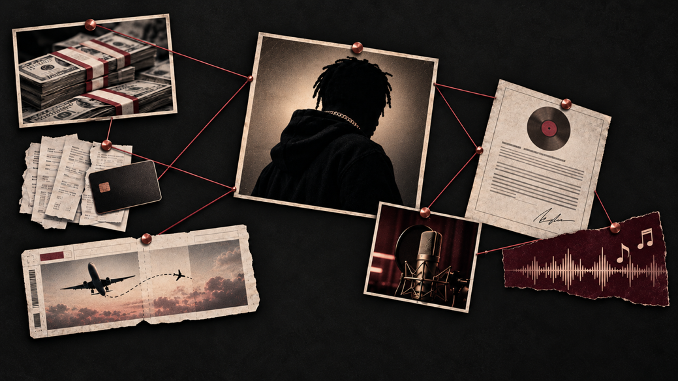
The more recent prosecution of Banks presented a harder evidentiary hurdle. Federal prosecutors alleged that Banks used OTF as a financial conduit, pointing to plane tickets purchased with an OTF-affiliated credit card, a hotel room rented with another OTF-affiliated card, and vehicles allegedly procured by a co-defendant.[xviii] The government also alleged that Banks offered a bounty for the killing.[xix] Specifically, the Second Superseding Indictment alleged that co-conspirators, including Banks, would pay anyone who took part in the killing of Rondo, or that they would be rewarded with lucrative music opportunities with OTF.[xx] However, the legal question was not merely whether the money or record deals could be traced to OTF, but whether the transactions or music opportunities proved that Banks specifically authorized them to be used as payment for the murder.[xxi]
Generally, for prosecutors, financial records, combined with communications or witness testimony, demonstrated coordination, planning, and movement across state lines, supports an inference of participation.[xxii] For the defense, those same records may reflect ordinary business expenses or even unauthorized use by individuals with access to corporate resources. When spending is constant and delegated, a financial record does not necessarily reveal who is behind the transaction.[xxiii] Banks’ defense centered on exactly that distinction: associates and entourage members acted independently, and access to Banks’ resources did not prove his personal direction or any specific criminal intent.[xxiv] Specifically, the defense argued that Kavon London Grant, Banks’ former personal assistant, arranged the shooting without Banks’ knowledge.[xxv]
On September 11, 2026, a federal jury acquitted Banks of the murder-for-hire charges.[xxvi] The verdict underscores the burden prosecutors face when relying heavily on a financial paper trail without proof of intent.[xxvii] Financial records may show that money moved, but they do not automatically prove why, who controlled the transaction, or whether the alleged benefactor intended that money to be payment for a killing. Rosemond and Banks show the difference between financial evidence that proves a direct bargain and financial evidence that requires jurors to infer intent from business expenditures.
As transactions within the entertainment-industry become more digitized and delegated through management networks, courts and juries will continue to confront this problem. While prosecutors may properly follow the money, the trail must show more than proximity to the crime. It must show that the defendant provided or authorized the resources with the deliberate intent to provide consideration for a killing.[xxviii] When multiple individuals can spend from the same accounts, a transaction says little about who directed it, and the inference of intent depends more on the surrounding narrative than on the actual transaction itself. Without a corroborating link, financial proximity cannot become liability under 18 U.S.C. § 1958(a).[xxix]
Banks’ acquittal did not end his federal prosecution entirely. Banks’ still faces separate federal racketeering murder and firearms charges that were severed from the charges in his first trial.[xxx] After the verdict on September 11th, First Assistant U.S. Attorney Bill Essayli stated, “‘While we are disappointed with the jury’s decision regarding Durk Banks, a.k.a. “Lil Durk,” we look forward to presenting our evidence at his second trial.’”[xxxi] Banks’ second federal trial is set for August 30, 2027 and will be centered on his alleged participation violence connected to an alleged criminal enterprise.[xxxii]
[i] See Brad Callas, Quando Rondo Witness to Deadly Shooting in Los Angeles, Complex (Aug. 20, 2022), https://www.complex.com/music/a/brad-callas/quando-rondo-caught-in-middle-of-shooting-los-angeles [https://perma.cc/SV4E-J7Y4] (“Quando Rondo is safe after the Georgia artist was caught in the middle of a shooting in Los Angeles on Friday.”).
[ii] See C. Vernon Coleman II, A Detailed Look at How Five Men Affiliated with Lil Durk Allegedly Conspired to Kill Quando Rondo, XXL (Oct. 25, 2024), https://www.xxlmag.com/lil-durk-affiliates-conspired-kill-quando-rondo-details/ [https://perma.cc/2Q9F-KSTE] (“Over two years after Quando Rondo was the target of a Los Angeles shooting that took the life of his cousin Saviay’a Robinson a.k.a. Lul PAB. . ..”).
[iii] Second Superseding Indictment, United States v. Banks, No. 2:24-cr-00621-MWF (C.D. Cal. May 1, 2025), ECF No. 147.
[iv] Id. at 3, ¶5 (“As alleged in Counts One through Three, on August 19, 2022, at the direction of defendant BANKS, defendants GRANT, WILSON, JONES, LINDSEY, and HOUSTON, and Co-Conspirator 2 used two vehicles to track, stalk, and attempt to kill T.B. by gunfire . . . resulting in the death of S.R.”).
[v] Id. at 2, ¶2 (“At times relevant to this Second Superseding Indictment, defendant BANKS was the leader of OTF. . . . Using a credit card associated with OTF, Co-Conspirator 3 would purchase airplane tickets for the co-conspirators to fly to California and murder T.B.”).
[vi] Id. at 4
[D]efendants, DURK BANKS, [among five others]. . . conspired and agreed with each other to knowingly use facilities of interstate and foreign commerce, namely, airplanes, cars, cell phones, and the internet, with intent that the murder of T.B. be committed . . . in violation of Title 18, United States Code, Section 1958(a). The use of interstate facilities to commit murder that was the object of the conspiracy resulted in the death of S.R.
[vii] 18 U.S.C. § 1958(a).
[viii] Id. (requiring “[i]ntent that a murder be committed . . . .”).
[ix] See Chicago Rapper Lil Durk Charged in Superseding Indictment Alleging Murder-for-Hire Plot to Kill Rival Near Beverly Center Mall in 2022, U.S. Dept. of Just., (Nov. 8, 2024) https://www.justice.gov/usao-cdca/pr/chicago-rapper-lil-durk-charged-superseding-indictment-alleging-murder-hire-plot-kill [https://perma.cc/UL6C-6RQK] (“According to the superseding indictment, in 2010, Banks formed an organization called Only the Family (OTF), which, among other things, produced and sold hip hop music from artists primarily from the Chicago area. . . .”).
[x] Id. (“[T]he hitmen used money from Banks and OTF-related finances to carry out the hit. Bank and flight records show that an OTF member and close associate of Banks coordinated and paid for five co-conspirators to travel from Chicago to California on the day before the murder.”).
[xi] See 18 U.S.C. § 1958(a).
[xii] See Czar Entertainment Founder James Rosemond Convicted in Manhattan Federal Court For Ordering the Murder of Lowell Fletcher, U.S. Dept. of Just. (Nov. 29, 2017), https://www.justice.gov/usao-sdny/pr/czar-entertainment-founder-james-rosemond-convicted-manhattan-federal-court-ordering-0 [https://perma.cc/73ZD-B7JW] (“Rosemond’s defense at trial – that he hired these men to shoot Fletcher, but did not intend for Fletcher to be killed – was swiftly and unanimously rejected by the jury.”).
[xiii] Id. (“Joon H. Kim, the Acting United States Attorney for the Southern District of New York, announced that JAMES ROSEMOND, a/k/a ‘Jimmy the Henchman,’ was found guilty last night of murder-for-hire, conspiracy to commit murder-for-hire, and firearms offenses for ordering the murder of Lowell Fletcher, a/k/a ‘Lodi Mack.’”).
[xiv] Id. (“Nevertheless, in 2009, ROSEMOND recruited a crew of men to murder Fletcher upon his release from prison by promising at least $30,000 in payment for killing Fletcher. At ROSEMOND’s direction, members of the murder crew selected a dark and secluded location for the murder . . . and lured Fletcher to that spot.”).
[xv] Id. (“On October 2, 2009, ROSEMOND had a trusted employee of his cocaine organization provide a kilogram of cocaine – worth about $30,000 in street value – to a member of his murder crew as payment for the murder.”).
[xvi] Id. (“For his role in ordering, planning, and paying for the murder of Lowell Fletcher, ROSEMOND was convicted of one count of substantive murder-for-hire, one count of conspiracy to commit murder-for-hire, and two firearms counts. ROSEMOND faces a mandatory minimum sentence of life in prison.”)
[xvii] See generally Czar Entertainment Founder James Rosemond Convicted in Manhattan Federal Court For Ordering the Murder of Lowell Fletcher, supra note xii. (detailing the United States case against James Rosemond).
[xviii] See Chicago Rapper Lil Durk Charged in Superseding Indictment Alleging Murder-for-Hire Plot to Kill Rival Near Beverly Center Mall in 2022, supra note ix.
[xix] Id. (“Banks allegedly ordered T.B.’s murder and the hitmen used money from Banks and OTF-related finances to carry out the hit.”).
[xx] See Second Superseding Indictment, supra note iii at 4, ¶A (alleging the consideration for killing Tyquain Bowman, professionally known as Quando Rondo, was “anything of pecuniary value, namely, money and lucrative music opportunities with OTF . . . .”).
[xxi] See generally 18 U.S.C. § 1958(a).
[xxii] See Jaelani Turner-Williams, Legal Teams Duel in Lil Durk’s Murder-for-Hire Trial Closing Arguments, Complex (Sep. 8, 2026), https://www.complex.com/music/a/jaelaniturnerwilliams/lil-durk-murder-trial-closings [https://perma.cc/VZC3-RE2F] (“‘Defendant Banks used his money, power and influence to stalk and kill his biggest opp, Quando Rondo,’ the [federal prosecutor] stressed . . . .”).
[xxiii] See Alex Ocho & Shawn Setaro, Lil Durk Trial: Brian Steel Says OTF Jam ‘Is Not Human,’ Insists He’s a ‘Serial Killer’, Complex (Sep. 8, 2026), https://www.complex.com/music/a/alex-ocho/lil-durk-trial-closing-arguments-brian-steel-otf-jam [https://perma.cc/N8Y3-8FDD] (“The attorney argued that Hester and fellow cooperating witnesses Kavon ‘OTF Vonnie’ Grant and Keith Jones each stood to gain from testimony that pointed directly at the rapper, whose legal name is Durk Banks.”).
[xxiv] Id. (“Steel leaned on the burden of proof, reminding jurors that membership in Banks’ OTF collective does not equal participation in what its members did, and that the government must prove Banks entered an agreement with the men who pulled the trigger.”)
[xxv] See Camila Curcio, Lil Durk’s Next Federal Trial Pushed to 2027 After Murder-For-Hire Acquittal, L. Comment. (Oct. 2, 2026), https://www.lawcommentary.com/articles/lil-durk-next-federal-trial-2027-murder-for-hire-acquittal [https://perma.cc/EXY4-Q8W3] (commenting on the murder-for-hire trial where Durk’s defense questioned the credibility of prosecution witnesses).
[xxvi] See Hillel Aron, Rapper Lil Durk Found Not Guilty of Murder-for-Hire, Courthouse News Serv., (Sep. 11, 2026) https://www.courthousenews.com/rapper-lil-durk-found-not-guilty-of-murder-for-hire/ [https://perma.cc/3JLT-C8UQ] (“A jury found Grammy-winning rapper Lil Durk not guilty of federal murder-for-hire charges on Friday for his role in the killing of 24-year-old Saviay’a Robinson in West Hollywood, California.”).
[xxvii] Id. (“Banks’ attorneys blamed Robinson’s death on Grant, calling him the ‘mastermind’ of the revenge plot who ‘manipulated the FBI and the LAPD’ into targeting Banks.”).
[xxviii] See 18 U.S.C. § 1958(a).
[xxix] See generally id.
[xxx] See Curcio, supra note xxv (stating allegations Durk Banks faces in second federal trial).
[xxxi] See Aron, supra note xxvi (quoting First Assistant U.S. Attorney Bill Essayli’s statement following Durk Banks verdict in murder-for-hire trial).
[xxxii] See Curcio, supra note xxv (stating the new trial date for Durk Banks second federal prosecution).