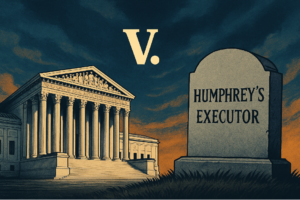
On September 22, 2025, The United States Supreme Court officially took up the question of whether to overturn its 1935 decision in Humphreys Executor v. United States.[i] If overturned, Humphreys Executor will mark another precedential casualty of the Roberts Court.[ii] To legal scholars, professors, and those that closely follow the Supreme Court, this upcoming showdown comes as no surprise. Over the last several years, the Justices have indicated a distaste for the principles established by Humphreys Executor, significantly narrowing both its scope and application.
So, what exactly is Humphrey’s Executor? Why is it important and why all the fuss over its potential overruling? The story started in 1931 when President Herbert Hoover nominated William E. Humphrey to be a member of the Federal Trade Commission (“FTC”), confirmed by the senate, and due to serve for a term of seven years.[iii] Several months into his first term, President Franklin Roosevelt wrote a letter to Humphrey asking for his resignation, stating, “the aims and purposes of the [a]dministration . . . can be carried out most effectively with personnel of my own selection . . . .”[iv] Humphrey disagreed, refusing to resign. In response, President Roosevelt removed him from his position on October 7, 1933.[v] Refusing to accept his fate, Humphrey continued to “insist that he was still a member of the commission, entitled to perform its duties and receive the compensation provided by law . . . .”[vi] The following February, Humphrey died.[vii]
The executor of Humphrey’s estate filed suit to recover lost wages from the five months between his removal as FTC Commissioner and his death.[viii] The FTC Act of 1914 prohibited the President from removing FTC Commissioners but-for inefficiency, neglect of duty, or malfeasance.[ix] The issue—whether this restriction on removal was a violation of the separation of powers—was brought to the Supreme Court by certified question.[x] Ultimately, the Court said it was not.[xi] Because the FTC Commissioners exercised powers that were “quasi-legislative” and “quasi-judicial” (e.g., conducting investigations and reports for Congress and recommending dispositions in courts), and not “purely executive,” Congress could limit the President’s removal power of those officers to require good cause.[xii] Thus, the concept of independent agencies was born, shaping the modern administrative state.[xiii]
Nearly a century later, the Court continues to grapple with the boundaries Humphrey’s Executor drew between executive authority and congressionally created agencies. For example, in Seila Law LLC v. CFPB, the Court struck down the congressionally created requirement stating that the Director of the Consumer Financial Protection Bureau could not be removed by the President, but for “inefficiency, neglect, or malfeasance.”[xiv] Writing for the majority, Chief Justice Roberts framed Humphrey’s Executor as one of the only two exceptions to the general rule that a President’s power to remove purely executive officers must be unrestricted.[xv] In his concurrence, Justice Thomas said that “Humphrey’s Executor poses a direct threat to our constitutional structure and, as a result, the liberty of the American People,” and further called the decision “erroneous.”[xvi] In Free Enterprise Fund v. PCAOB, the Court declined to expand this so-called exception to cover more than one layer of removal protection, holding it to be a violation of Article II’s vesting clause.[xvii] Seila Law was again applied in the case Collins v. Yellen, where the Court found a “for-cause” protection for the Director of the Federal Housing Finance Agency unconstitutional.[xviii]
Interestingly, all three of these cases rely on Myers v. United States, a case that was thought to be narrowed—and in part overruled—by its successor, Humphrey’s Executor.[xix] In fact, Myers was once considered to be dead letter, a decision that Humphrey’s Executor aimed at correcting.[xx] This suggests a role reversal, a revival of Myers’ doctrinal importance and a return to the early 1900’s unitary executive jurisprudence.[xxi]
Trump v. Slaughter, which is the vehicle chosen by the Court to decide the future of Humphrey’s Executor, arises out of a strikingly similar situation. In March 2025, President Donald Trump contacted FTC Commissioner Rebecca Slaughter, removing her from her position because of “inconsisten[cies] with . . . [a]dministration[] priorities,” without pointing to any “cause” for the decision.[xxii] While similar in facts to Humphrey’s Executor, the Court granted a stay on a district court order preventing Commissioner Slaughter’s removal.[xxiii] The Court also granted stays in other similar cases arising out of President Trump’s no-cause-stated removal of officers from various independent agencies.[xxiv]
As Justice Kagan notes, reaching these conclusions would be impossible unless Humphrey’s Executor was overturned.[xxv] With the expedited grant of certiorari and an official transfer of the question to the Court’s “merits docket,” that is exactly what the Justices seem poised to do.
[i] See Trump v. Slaughter, No. 25-332, 2025 U.S. LEXIS 2794, at *1 (Sep. 22, 2025) (granting certiorari before judgement on the question of whether Humphrey’s Executor should be overruled).
[ii] See, e.g., Dobbs v. Jackson Women’s Health Org., 597 U.S. 215, 292 (2022) (overruling Roe v. Wade, 410 U.S. 113 (1973) and Planned Parenthood v. Casey, 505 U.S. 833 (1992)); Loper Bright Enters. v. Raimondo, 602 U.S. 369, 412 (2024) (overruling Chevron, U.S.A., Inc. v. Nat. Res. Def. Council, Inc., 467 U.S. 837 (1984)); Citizens United v. FEC, 558 U.S. 310, 365–66 (2010) (overruling Austin v. Mich. Chamber of Com., 494 U.S. 652 (1990) in whole and McConnell v. FEC, 540 U.S. 93 (2003), in part).
[iii] See Humphrey’s Ex’r v. United States, 295 U.S. 602, 618 (1935).
[iv] Id.
[v] Id. at 619.
[vi] Id.
[vii] See Daniel A. Crane, Debunking Humphrey’s Executor, 83 Geo. Wash. L. Rev. 1835, 1842 (2015).
[viii] Id.
[ix] See Seila Law LLC v. CFPB, 591 U.S. 197, 244 (2020) (Thomas, J., concurring in part and dissenting in part);
[x] Humphrey’s, 295 U.S. at 619; see Seila Law, 591 U.S. at 244.
[xi] See Humphrey’s, 295 U.S. at 632.
[xii] Id. at 628–29.
[xiii] See Crane, supra note vii, at 1836–38 (“[Humphrey’s Executor] served to legitimize the modern regulatory state and remains one of the iconic judicial pillars of the technocratic, independent administrative system.”); see also Seila Law, 591 U.S. at 278 (Kagan, J., dissenting); see generally Kitri Datla & Richard L. Revesz, Deconstructing Independent Agencies (and Executive Agencies), 98 Cornell L. Rev. 769, 779–824 (2013) (providing an overview on the structure and functions of federal agencies post Humphrey’s Executor).
[xiv] See Seila Law, 591 U.S. at 202–04, 238–52 (Thomas, J., concurring) (acknowledging the majority opinion as limiting Humphrey’s Executor, being the “latest in a series of cases significantally undermining” Humphrey’s Executor, and ultimately calling for reconsideration of Humphrey’s Executor in the future).
[xv] See id. at 204–15.
[xvi] See id. at 239 (Thomas, J., concurring in part and dissenting in part).
[xvii] See Free Enter. Fund. v. Pub. Co. Acct. Oversight Bd., 561 U.S. 477, 483–84 (2010).
[xviii] See Collins v. Yellen, 594 U.S. 220, 256 (2021) (citing to Seila Law, 591 U.S. at 220).
[xix] Free Enter. Fund., 561 U.S. at 516 (Breyer, J., dissenting) (“See Humphrey’s Executor . . . overruling in part Myers); see Humphrey’s, 295 U.S. at 627 (1935) (“[T]he decision in the Myers case cannot be accepted as controlling our decision here.”).
[xx] Crane, supra note vii, at 1840–46 (referring to Humphrey’s Executor as a “correction” to Myers and noting that Wiener suggested Humphrey’s Executor should be understood as the general rule); see Wiener v. United States, 357 U.S. 349, 352 (1958) (referring to Myers as “short-lived” and recognizing that the Court “narrowly confined the scope of the Myers decision . . . . [and] explicitly disapproved” of it); see also Seila Law, 591 U.S. at 277 (Kagan, J., dissenting).
[xxi] See Crane, supra note vii, at 1837–48.
[xxii] See Slaughter v. Trump, No. 25-909 (LLA), 2025 U.S. Dist. LEXIS 136631, at *7–8 (D.D.C. Jul. 17, 2025).
[xxiii] See Trump v. Slaughter, 2025 U.S. LEXIS 2794, at *1 (“The application for stay . . . is granted.”)
[xxiv] Compare Trump v. Slaughter, 2025 U.S. LEXIS 2794, at *2 (referring to the stay as “just the latest in a series”), with Trump v. Wilcox, 145 S. Ct. 1415, 1416 (2025) (recognizing that “no qualifying cause” was given for the removals of members from the National Labor Relations Board and the Merit Systems Protection Board, and granting the stays), and Trump v. Boyle, 145 S, Ct. 2653, 2654 (2025) (staying an order from the United States District Court for the District of Maryland prohibiting the removal of a member of the Consumer Product Safety Commission).
[xxv] See Trump v. Slaughter, 2025 U.S. LEXIS 2794, at *3 (Kagan, J., dissenting) (relying on Humphrey’s Executor to say, “the President cannot, as he concededly did here, fire an FTC Commissioner without any reason. To reach a different result requires reversing . . . Humphrey’s[.]”).